November’s “Notes on Notes” is about oud, or agarwood. I don’t think I can provide a better or clearer explanation than this, from Sarah McCartney in her book “The Perfume Companion: The Definitive Guide to Choosing Your Next Scent”:
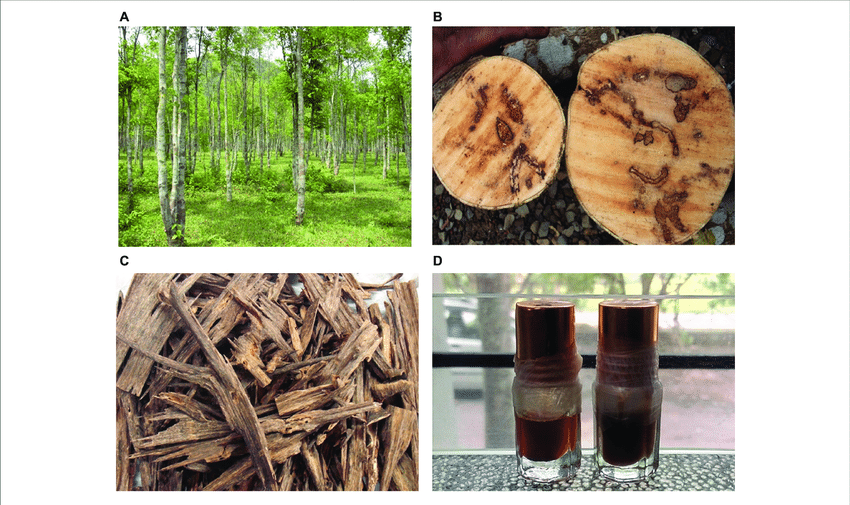
Oud is Arabic for wood, and you’ll also see it spelled oudh, aoud, and aoudh. An oudh is also a musical instrument which looks a lot like a lute. In perfumery, though, it’s a specific kind of wood from the agarwood tree, also called aloewood. Even more specifically, this tree must be infected by a species of mould, Phialophora parasitica, which makes it strongly whiffy.
Agarwood and its products; image from Researchgate.net.
Perfumer Geza Schoen offered this explanation to Allure magazine in its excellent article:
Natural oud, the scent (the essential oil) arises when a particular fungus places itself on an Aquilaria tree. A reaction creates a resin that slowly embeds into the wood creating agarwood, known as oud, which is then soaked, and using a distillation and evaporation method is developed into an oil.
That is how perfumers in the Middle East, India, and the Far East have traditionally made a essential oil that can be very costly. As many perfume-lovers know, oud has been a trend in Western perfumery for several years (6 Western commercial fragrances based on oud were launched in 2007, over 200 by 2019), but what we mostly encounter is a synthetic re-creation of that oil, which puts oud-based fragrances within reach of many more fragrance lovers. The qualities of oud that don’t attract me are when it is used heavily to evoke smoke or leather. A great reference for some fragrance-lovers, but not really me. However, I’ve read that there are many different facets to oud, in nature depending on the specific variety of Aquilaria tree and the environment where it was grown, so I’m sure the synthetic creations also vary widely.
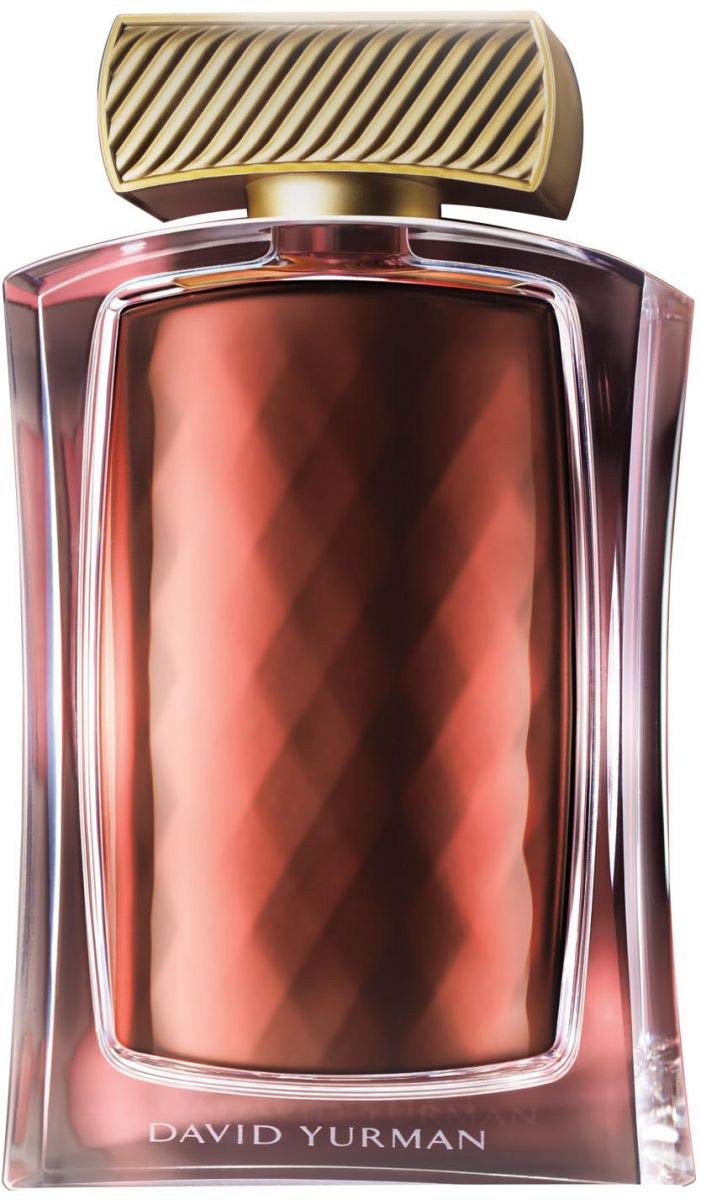
I’ll be honest – I can’t think of many oud-focused fragrances that I like a LOT, though I don’t object to it as a supporting player. It may be that my nose is acting sensitive toward a synthetic, but that’s not usually an issue for me. And I’ve gotten weary of every other new fragrance seeming to have “oud” in its name! There is one oud-centric fragrance that I really do enjoy a lot, and it grows on me every time I wear it: David Yurman Limited Edition. It is a classic combination of rose with oud, and both are used with a deft touch. The bottle, by the way, is gorgeous, a heavy, faceted, dark red crystal flacon.
David Yurman Limited Edition extrait de parfum; image from Amazon.com
Launched in 2011, it is an extrait de parfum with central notes of oud and Taif rose. Top notes also include coriander, geranium, saffron, and raspberry, but the rose and oud notes appear immediately and carry through the parfum’s development, so the typical pyramid structre may not accurately describe it. Heart notes include violet and jasmine, though at this stage my nose is so distracted by the Taif rose and oud that I hardly detect them. Base notes add suede, musk, vanilla, and sandalwood. Interestingly, the notes list makes a point of saying “natural agarwood”, though that is no guarantee that the ingredient used isn’t synthetic.
I think this is a very skillful fragrance. The rose and oud could have been overwhelming, and they’re not, at least not with a controlled application, lol. This fragrance is all about gentle, rosy warmth with a bit of spice. The notes are well-blended, with saffron and fruity raspberry peeking through. The rose fades away sooner than the oud but it still hums softly in the background. DY Limited Edition reminds me a bit of Aramis’ Calligraphy Rose, and I wonder how it would compare to Calligraphy Saffron, which I haven’t tried. It’s not clear who was the perfumer behind DY Limited Edition, but I think it has to have been Harry Frémont of Firmenich, who created all the other David Yurman fragrances (the link will take you to a long interview of him by Richard Goller of the Fragroom blog).. He certainly knows his way around a rose, too, as a creator of Estée Lauder’s marvelous Knowing, as well as dozens of other scents.
Have you tried DY Limited Edition? Or can you suggest other oud fragrances that would appeal to a floral lover like me? Drop by Australian Perfume Junkies to see what Portia has to say about oud!
Welcome to the weekly Perfume Chat Room, perfumistas! I envision this chat room as a weekly drop-in spot online, where readers may ask questions, suggest fragrances, tell others their SOTD, comment on new releases or old favorites, and respond to each other. The perennial theme is fragrance, but we can interpret that broadly. This is meant to be a kind space, so please try not to give or take offense, and let’s all agree to disagree when opinions differ. In fragrance as in life, your mileage may vary! YMMV.
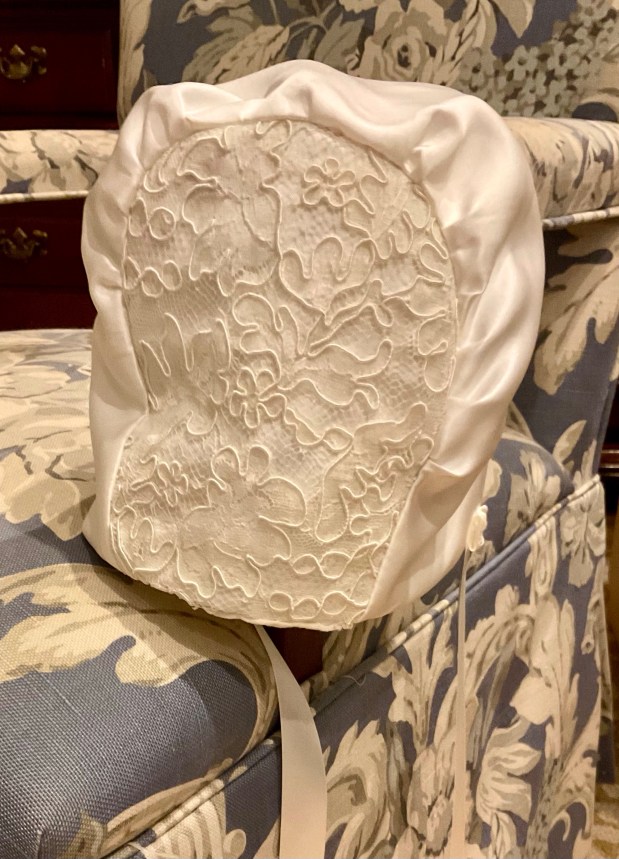
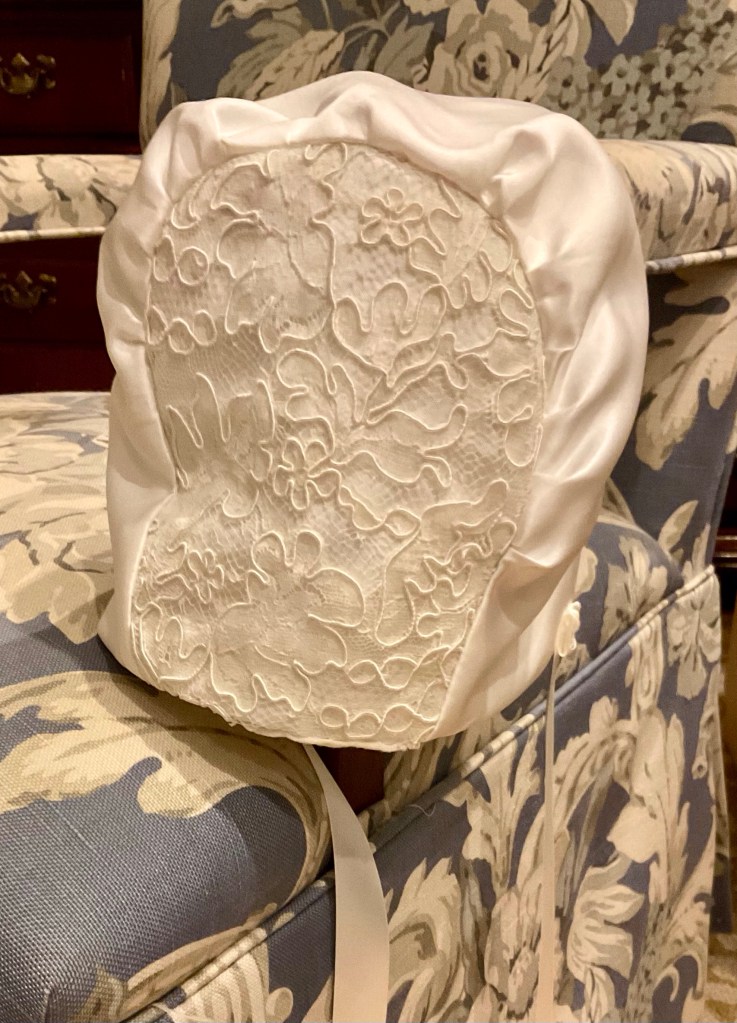
Today is Friday, November 3, and I’m on my way to New England for a family christening! Our niece had her first baby this year, the first grandchild of this generation. The baby is my older sister’s first grandchild. I made her a bonnet from silk and lace from my sister’s wedding dress; I’m quite pleased with how it turned out, given that it’s my first real sewing project in many years.
I’m excited — I took part this week in a NST splitmeet for the first time! I’ve received my 5 ml of Jacques Fath’s L’Iris de Fath eau de parfum from the NST splitmeet; haven’t worn it yet because I’ve been so busy this week and want to give it my full attention. Some of you may remember how I swooned when I got to sample the extrait de parfum when it was first released, at the boutique Jovoy Paris, in London. I am so, so tempted to buy the eau de parfum but I’m trying to behave myself and not rush into an expensive blind buy. Splitmeet to the rescue!
Portia and I will be posting a new “Notes on Notes” on Monday, so please drop by and share your own thoughts!
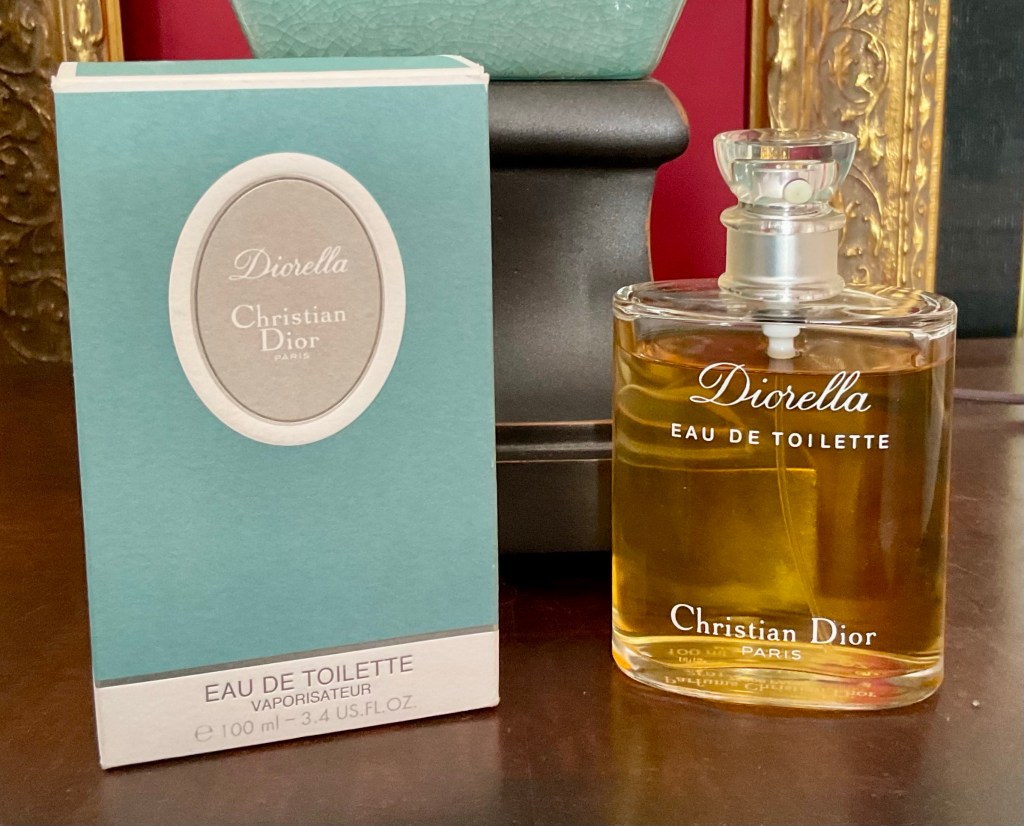
Welcome to the (late!) October installment of “CounterPoint”! I was thrown off by how early the first Monday of the month was, and various other distractions, but here we are, to discuss Christian Dior’s Diorella. Thank you, Portia, for being so patient!
Launched in 1972, Diorella is a “lemon chypre”, a narrow and specialized category of fragrance, given that chypres generally are a specific category. Perfumer Edmond Roudnitska created Diorella in 1972 at the peak of his powers, having already created for Dior the legendary fragrances Diorama, Diorissimo, and Eau Sauvage.
Diorella; image by Christian Dior.
Interestingly, Diorella was the inspiration for Meet Me On The Corner, a crowd-funded fragrance by Sarah McCartney of 4160 Tuesdays that she created to capture the vibe of 1970s chypres and named after a 1972 pop song.
Tye-dye girls, Doreen Spooner/Getty Images
How did you first encounter Diorella and what was your first impression?
Portia: When Old Herbaceous asked if we could do Diorella my first internal response was “Diorella? Sure I’ve heard of it but have no memory of ever seeing it or smelling it.” Dutifully I went to the DIOR box and rummaged around just to be sure. Lo and behold, there is a 100ml, extremely vintage looking beat up houndstooth box of Diorella EdT. There’s clearly been some leakage, the sprayer and surrounds have residue and some eating away of the silver. The moment I touched the very bleached out label it just fell off. This bottle is O L D. Even on spritzing I have no memory of smelling this beauty. So while I may have smelled Diorella in the past I’m coming at it as a newbie. First impression is that I’m really surprised that the top seems to be intact.
Old Herbaceous: My perfumista journey began when I read “The Perfect Scent” by Chandler Burr, then moved on to “Perfumes: The A-Z Guide” by Luca Turin and Tania Sanchez. I was fascinated by their witty insights and their rating system of stars, so I started to seek out the fragrances they had awarded five stars, their top rating. One of those was Diorella, in its pre-2009 formulation. As I learned more about fragrances, I started to figure out how to find vintage fragrances (sadly, without access to the amazing Japanese flea markets that Neil Chapman describes in his blog The Black Narcissus!). I found an intact bottle of Diorella eau de toilette that dates from 2002, as best I can tell, based on its box, bottle, and batch number. It was a reasonable price, so I snapped it up.
My Diorella
My first impression was “Yes, this is a true chypre!” I happen to love most chypres (I can’t think of one I have disliked yet), with their classic structure of citrus top notes, floral heart notes, and base notes that include oakmoss. Per Fragrantica, the structure of the original Diorella is: top notes of green notes, Sicilian lemon, bergamot, melon, and basil; middle notes of honeysuckle, Moroccan jasmine, peach, carnation, cyclamen, and rose; and base notes of oakmoss, vetiver, patchouli, and musk. While the top notes of my bottle have faded somewhat with age, the combination of citrus and green notes is still evident and lively.
2. How would you describe the development of Diorella?
Old Herbaceous: The top notes aren’t as vivid in my bottle as I’m sure they were when it was new, but they are vivid enough to indicate the lemony/green opening accord intended by M. Roudnitska. The melon and green notes have taken precedence in my bottle, including a lovely basil accord. I think the basil is what may have prompted Turin and Sanchez to declare that if Guerlain’s fragrances are desserts, Diorella is a Vietnamese beef salad. Fear not! It smells nothing like rare meat. I think I can smell a couple of the base notes right from the start, specifically the vetiver and oakmoss, humming in the background.
In the heart phase, I smell honeysuckle and jasmine. The jasmine isn’t heavy or narcotic, it stays light. The hum of vetiver and oakmoss becomes more noticeable, and soon they take over from the floral notes entirely. In the drydown and base stage, Diorella moves from fresh toward warm without becoming spicy, supported by patchouli and musk. It also lasts a good long time, surprising in a fragrance that also smells very fresh.
Portia: Fizzy opening with bright green citruses and aldehydes, leaning slightly waxy like putting your fingernail into the peel and getting that luscious burst of fresh and sunshiny goodness. The greenery is both camellia leafy and tulip stemmy, crushed to let their greenness explode.
As the initial heady notes calm, I have a very modern masculine waft of cucumber/melon intertwined with the bouquet. It’s a surprise to have something so stuck in my mind as a 1980/90s gym men’s changeroom smell be lurking so significantly in this epitome of female beauty. It does not detract from the femininity at all and makes me think of how many of the men would also swoon for Diorella.
I will say that Diorella is very cologne-ish. This is not a complaint, merely an observation. For some reason I was expecting a very fruity/mossy chypre in the style of Mitsouko. This is as far from that as you can imagine while still bearing many of the same notes.
The heart and base take a long time merging and there’s plenty of crossover during this time, plus the citruses are subtly tenacious.
The crisp, green, oily grassiness of vetiver is tempered by the earthy patchouli and moss but there is much more going on here. I’m getting wafts of quite astringent eucalyptus, the fresh green of shady creeks as you trudge through the greenery. There’s a cooling, slightly salted seaside breeze hiding below.
The last gasps are a very vegetal musk and sweet greenery.
Diorella is so tapestried and I think it will take a dozen more wears to even get a hold of what’s happening here.
3. Do you or will you wear Diorella regularly? For what occasions or seasons?
Portia: Honestly, now that I’ve found this gorgeous unicorn it might be too special to wear willy nilly. Though it feels like an excellent sunny day spritz and could give me blue sky reminiscences in winter, I think just holding the bottle and sniffing the cap will be all I’m capable of doing.
Old Herbaceous: I haven’t been wearing Diorella regularly, but it has been such a good fit for the beautiful October weather we’re having that I plan to keep it out and within reach for at least a while (keeping it in its box, of course, to protect it from light!). It partners beautifully with these crisp, sunny, dry autumn days, although I often think of it more as an early summer scent. Diorella works well for a whole range of occasions, from casual to elegant, from daytime to evening. It’s like a Diane von Furstenburg wrap dress, the kind that were so fashionable in the 1970s (my mother wore them) and that you could dress up or dress down, endlessly versatile but with a distinct, chic personality.
4. Who should/could wear Diorella?
Old Herbaceous: Well, here’s what Luca Turin wrote on that topic: “Diorella was intended as a feminine and was the very essence of Bohemian chic, with an odd, overripe melon effect that still feels both elegant and decadent. The modern version, no doubt fully compliant with all relevant health-and-safety edicts since the fall of the Roman Empire, is drier and more masculine than of old, no bad thing since I have always seen it as a perfected Eau Sauvage and one of the best masculines money can buy.”
So there you have it! Diorella will work well for many perfume-lovers and can be spritzed for just about any occasion.
Portia: A truly unisex beauty that is cologne related but so much more. I need to go sniff a modern bottle to see if it still smells as good. Then if it does I might buy a bottle and wear it regularly through the warmer months. I’ll be most interested to read OH’s description of how it has survived.
Old Herbaceous: Borrowing again from Luca Turin with regard to the 2009 reformulation: “Great perfumery accords share with holograms the strange property of being damage resistant; the picture remains legible even though noise increases and fine detail is swept away. Diorella is one of those accords, and while the latest version is less caressingly decadent and lush than of old, it still conveys much of what made the original great.” Note that his comment is about the 2009 version; I think this is still the current edition, as I haven’t been able to find anything about a later formulation despite new IFRA restrictions on oakmoss. I wonder whether the oakmoss was already greatly reduced in 2009, with vetiver taking a more prominent role in the base, so more changes weren’t necessary.
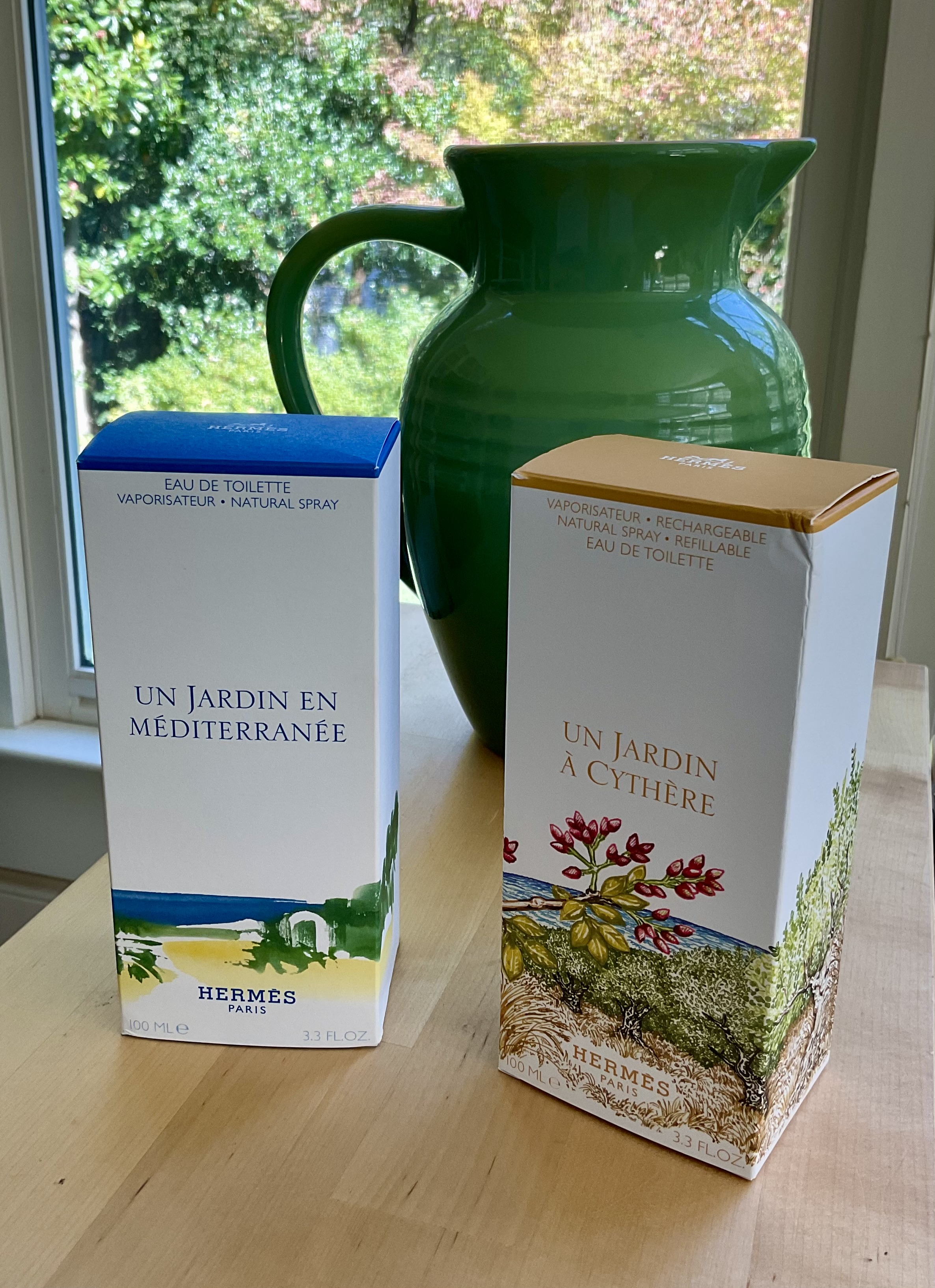
Happy fall! Portia Turbo of Australian Perfume Junkies and I both forgot to post our “Notes on Notes” on the usual first Monday of the month, which was LAST Monday, October 2 (it crept up on us), so we’re a week off. This month’s Note for discussion is nuts. TBH, I suggested this because I wanted to write about the newest addition to my collection, this year’s Un Jardin à Cythère, which my lovely spouse brought me from his trip to London. It features a pistachio note.
Un Jardin à Cythère, by Hermès; image from Hermes.com.
As it happens, apparently pistachio is very au courant in 2023, according to Harper’s Bazaar: “Why All the Cool Kids Smell Like Pistachio Right Now.” Writer Lindy Segal credits the trend to the ongoing fascination with gourmand fragrances, and a post-pandemic desire for fun. And it’s true that pistachios lend themselves to sweet and savory fun, from celadon green ice cream and the toothaching sweetness of baklava, to dishes of salted cocktails nuts and the messy joy of shelling roast pistachios out of a bag.
It turns out that although pistachio is having a moment, and it’s not a commonly used note, it has been featured in other fragrances that have been popular for a while, such as Tom Ford’s Soleil Blanc, Guerlain’s Une Petite Robe Noire Eau Fraiche, and even another of the Jardin fragrances, Un Jardin en Méditerranée. To my surprise, Fragrantica reminded me that it is a note in SJP’s Stash, which I had forgotten. I love Stash, and it couldn’t be more different from the Jardin fragrances, which I also love.
Of course, other nutty notes have been used in perfume, but even looking at the whole category, they’re not terribly common, except for hazelnut. Chestnut, walnut, even almond, aren’t nearly as prevalent as, say, various woody notes. Hazelnut appears as a note in several fragrances I own: Jo Malone’s English Oak and Hazelnut and Ginger Biscuit, Jean Patou’s Que Sais-Je?, Penhaligon’s Elisabethan Rose (2018); and others I know but don’t have: Zoologist’s Chipmunk, Jo Malone’s Oat and Cornflower, L’Artisan’s Mechant Loup, Guerlain’s Habit Rouge, among others. In all of these, hazelnut adds a certain sweetness without sugar, woodiness without weight.
Back to pistachio! I’m fascinated by how differently it is used in the Jardin fragrances. They were, of course, created by two different Hermès perfumers: Jean-Claude Ellena created Méditerrannée in 2003, and Christine Nagel, his successor, launched Cythère twenty years later. In UJeM, pistachio is a bit player, lending some depth to the basenotes, but subordinate to the dominant fig note. (By the way, fig and pistachio are a time-honored combination in various recipes, often partnered with honey and a soft, mild cheese like ricotta or mascarpone – yum!). UJeM is based on an actual garden in Tunis, and it includes floral notes such as orange blossom and white oleander, although the most prominent notes are fig leaf, cypress, cedar, and juniper, which form the base notes together with a touch of pistachio and musk.
Hermès’ Un Jardin en Méditerranée; image by Hermes.com.
In UJaC, Mme. Nagel puts pistachio at the very heart of the fragrance, pairing it beautifully with an accord of olive wood. In comments about her latest Jardin creation, she has said that her pistachio accord is based on her memory of the fresh pistachios she enjoyed on trips to the Greek isle of Kythira, twenty years apart.
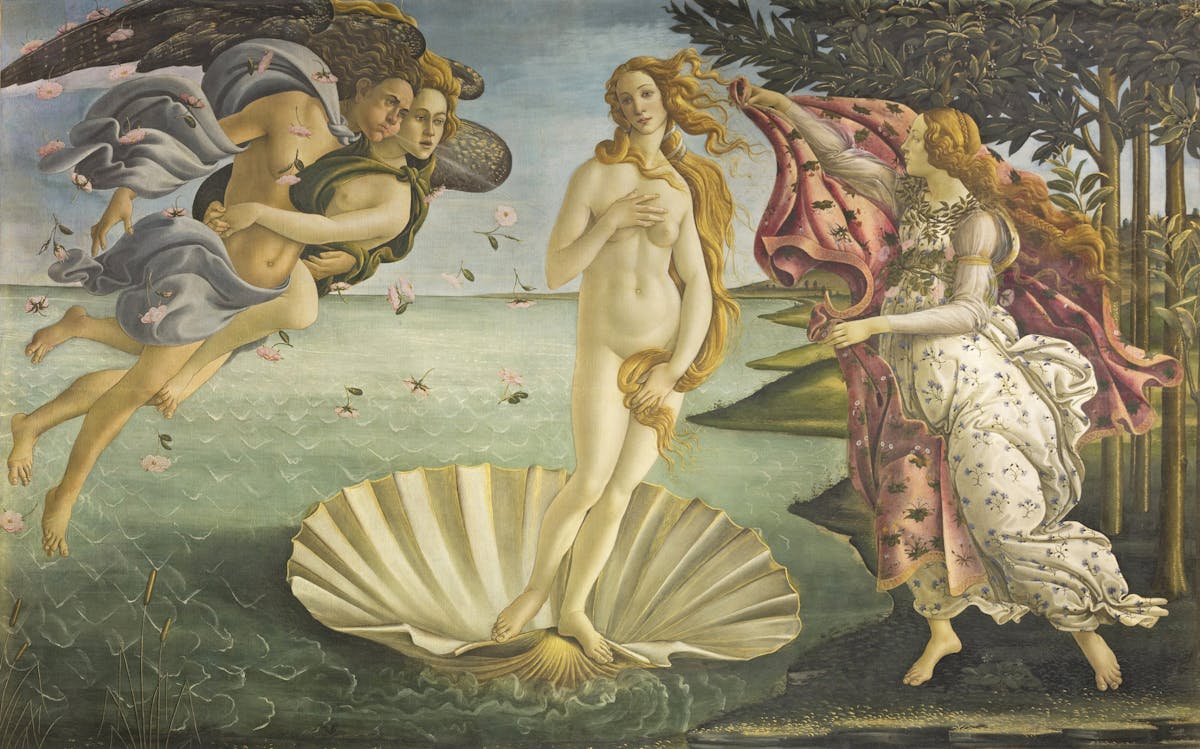
Her composition is very clever: this is a garden without flowers. The citrus notes of the opening recall the island’s citrus groves, the pistachio and olive notes evoke the harvests of those important products, and an accord of dry grass captures the dry, sunny climate of Kythira. This is a truly unisex fragrance, despite Kythira’s fame as the legendary birthplace of Aphrodite, who rose from the sea foam off its rocky shores.
Birth of Venus/Aphrodite, by Botticelli; image from the Uffizi Gallery.
As it dries down, UJaC retains the nutty sweetness of pistachio, and one understands better why nuts like pistachios, hazelnuts, and almonds lend themselves so well to sweet desserts and combine beautifully with various fruits. Unlike peanuts, which combine with chocolate well because of the contrast between the two, these sweeter nuts harmonize with sweeter ingredients, the whole becoming greater than the sum of its parts. Think Nutella (hazelnut and chocolate), marzipan (almond and honey), and pistachio gelato (pistachios with milk and sugar).
Pistachio ice cream happens to be my husband’s favorite flavor, and although we don’t usually keep it in the house (both watching our girlish figures, lol), it is a regular though infrequent visitor. Usually the commercial ice cream is made with artificial flavoring, but we do have a local Italian gelato store that has been here for decades, and they make pistachio gelato from scratch, so now I have a yen to go try some! I know I can count on my dear spouse to come along.
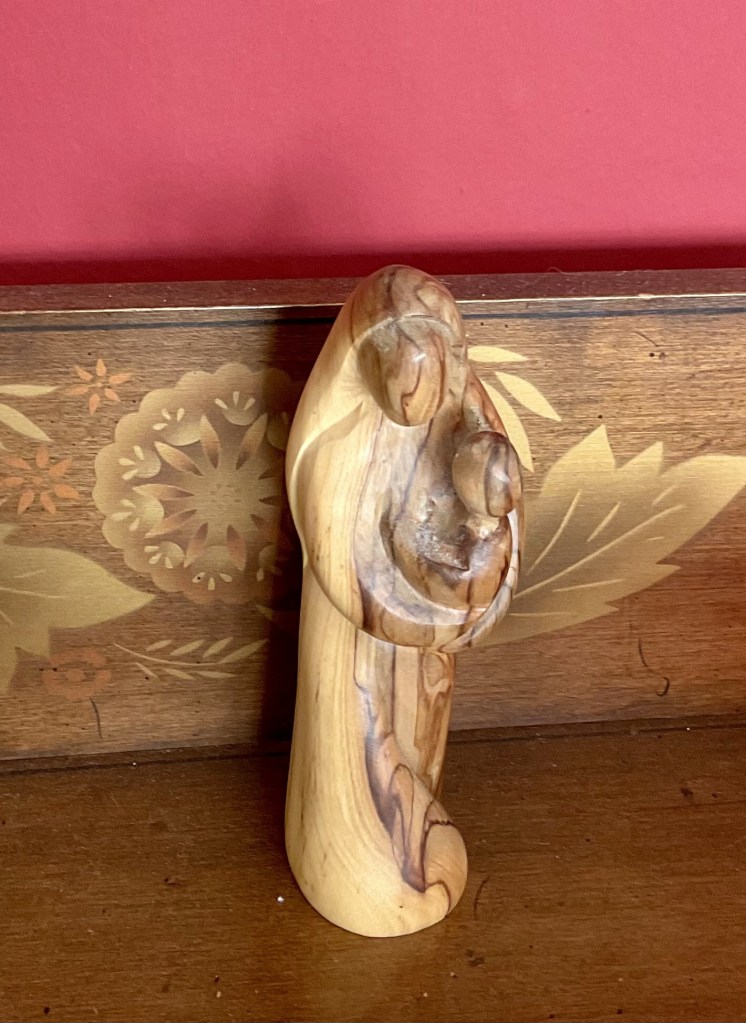
The base of UJaC is supported by an accord of olive wood; if you’ve ever visited an olive wood craft workshop, you know that it does indeed have its own distinctive and pleasing aroma. I love carved olive wood and have well-used kitchen implements made from it, the oldest being salad servers we bought on our honeymoon in Provence. My favorite olive wood carving, though, is a little statuette of Madonna and Child, the Virgin Mary being another incarnation of the divine feminine. The wood is as smooth as satin, the grain beautifully suggesting the folds of fabric in her robe.
I’m very happy to have added Un Jardin à Cythère to my collection. It hasn’t displaced Un Jardin Sur le Nil or Un Jardin Après la Mousson as top favorites, but it isn’t far behind. Have you tried it yet? What did you think? And make sure to hop over to Australian Perfume Junkies to get Portia’s Notes on nuts!
Happy Monday! Today, in our monthly “CounterPoint” collaboration, Portia of Australian Perfume Junkies and I consider Caron’s classic Infini.
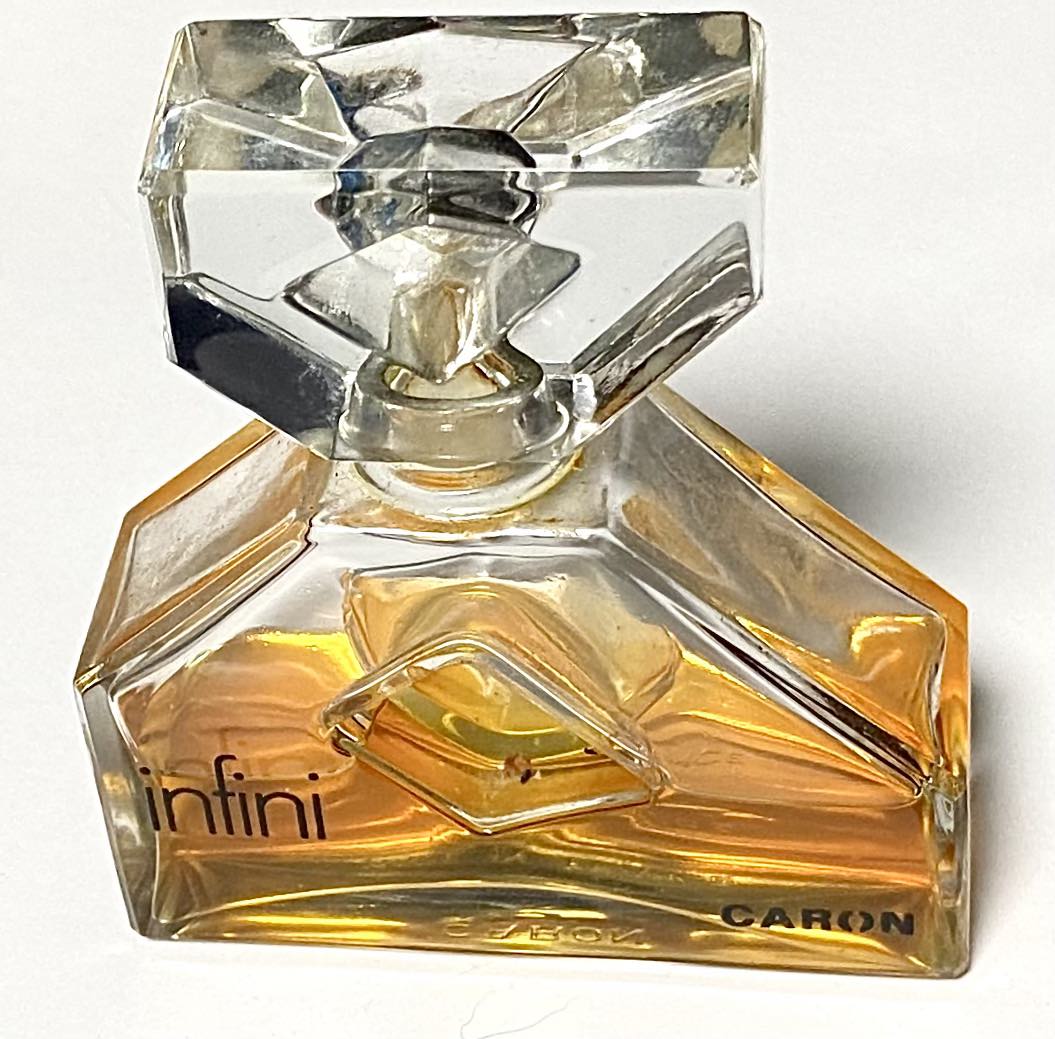
The Infini many of us know is the 1970 formulation, which reused the name of an earlier Caron (Ernest Daltroff) fragrance from 1912. It was conceived of at the height of the race between the US and the Soviet Union to explore space and land a man on the moon. The goal was for Caron’s new fragrance to encapsulate a new modern era and an “infinite” future. The bottles for both the perfume and the parfum de toilette embody that sense of sleek, technical modernity, with the mathematical, angular perfume bottle and the smooth, silver-topped spray bottle of parfum de toilette.
“Caron’s futuristic project was apparently fifteen years in the making, as the perfumers searched for the most indefectible equilibrium of sharp green florals, woods, aldehydes, and musky animalics. The result – unseamed, flawless – is in my view one of the finest scents ever made.”
Notes are listed as: top notes – aldehydes, narcissus, muguet, jasmine; heart notes – iris, rose, tuberose, lilac; base notes – vetiver, sandalwood, musk, tonka bean, amber.
1. How did you first encounter Caron Infini, and what was your first impression?
Old Herbaceous: I first encountered Infini in the last few years, when I was already deep into my perfume rabbit-hole. I had been looking up fragrances with notes of narcissus, one of my favorite flowers and fragrance notes, and Infini kept appearing in various posts and lists as a classic to try if you like narcissus. So eventually, I found a vintage bottle of parfum de toilette (the version launched in 1970) for a reasonable price, and it was mine! It did not disappoint. I love the strong green aura that is present from the very start, with a noticeable narcissus accord lifted airborne by a hefty dose of aldehydes and enhanced by notes of jasmine and lily-of-the-valley. The last two floral notes are truly supporting players; they bring more green freshness and add to the slightly narcotic effect of the narcissus, but that’s the extent of their contribution (given that vintage fragrances do tend to lose some of their top notes, my impression may be affected by the age of my bottle).
To my nose, Infini definitely smells like a scent of the 1970s, when there were several successful strong green and herbal fragrances on the market, perhaps echoing the momentum of the environmental movement during that decade, which began with the first Earth Day. It fits right in with major loves of mine from that era, like Chanel’s Cristalle and No. 19, Aromatics Elixir, Silences, etc.
Portia: When I first got crazy about perfume Infini was not in demand and it seemed like there were gallons of it online for next to nothing. Out of interest I bought a small parfum in that outrageously brutalist bottle. It was love at first sniff. While smelling antique it also smells wholly new and modern. Perfumey but also like it’s trying to forge a new path from very well used ingredients. Coming from the same year as CHANEL No 19 it’s interesting to smell two so disparate sisters with quite a few parallels. No 19 being the more stoic and Infini feeling like a fun, flirty sibling.
2. How would you describe the development of Caron Infini?
Portia: Today I’m wearing vintage parfum and Parfum de Toilette. That aldehydic narcissus opening has always smelt more like fresh carnations to me. Not the perfumers trope of carnation but buying a bunch at the florist. Cool, green tinged, powdery and crisp. The heart is very sweet amber floral for me with reminders that narcissus is the major player here. My question is why aren’t oakmoss and some kinds of animalic noted? Or galbanum? The sweet, furry, resinous dry down lingers and i can smell faint traces of it next morning. A soft, powdery waft of gorgeousness long gone.
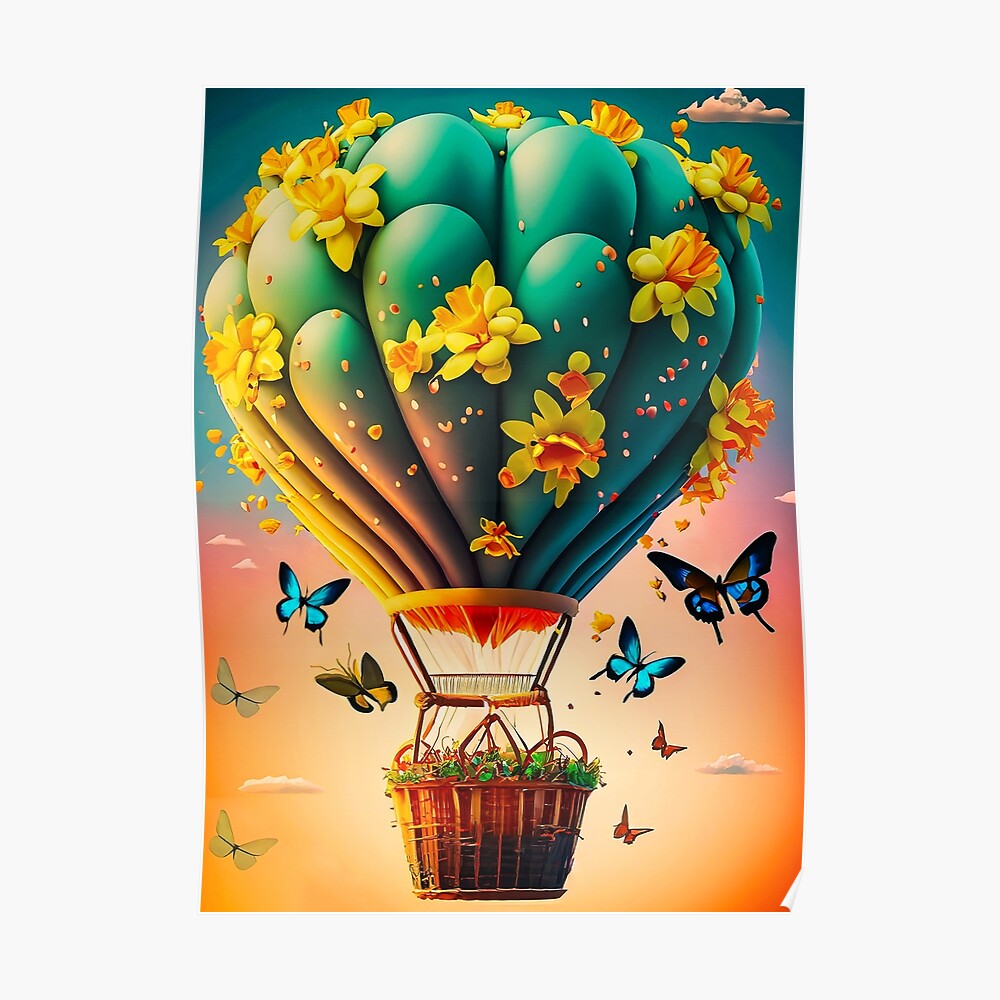
Old Herbaceous: Whenever I smell fragrance with a strongly aldehydic opening, what comes to mind is Luca Turin’s approving comment about my beloved Chanel No. 22, which has even more of a dose of aldehydes than its predecessor No. 5: “Stand back and watch the whole thing lumber off into the sky after a three-mile takeoff roll.” In the case of Infini, the aldehydes actually evoke the idea of an aerial vehicle taking off, as if it were a gleaming silver cartoon spaceship, a mid-century zeppelin, or a sparkling hot-air balloon. This balloon, though, carries a hefty load of daffodils and greenery. And while no one has listed galbanum as a passenger, my nose suspects it is along for the ride as a stowaway.
Hot air balloon; image by frigamribe88 at redbubble.com.
3. Do you or will you wear Caron Infini regularly? For what occasions or seasons?
Old Herbaceous: I haven’t been wearing it regularly, but now that I’ve dug it out of my collection for this post and our weather has cooled down, I’m going to include it in my fall rotation this year. The green fragrances I love so much are ideal not only for springtime, but also for this transitional season, when the oppressively humid heat gives way to cooler, drier air and the sky regains its vivid blue hue. September may be my favorite month although spring is my favorite season; having spent so many years in education, my own schooling and my later career, September always feels to me like a fresh start, like the hopeful beginning of a new school year. Besides, it is my birth month so for me personally, it is actually the start of a new year. Crisp green fragrance notes suit my mood in September.
As for occasions, I agree with Portia that Infini can dress up or dress down. To me, it has more warmth than No. 19 so it feels less standoffish, although it can still contribute a certain air to a soignée outfit.
Portia: Infini is a staple in my wearing rotations. Being such a pronounced beauty it’s perfect for nights working in drag. It slips seamlessly from summer to winter and always feels comfortable, elegant and just a little over the top. Infini fits afternoon BarBQs, lunch, fully dressed up or down. Though it’s not a shapeshifter itself it never feels out of place.
4. Who should/could wear Caron Infini?
Portia: Wearable by both sexes but I think you need to be a certain person to wear Caron Infini, especially the vintage formulas. While I think it could easily be a fragrance to confer extra confidence the wearer would have to be savvy enough about fragrance to understand that it can be used as such. Most general public in modern times could find it too far from what they know or smell in department stores. That’s my thought, happy to be proven wrong.
Old Herbaceous: Definitely a unisex option, excellent for both men and women. It reminds me a bit of Geoffrey Beene’s Grey Flannel, launched in 1975 as a traditionally masculine fragrance, though I wouldn’t say they smell alike. They do have a number of notes in common; but where Infini, targeted at women, has “perfumey” aldehydes among its top notes, Grey Flannel has citruses; while narcissus is dominant in Infini, it plays a supporting role to the violet accord in Grey Flannel. Just as women may smell wonderful in Grey Flannel, men may smell wonderful in Infini.
Miguel Matos at Fragrantica ha/s written about the latest version of Infini, launched by Caron in 2018, pointing out that it has nothing to do with the Infini of earlier decades. Indeed, it is a floral fruity gourmand. I wish Caron all possible success; but I also wish they wouldn’t reuse a name for a fragrance that differs so egregiously from the classic fragrance linked to that name. Have you tried any version of Infini? What do you think of it?
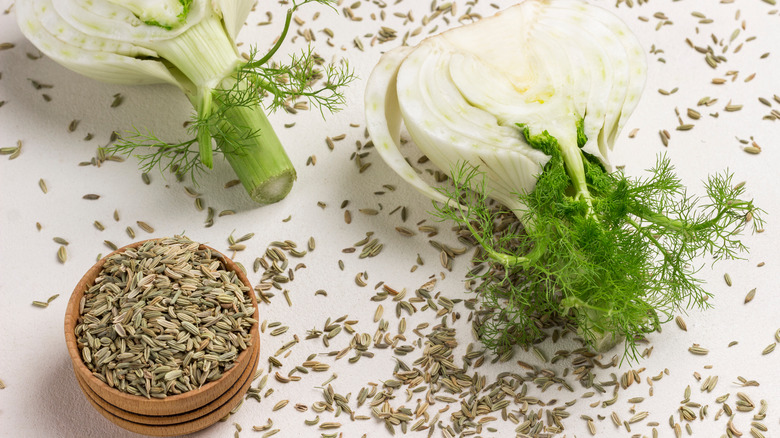
Happy September! Anise the subject of our Notes on Notes this month, and it is a note not commonly found in perfume. The fragrance company Bon Parfumeur has a thorough explanation of anise in perfumery on its website. When one finds anise in a fragrance, it is usually anise or star anise, which come from the seeds and oil of two different plants. Anise comes from Pimpinella anisum, native to and grown throughout the Mediterranean area, while star anise comes from Illicium verum, native to southeastern China and Vietnam. Although the seeds’ fragrance and flavor resemble each other, the plants are not related; I was interested to learn that Pimpinella anisum is a member of the same plant family as parsley. Licorice, whose scent and flavor also resemble those of anise, is yet another different plant altogether, and it comes from the roots, not seeds.
Fennel with anise seeds; image by Olena Ukhova/Shutterstock.
All three are used to create an aromatic, spicy accord in a fragrance. Fragrantica had a great “round-up” of best anise fragrances in 2022, noting that fennel is another variation on the same theme (and the plant is related to anise). The substance they have in common is anethole, and I must have an innate affinity for that, because I love strong black licorice, and fennel, and anise-flavored baked goods. My love for black licorice is so familiar to my family that on the rare occasion when jelly beans appear in our house (usually Easter), they all pick out the black ones to give to me! Bon Parfumeur describes its uses in perfumery:
It is used as a top note in perfumes, providing an initial burst of fragrance. It is also used to add a touch of sweetness and richness to gourmand fragrances. In addition, anise complements the warm, exotic compositions of oriental fragrances and contributes to the creation of spicy accords, blending harmoniously with other spices. In addition, anise adds a bold, assertive facet to men’s fragrances. It can also be used to create contrast and complexity when layered with other notes. This is why anise is favored by niche and artisan perfumers for its unique, individual character.
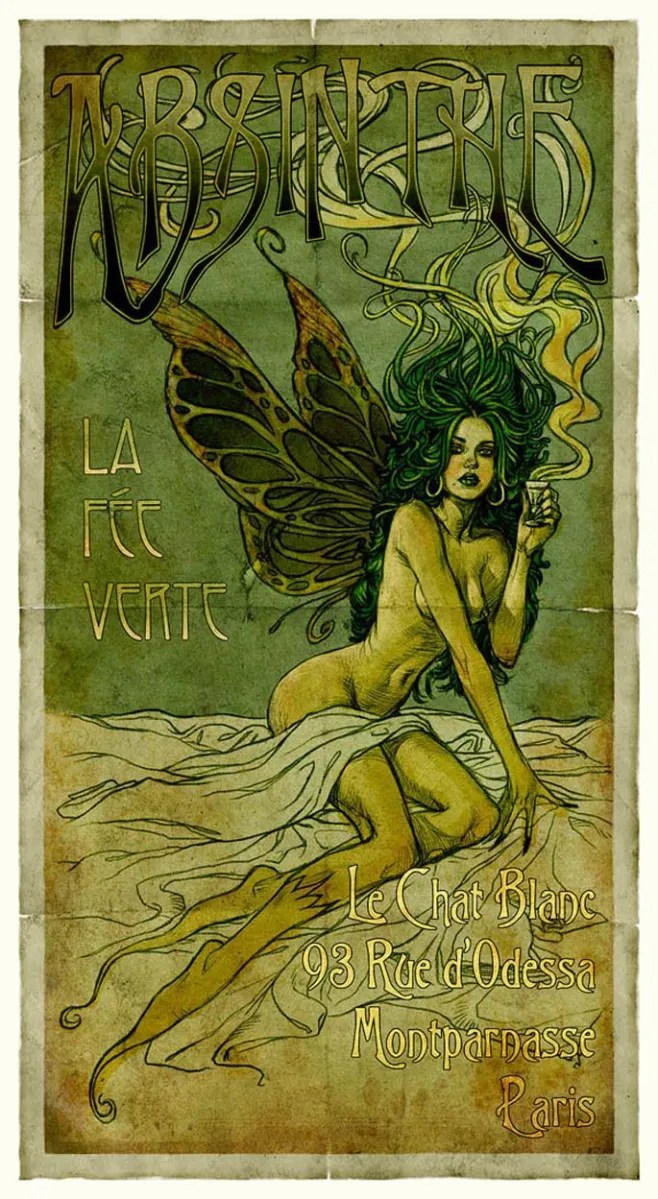
Anise is more often used to flavor liquor and liqueurs, most famously absinthe (said to drive men mad, thus inspiring the name of L’Artisan Parfumeur’s Fou d’Absinthe), but also pastis, ouzo, anisette, sambuca, raki, and others that were created in Mediterranean countries.
La Fée Verte, by Henri Toulouse-Lautrec.
That being the case, it seems fitting that the most obviously anise-forward fragrance I own comes from a Spanish perfumer: Ramon Monegal’s Lovely Day. I think I also have a decant of Réglisse Noire, from 1000 Flowers, which is focused on licorice, as befits its name. However, Elena Vosnaki of Fragrantica, names one fragrance as the “archetypal anisic floral”: Guerlain’s L’Heure Bleue, whose origins go back to 1912 (do read her review, it’s a gorgeous piece of writing). I’ve always loved its name, meant to evoke the twilight hour when the sky briefly turns all shades of darkening blue, purple, and even green.
Painting of twilight by Maxfield Parrish
I happen to have a new bottle of the reissued eau de toilette of L’Heure Bleue, bought in January during a visit to the Guerlain boutique in The Breakers hotel in Palm Beach (highly recommended, if you’re in the area!). Like others in Guerlain’s 2021 collection of Les Légendaires, it does not disappoint. If you don’t love anise, fear not – it has been toned down in this reissue, although I can still pick it up among the top notes (it is listed as “aromatic spices”). It is definitely there, lending a tinge of spice and, dare I say, a tinge of green; more reminiscent of fennel than of licorice. It gives way seamlessly to the heart notes of violet and carnation, which segue into iris, but enough of it lingers to help the florals bridge from the top notes through the heart to the base notes of benzoin, vanilla, and tonka. This edition of L’Heure Bleue is eminently wearable, a true classic that suits modernity well while staying true to its roots.
I know some readers are devoted to Réglisse Noire; do any of you have any other favorite anise or licorice fragrances? Please share in the comments! And check out what Portia has to say about anise at Australian Perfume Junkies.
Welcome to this month’s “CounterPoint” about a newer fragrance: Chanel’s Paris-Édimbourg, one of Les Eaux de Chanel”, which has been a very successful series of lighter, more casual Chanel fragrances focused on freshness and named for particular destinations to which Coco Chanel regularly traveled, such as Biarritz, Deauville, and Venice. Most of “Les Eaux” are truly unisex, but Édimbourg, the fifth in the series, launched in 2021, smells to me more traditionally masculine than its predecessors. And indeed, perfume Olivier Polge has said: “Both fresh and woody, PARIS-ÉDIMBOURG could be the fragrance of a tweed jacket borrowed from the men’s wardrobe that was such an inspiration to Gabrielle Chanel.”
Apparently, Coco Chanel spent a lot of time in Scotland in the 1920s during the years when she was having an affair with the Duke of Westminster, who owned vast estates in the Scottish Highlands — a wild, forested, mountainous area, where nevertheless the visiting landed gentry and their guests still dressed for dinner after a day of fishing, shooting, tramping, and other outdoor pursuits.
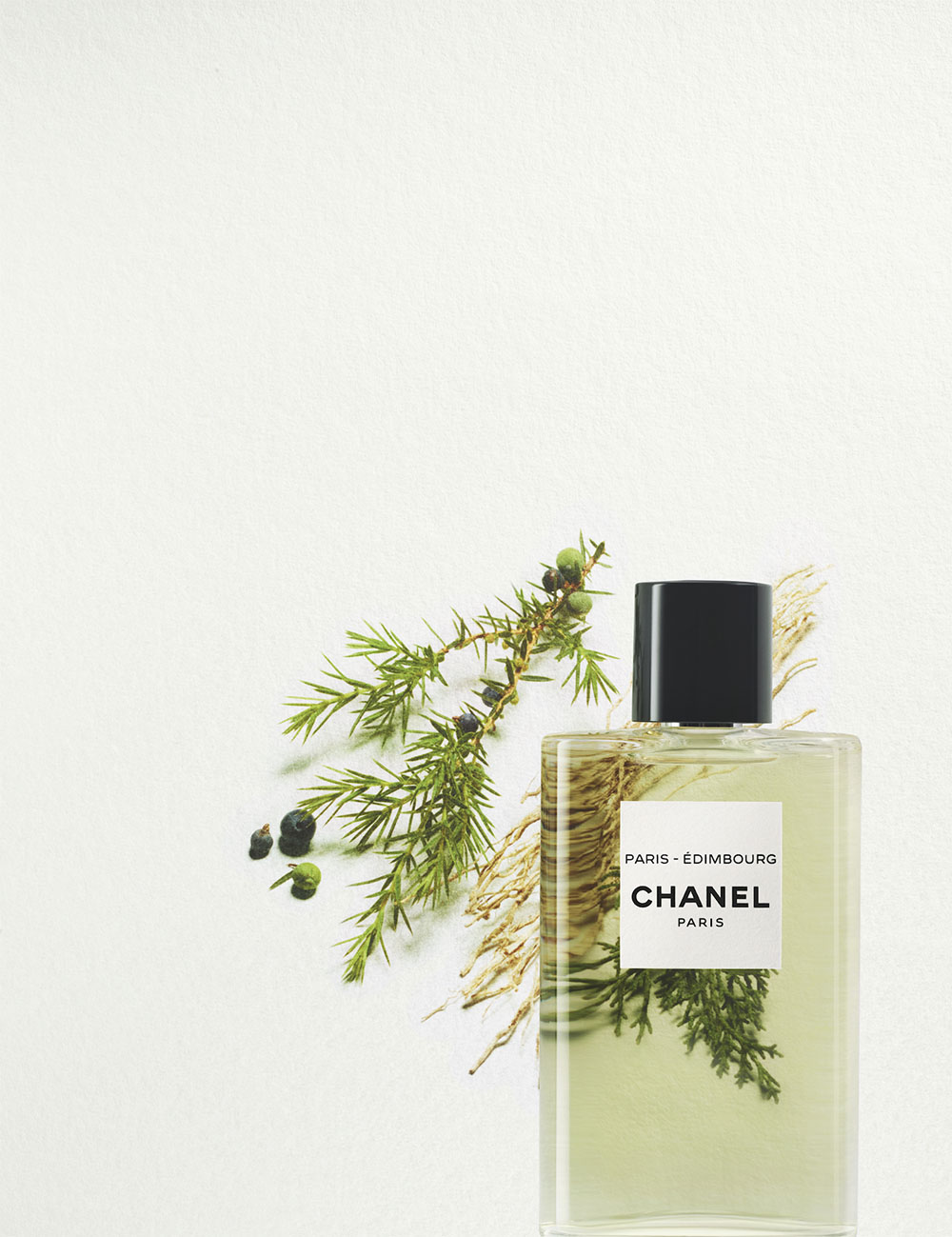
Les Eaux de Chanel: Paris-Édimbourg; chanel.com
How did you first encounter Paris-Édimbourg and what was your first impression?
Portia: Being an Aussie we tend to get everything a little behind the rest of the world but I always check in with my local CHANEL Beauty stand alone store in the Westfield just down the road. Everyone was raving about the newest from the Les Eaux range and that they’d picked such a strange place to be the destination. I’ve no memory in my readings of Coco hitting the Scottish Moors but that’s probably my memory. Anyway, I went into CHANEL Beauty on the off chance and lo and behold there was a Tester and stock. Did you know they also have body products? So cool. Tried it, walked around the mall doing my shopping and went back to buy it before leaving. Honestly, I would have bought it anyway because I’m a completionist and I already had the rest of the line. That it was so bloody gorgeous was just the cherry on top.
Old Herbaceous: I was able to get a travel spray decant of it from a monthly fragrance subscription, after I had done the same with the earlier “Eaux de Chanel.” With the first three, I had tried them as samples pre-pandemic at Nordstrom, and liked them very much. So when my subscription started offering decants of them, I quickly added them to my queue! Also, I have a thing for complete collections (Portia calls that being a “completionist”, lol), which I usually try to restrain, but chose to indulge with Les Eaux. After all, travel sprays don’t take up much space!
My first impression was that this is a traditionally masculine aromatic fragrance, and that is still my impression. I ended up giving my travel spray to my 22 year-old son, and he loves it so much that he requested a full bottle for his birthday this summer. His very chic girlfriend loves it on him, which I’m sure clinched the matter! It does smell very nice on him, and he likes the fact that it reminds him of Scotland, a country we have visited as a family and enjoyed very much.
Fragrantica classifies Paris-Édimbourg as woody, aromatic, and aquatic. Top notes are listed as cypress and juniper berries, middles not as cedar, lavender, and vetiver; base notes as musk and vanilla. I’m not sure why it includes “aquatic” in its description, because to me, it doesn’t particularly evoke water or watery notes. It does have the bracing, cool quality of aromatic evergreens.
2. How would you describe the development of Paris-Édimbourg?
Old Herbaceous: The opening is quite strong, and redolent of juniper even more than cypress. I like that a lot (the only hard spirit I drink, on the rare occasion when I have a cocktail instead of wine, is gin, which is flavored with juniper berries; perhaps that is the perfumer’s clever reference to the cocktails undoubtedly enjoyed by Chanel and her friends). The cypress and juniper notes combine to smell very herbal and green, to my nose — another plus for me. At this stage, Paris-Édimbourg has strong sillage, so one might want to apply it lightly. One light spritz on my wrist carries well beyond my arm’s reach, and I expect most wearers will want to apply scent to more than just one wrist.
As it moves into the heart phase, Paris-Édimbourg becomes less green and more herbal with the lavender accord becoming prominent. The cedar and vetiver accords lend warmth and woodiness to this stage, and contribute, with the lavender, to the impression of a more traditionally masculine fougere-style fragrance. The light application to start pays off in this stage, as it now feels “just right” to my nose, though still a fragrance I would prefer on my husband’s skin to my own. It just goes to show you how engrained these cultural impressions can be, aided by the fact that both my husband and my late father have leaned toward classic “barbershop” fougeres in their fragrances.
The dry-down stage is very pleasant, becoming the scent of warm “skin but better” with its base notes of musk and vanilla. The lingering traces of lavender lend it a soapiness that is very pleasing, evoking not just warm skin, but clean skin.
Portia: The opening woods are green and spicy. The tart citrus even veers towards grapefruit and I’m smelling something spicy like nutmeg, maybe cinnamon. Could it be the juniper berry? I’ve always smelt that as a cool spice, like capsicum as opposed to chilli.Ahhh, the heart resolves into juniper and pine.
Paris-Edimbourg smells so fresh and clean, like a modern fine fragrance version of Norsca. Yeah! I remember thinking that on my first wear. Reminiscent, not same. Just a jump started memory. There is a warm sweetness as we head towards dry down. I’d have said a not very vanilla heavy amber, resinous sweetness.
I’ve been and had Korean BarBQ, a few drinks and chatter, then watched some footy. There’s still an oily grass, pithy citrus and fluffy musks with some torn green twiggy branch. Now feeling done in a very Jean-Claude Ellena vein. A soft wash of it. That’s a long ride for what is basically a cologne style of fragrance.
3. Do you or will you wear Paris-Édimbourg regularly? For what occasions or seasons?
Portia: Amusingly, until today Paris-Edimbourg had sat unopened in my wardrobe. You can see the wrapping in the photo.
Les Eaux de Chanel: Paris-Édimbourg; image by Portia Turbo.
We are heading into our warmer months in Oz. Already the days are 20C/70f and above. Paris-Edimbourg fit the day perfectly and has even been a good fit for this evening. Last summer I wore Paris-Venise and Paris-Riviera so much they secured places in the grab tray. I think Paris-Edimbourg will be taking Paris-Venise‘s spot.
Old Herbaceous: I doubt that I’ll wear it myself, but I’ll enjoy smelling it regularly on my son! I think it’s just right for an occasion when one wants to smell a bit more “dressy” but still at ease. Paris-Édimbourg strikes me as the scent equivalent of male or female “business casual” — a fragrance that goes with a crisp collared shirt and neatly pressed, tailored pants. Classic and well-mannered.
4. Who should/could wear Paris-Édimbourg?
Old Herbaceous: Aside from the standard reply, “anyone who wants to”, I do perceive this as a more masculine fragrance based on my own scent history, but it could be worn to great effect by a woman or really anyone of any gender! In that sense, like the other “Eaux de Chanel”, Paris-Édimbourg is absolutely unisex. Perfumer Olivier Polge and Chanel have called it “androgynous”, which I think fits.
Portia: The joy of the Les Eaux line is they are wearable by all. Paris-Edimbourg is no exception and I think it might even be the most masculine leaning of the set. The bottles are a beautiful hark back to vintage CHANEL and I love that they’ve used the regular box lining-card for the outer presentation. The price point is affordable for a luxury brand and I’m thinking this could be a very good gift for someone special. Who doesn’t love a little bit of a CHANEL logo?
Most of us need another perfume like an extra hole in our heads but if your collection is missing a very wearable, spritz and go cologne style scent then you could do a lot worse than Paris-Edimbourg.
Have you tried this, or any of the other “Eaux de Chanel”? Any favorites? Do you have any on your wish list or “to-try” list?
Les Eaux de Chanel: Paris-Édimbourg; image from chanel.com
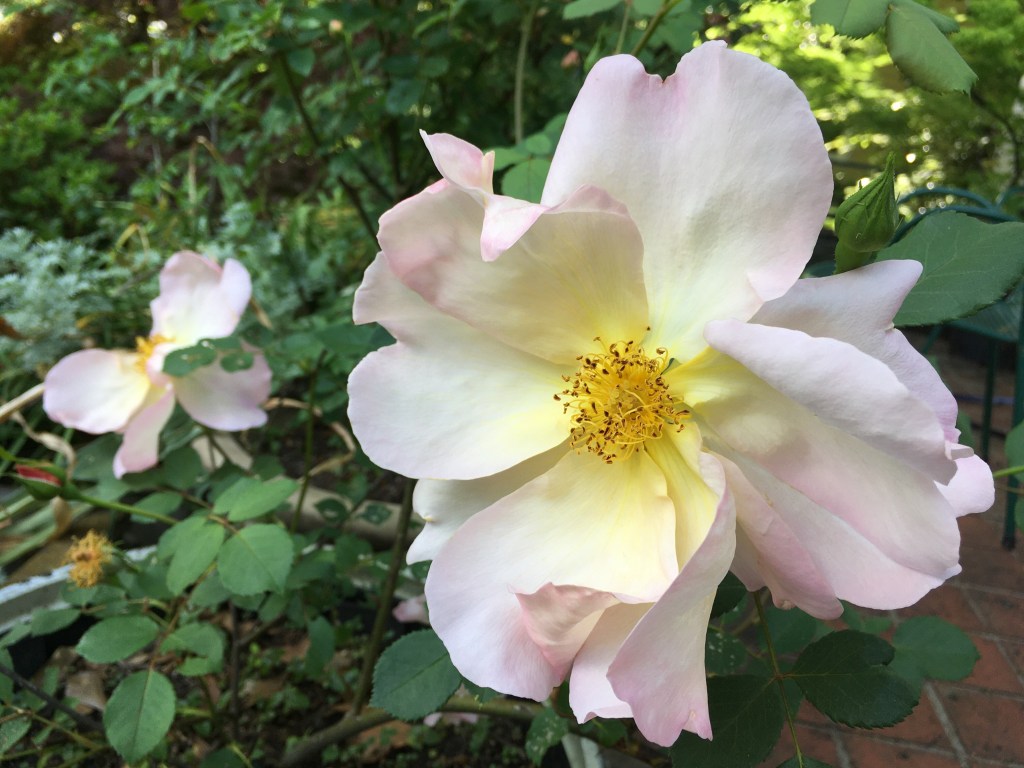
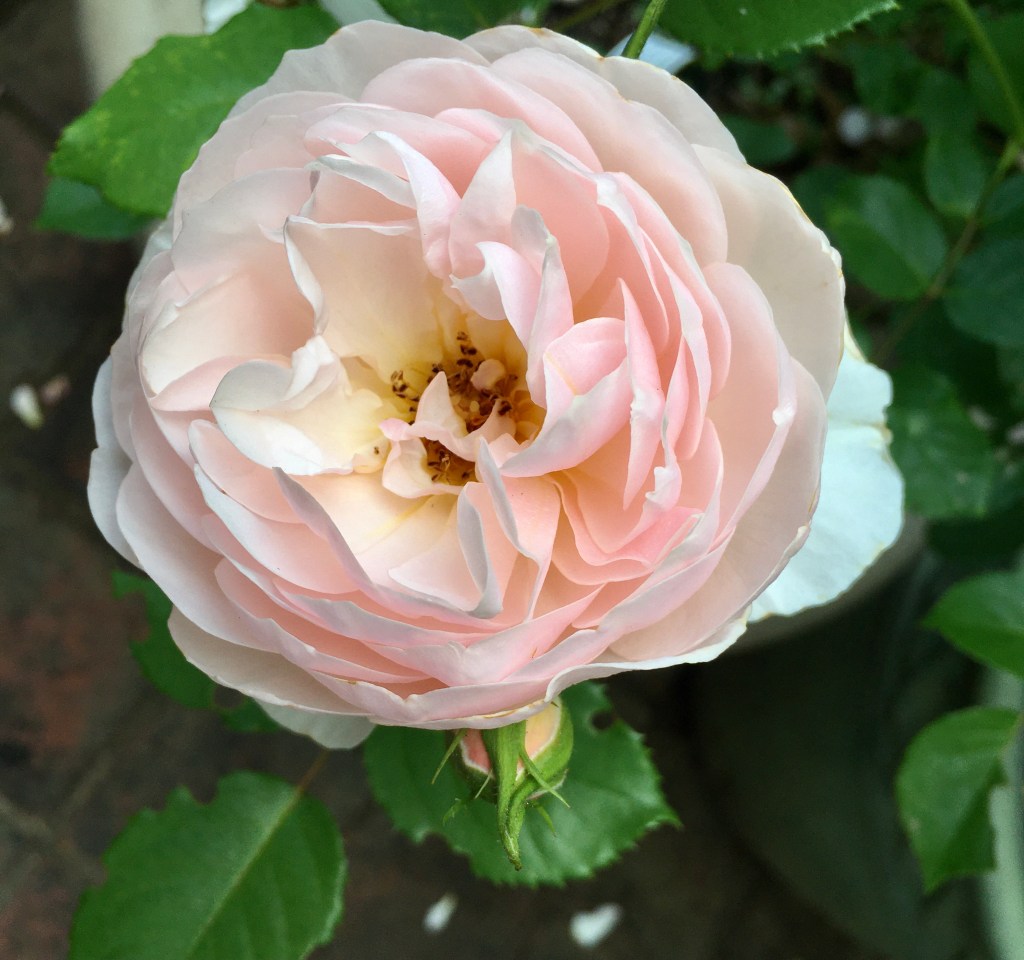
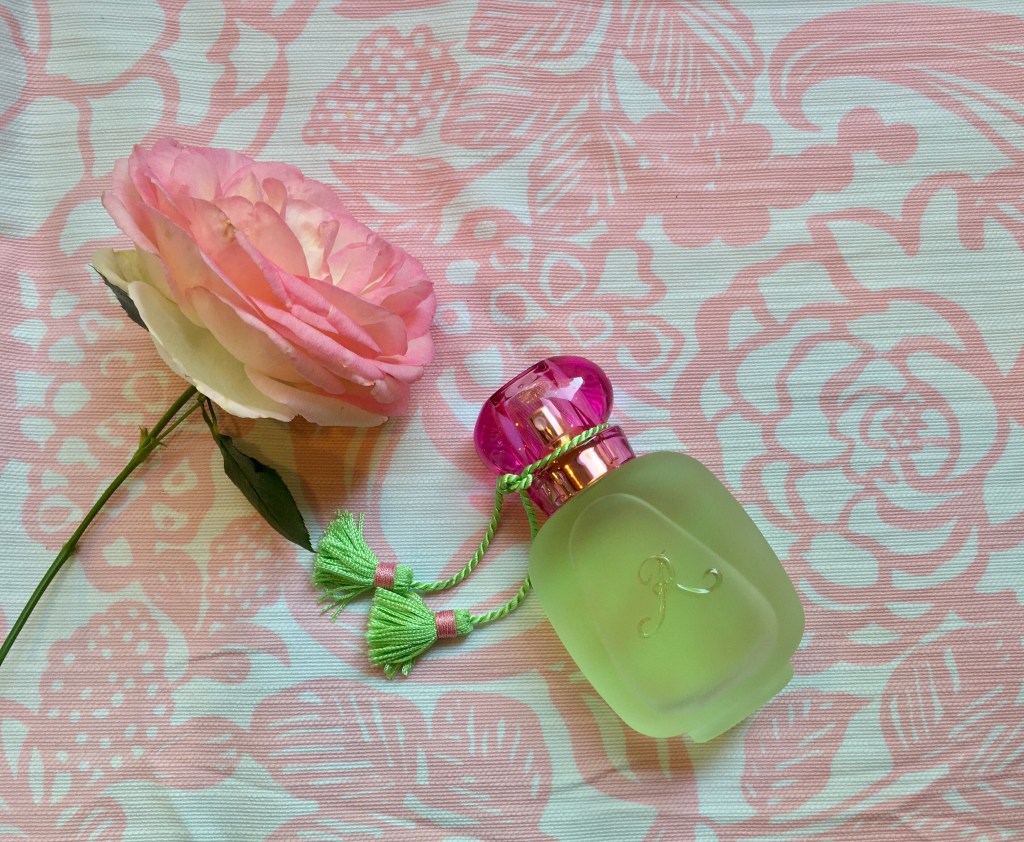
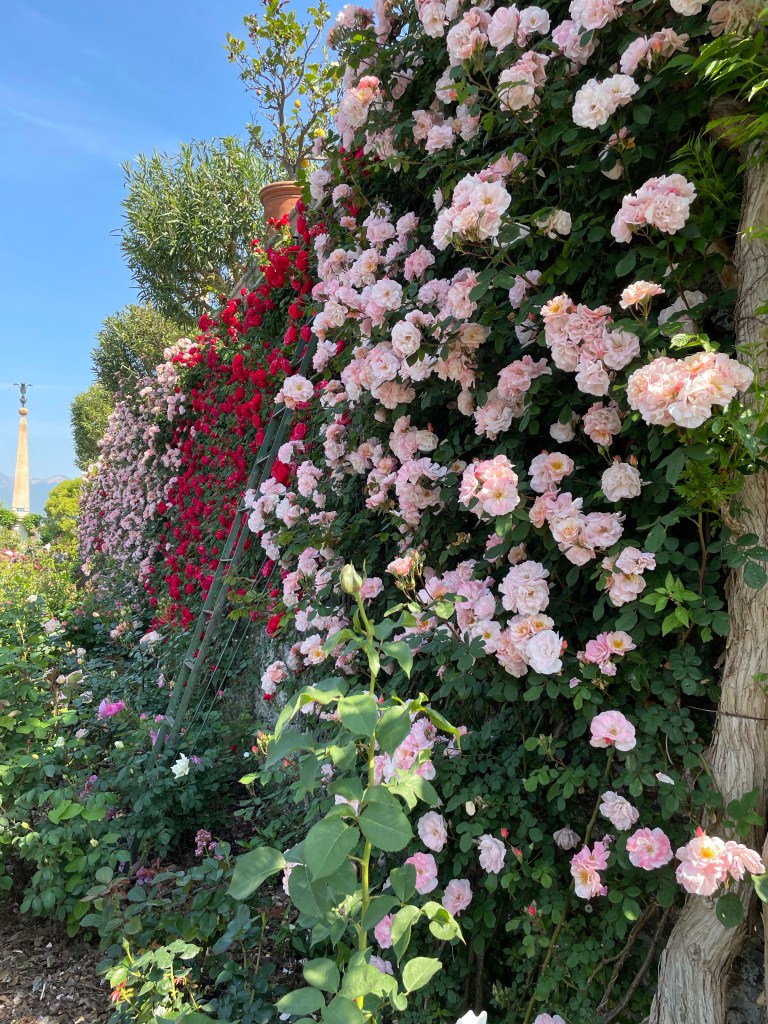
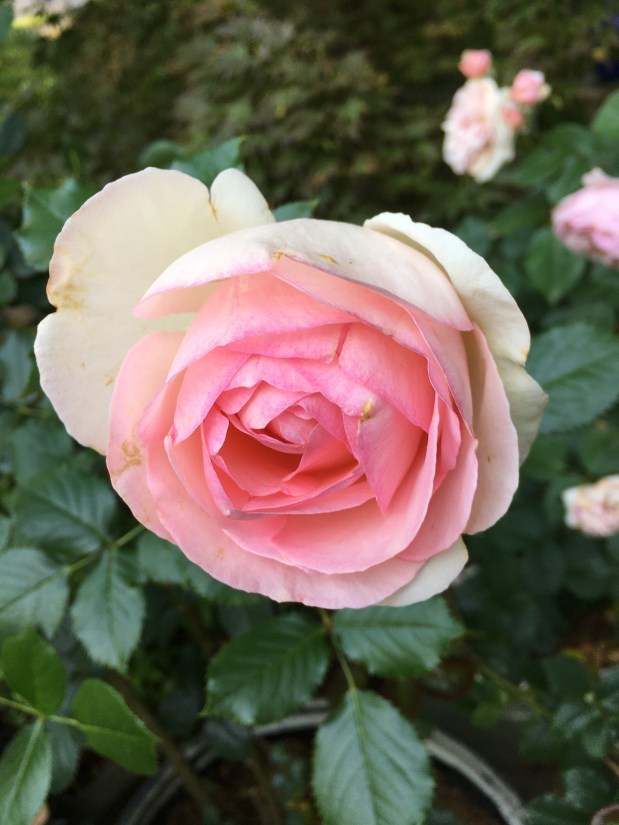
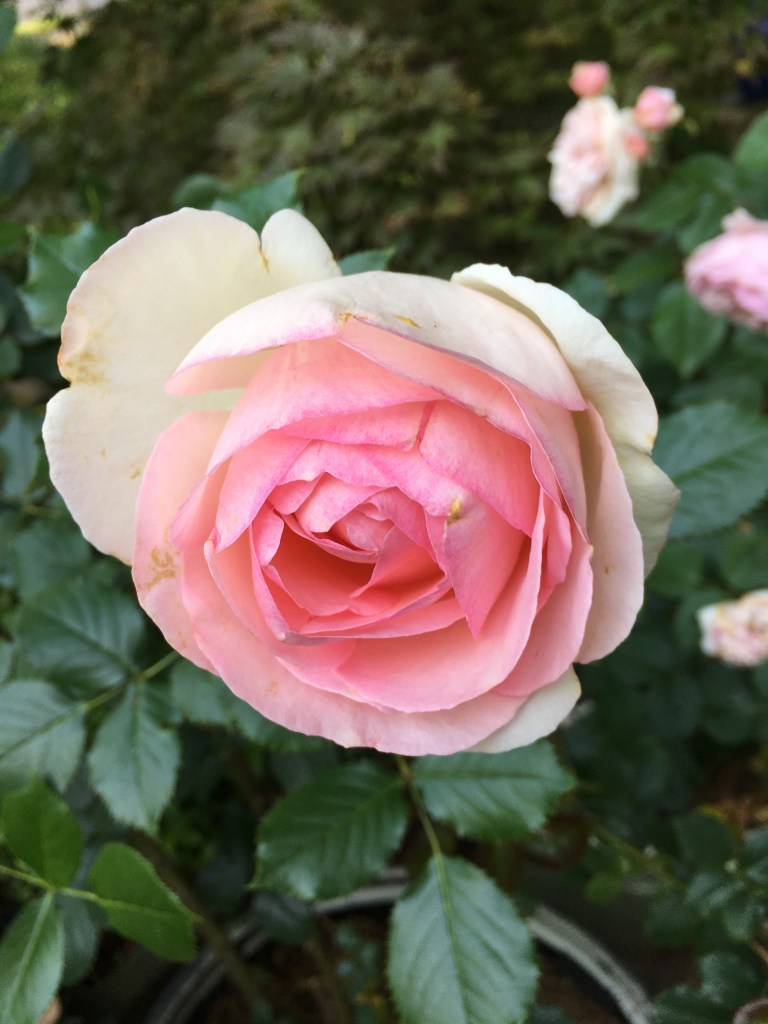
Ah, roses. As you may imagine (and regulars here know), with a pen name like Old Herbaceous, it is likely that I love roses. And I do – especially the highly fragrant English Roses hybridized by the late David Austin. As of last count, I am growing 14 of them, mostly in large pots. I’ve even visited the amazing display by David Austin Roses at the RHS Chelsea Flower Show! One rewarding aspect of seeing many varieties together in real life is that one can appreciate the different scents they emanate, as well as their different shapes and colors. Below are some photos from my terrace:
The fragrance of roses is actually a very complex ballet of many different molecules. As the American Rose Society notes, different varieties can smell quite different from each other, though recognizably and undeniably “rose”. According to ARS and the website Flower Power, “Rose scents fall into seven distinct categories. They are: rose (or damask), nasturtium, orris (which is similar to violets), violets, apple, clove and lemon (the fruit, not the blossoms). There are also twenty-six other less common aromas that can be discerned. Among them are: honeysuckle, moss, hyacinth, honey, wine, marigold, peppers, parsley, and even fruity raspberry.” These different nuances present an irresistible opportunity to perfumers: they can create endless variations by emphasizing one facet or another of a rose accord’s complicated structure. The Perfume Society says that rose is a note in at least 75% of traditionally feminine fragrances and at least 10% of traditionally masculine fragrances. While many perfumistas dislike rose notes in perfume, it may be that they haven’t found the right rose yet, since there are so many, varying widely from the classic rose-scented soap your older relatives may have used. In fact, one of my favorite perfume houses focuses almost entirely on rose-centered fragrances: Les Parfums de Rosine, founded by the late Marie-Helène Rogeon.
Clair Matin, Les Parfums de Rosine
I’ve written about many of the rose fragrances I own in past years’ “Roses de Mai Marathon”, but this month I have some new ones with which to illustrate “rose” as a note in fragrance. The newest in my collection is The Coveted Duchess Rose, from Penhaligon’s “Portraits” collection and created by perfumer Christophe Raynaud. It is an eau de parfum that Fragrantica classifies as an “amber floral”. I think that’s a misnomer; the “amber” quality is due to a vanilla accord which, oddly, isn’t listed as a note on Fragrantica but is listed on the brand’s website. Other notes are Rosa centifolia (one of the varieties most used in perfume), mandarin orange, musk, and “woody notes.” The mandarin orange note opens the fragrance, which quickly pivots to a beautiful, fresh, classic rose accord. As it dries down, Duchess Rose gets warmer and muskier in a soft progression toward its base notes. The rose accord is evident throughout, but the vanilla becomes an equal partner in its dance after a couple of hours. One of the things I like about this fragrance is that it starts out very dewy and fresh, because of the mandarin orange, then slowly warms up, with the floral aspect strongest in its heart phase. It reminds me of a sunny English summer day, dawning cool and fresh, the light becoming stronger as the sun rises, then warming into late afternoon.
Probably the most unusual new rose fragrance in my collection is Miguel Matos’ Miracle of Roses, which comes as an extrait. I was able to try it and buy it this spring in Barcelona, at The Perfumery (if you get a chance, do go visit this wonderful shop with its many niche and artisanal perfumes!). It is named for a legend about St. Elizabeth of Portugal, a medieval queen. M. Matos tells the story:
“Elizabeth was born in Zaragoza, Spain in 1271, she was the daughter of Peter III of Aragon and was married off to King Denis of Portugal in 1282. Throughout her life, Elizabeth demonstrated a great compassion to the poor and legend says she would leave the palace in disguise, in order to take food for the less fortunate.
The Miracle of Roses happens one day when the king discovered that Elizabeth was leaving the palace to take food to the poor. This is something that the queen had been forbidden to do. The king had threatened to lock her up and she was to never leave the palace again if the disobeyed. Despite this, the Queen never stopped feeding the poor and every day she would leave the palace and help her people.
One winter day, Elizabeth left the palace carrying pieces of bread hidden in her dress. As the King saw her going out, he asked, “What you are carrying?” She answered, “Roses, my lord.” As it was winter and roses were nowhere to be found at the time and in that cold weather, he demanded her to show him what she was carrying. When the queen unfolded her dress, roes fell on the floor.
The transformation of bread into roses is a miracle attributed to St Elizabeth of Portugal, a woman that set an example for devotion to God and kindness to her people. After the death of her husband in 1325, she entered the Santa Clara a Velha Monastery in Coimbra where she lived until 1336, when she passed. Pope Urban VIII canonized her in 1625.”
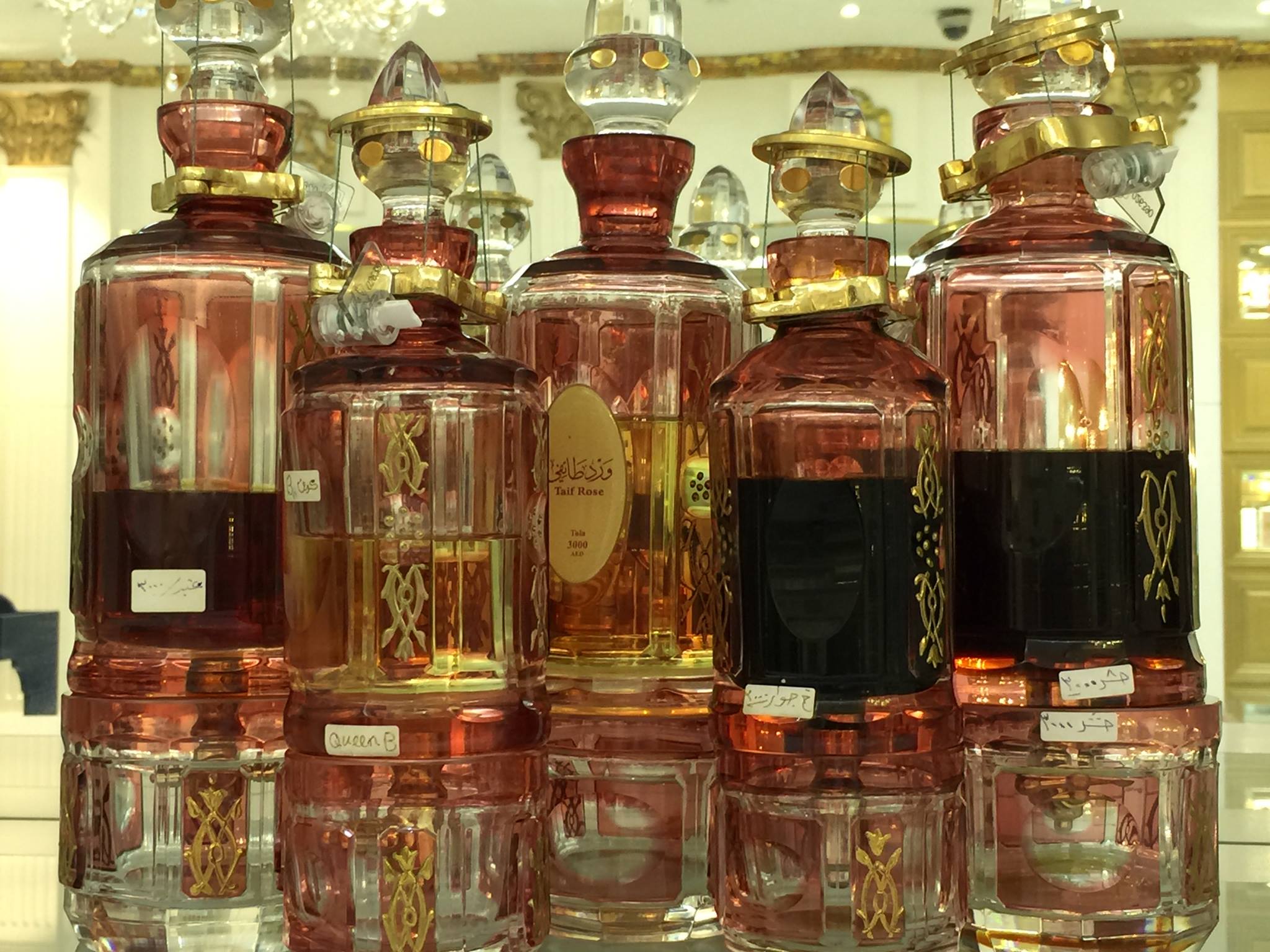
Miracle of Roses opens with a combination of cinnamon, bread, and milk. Yes, it really does smell of bread and milk, both of which are associated with kindness and charity. The next stage is where the rose makes its first appearance, accompanied by heliotrope, immortelle, and iris. The rose is not dominant, it is equaled here by the other flowers. The base notes are frequent “collaborators” with rose accords in fragrance: sandalwood, honey, incense, and woody notes. Miracle of Roses is a beautiful, slightly eccentric fragrance that is unlike any others I own. In fact, in future wearings I may add a drop on my wrist of the gorgeous attar of Taif roses that my husband bought for me in Dubai, to amp up the rose accord (don’t tell Miguel).
Speaking of Taif roses, the third rose fragrance I’ll use to discuss the note is Perris Monte Carlo’s Rose de Taif, an eau de parfum created by perfumer Luca Maffei; it is also available as an extrait. It is an aromatic, spicy rose, with herbal nuances. Fragrantica lists its notes as: geranium, lemon and nutmeg; middle note, Taif rose; base notes, damask rose and musk. Geranium and lemon are also common companions for roses in fragrance; they share some of the same molecules like geraniol. Not surprisingly, Rose de Taif smells a bit like a scented geranium, and less fruity than some rose-based fragrances. It is a far cry from the rose soaps that turned many people against rose in fragrance! It is clearly still a rose-centric fragrance, but it has a modern flair. As proof of that, my son’s very chic college girlfriend was at our house recently when I was wearing Rose de Taif for this blog post. She immediately sniffed the air and asked what smelled so great. I feel seen! Or smelled. The modern, spicy nuances of Rose de Taif also make it an ideal unisex fragrance, especially for men who may tend to avoid sweeter, more flowery rose scents. There are many great rose fragrances targeted to men these days, but I don’t see any reason why any man couldn’t wear whatever rose fragrance appeals to him, no matter who is the target customer.
Finally, Attar de Roses by Keiko Mecheri. My bottle has gone off a bit, so I get a sort of fermented rose smell when I first spray it, but that evaporates in seconds and becomes a lovely, warm, woody rose. It has been discontinued, so the brand’s website no longer lists it. According to Fragrantica, its notes include: Taif, Shiraz and Ancienne roses, jasmine, warm, woody notes, amber and leather. Jasmine is another classic rose companion in fragrance, famously paired with rose accords in perfumes like Chanel No. 5 and the late, great Joy by Jean Patou. Here, I barely detect it; the woody notes, which smell to me like sandalwood, are more evident to my nose. Although Attar de Roses is labeled as eau de parfum, I think it must have a high concentration of fragrance oil, because I can see it as a moist patch on the back of my hand where I sprayed it, long after that first spray. It stays rose-focused throughout its development in an almost linear fashion, which I appreciate when I’m in the mood.
Bringing us back to the garden aspects of rose fragrances, I actually found a scented geranium this year called – “Attar of Roses.” By golly, when you rub its leaves, it really does smell like a rose! Most scented geraniums smell like citronella or lemongrass to my nose. I like them, but I did a double-take when I smelled this one. So of course I bought it on the spot, and it is sitting in its own, smaller pot on the terrace where I grow my English Roses. I rarely bring tender plants inside to nurture over the winter and try to bring back in the spring, but I may have to make an exception for this one.
Rose fragrances tend to elicit strong feelings, as far as I can tell. Do you love or loathe rose fragrances, or do you have mixed reactions? Please add your thoughts in the comments – just remember that a fragrance you dislike may be another reader’s long-time favorite, so as always, please try not to give or take offense! Also, go see what Portia has to say, over at Australian Perfume Junkies. And Happy Fourth of July to my fellow Americans!
Welcome to the weekly Perfume Chat Room, perfumistas! I envision this chat room as a weekly drop-in spot online, where readers may ask questions, suggest fragrances, tell others their SOTD, comment on new releases or old favorites, and respond to each other. The perennial theme is fragrance, but we can interpret that broadly. This is meant to be a kind space, so please try not to give or take offense, and let’s all agree to disagree when opinions differ. In fragrance as in life, your mileage may vary! YMMV.
Today is NOT Friday, June 30, when I should have posted. I got distracted by an unexpectedly long eye doctor’s appointment that morning, and then some unexpected work tasks in the afternoon, and I forgot to post! We’re living through a massive heatwave here in the Southeast, so I’ve also been very busy watering my many plants, garden beds, and vegetable garden. Plants that need special attention are my David Austin roses, most of which I grow in large pots because I don’t have great locations for roses elsewhere in my garden, and because our front terrace gets the most sun plus air circulation. They flourish in the pots but they have to be watered daily during hot weather. Totally worth it, as they are so lovely and smell wonderful!
Speaking of roses, Portia Turbo and I will be posting again tomorrow in our regular collaboration “Notes on Notes”, and the note we’ve chosen is — rose. Whether you like or loathe rose fragrances, please drop by and comment (nicely) here and on Australian Perfume Junkies once we’ve posted!
PSA: Penhaligon’s USA is having its summer sale; several really nice ones are on sale, including one of my favorites, Juniper Sling, and I snagged a discovery set of eight of the “Portraits” fragrances. At least one will probably make an appearance in tomorrow’s “Notes on Notes.”
Yesterday I went to a fashion exhibit I’ve been meaning to visit for months now. It is a collection of couture by Madame Grès, of Cabochard fame, owned by the late Azzedine Alaïa in his personal collection, covering decades from the 1930s to the 1980s. The exhibit displayed about 70 dresses and other outfits — for a sometime sewist like me, they were just stupendous; the designs and workmanship were astonishing.
Four weeks from tomorrow will be my last day at work! My workplace is having a retirement reception for me, and I’m looking forward to that and then having the rest of the summer off. Usually I’ve only had two weeks of vacation each summer. TBH, I look back over the 18+ years I’ve been in that job, and I’m stunned that I persisted through so many challenges — everything from students in severe crises to vicious academic politics, without any of the job protection most faculty have (I’m staff), all while raising three children. The youngest was three years old when I started that job. I couldn’t have done it without my very supportive, loving husband, who kept me sane when the job did its best to undermine sanity.
How is your summer going? Any particular adventures had or expected?
Welcome to June’s installment of “Counterpoint”, a feature in which Portia of Australian Perfume Junkies and I exchange our thoughts on the same fragrance! This month’s featured fragrance is Le Jardin de Monsieur Li .
Le Jardin de Monsieur Li, by Hermès; image from Portia
Le Jardin de Monsieur Li is part of the “Jardin” series by Hermes, created by Jean-Claude Ellena. It was launched in 2015, and it is meant to evoke a Chinese garden, with notes of kumquat, bergamot, jasmine, mint, and green sap.
I believe this was the last of the “Jardin” fragrances create by M. Ellena while he was Hermès’ in-house chief perfumer. I love gardens, and I love the “Jardin” fragrances, each one inspired by a different garden. In the case of Le Jardin de Monsieur Li, Hermès says it is a garden “poised between reality and imagination”, but it reminds me of a real garden I visited the one time I have ever been to China. I had gone with my husband to Shanghai, where he had work for a week, and I was on my own to explore the city. I don’t speak Mandarin, but I taught myself a few phrases (“Excuse me”, “Please”, and “Thank you”) and the Shanghai metro was very easy to navigate. High on my list of places to go was the Yuyuan Garden, built several hundred years ago during the Ming dynasty.
Yuyuan Garden; image from ChinaXianTour.com.
It is a remarkable place, five acres completely enclosed by ancient stone walls in the middle of a bustling part of Shanghai where the Old City has been engulfed by the modern metropolis. The garden is divided into six main areas with different themes and purposes; parts of the garden and its structures were used for performances, for example. It has water features and a large koi pond, and amazing stone work in addition to several rockeries. Some of the most striking elements are the “dragon walls” that divide the garden; the walls are built to look like the undulating back of a long dragon, and they end with a dragon’s head! The garden’s name means pleasing and satisfying, and it was created as a tranquil haven for an important Chinese official’s parents by their dutiful son.
Upon entering the garden after leaving the modern metro, one may experience a quick, delighted intake of breath, and I had the same reaction to Le Jardin de Monsieur Li. It is at once citrusy, aromatic, and floral – a perfect summer fragrance.
How did you first encounter Le Jardin de Monsieur Li, and what was your first impression?
Portia: As soon as Monsieur Li came out I wanted to get some on my skin. The Jardin range is some of Jean Claude Ellena’s best work (in my opinion anyway) and I’m yet to find one that disappoints. Sydney gets things later than the world but luckily Jin and I were in Tokyo and we hunted it down at a department store Hermès counter. Mint is one of my favourite notes in fragrance and so I was immediately smitten. Jin bought me a set with shower gel and lotion in the most fabulous box. So not only is Monsieur Li lovely but it has an excellent scent memory to match.
Old Herbaceous: I first encountered it when I “met” the other Jardin fragrances. It launched at about the same time that I went completely down the perfume rabbithole, in 2015 (the same year I started this blog to record my impressions and experiences). My late mother had sent me a generous birthday check, and I discovered that a certain discounter website had all five of the original Jardin fragrances for very affordable prices, so I used her gift to buy myself the whole set (I have a thing for complete sets), having become intrigued by reading Chandler Burr’s book The Perfect Scent, which included his account of how M. Ellena created Un Jardin Sur le Nil.
I think my first impression of Monsieur Li was colored by how much I love Un Jardin Après la Mousson and Sur le Nil. I didn’t pay as much attention to it. Once I really tried it and focused on it, I found Monsieur Li to be just as rewarding as those favorites, though they still “outrank” it.
2. How would you describe the development of Le Jardin de Monsieur Li?
Old Herbaceous: The citrus notes in the opening are refreshing with that slight bitterness, like the grapefruit accord that M. Ellena uses so often. They are quickly joined by the jasmine, but this is a light, fresh jasmine, not the heavy narcotic white flower smell often associated with that accord. To me, it smells like jasmine polyanthum, a lovely pinkish white jasmine vine that is often grown indoors as a houseplant.
I smell a touch of mint, which adds to the freshness of the scent and lends it a tinge of green. As some of you know, I do love my strong green fragrances; this is not a strong green fragrance at all, but it has just enough greenness to appeal to me. As it dries down, the citrus notes slowly recede, as they usually do, but they linger enough to maintain the aromatic aura of this summer floral. The final stage is lightly musky, but I can still smell jasmine and mint, so it has a lovely, soft finish.
Portia: Before we get to spritzing I’d like to say how much I love the feel of these bottles. The glass is so smooth it’s like fabric. It’s hefty without being heavy and fits my hand like it was made just for me. Already I’m feeling good. I rather like the way JCE thinks:
“I remembered the smell of ponds, the smell of jasmine, the smell of wet stones, of plum trees, kumquats and giant bamboos. It was all there, and in the ponds, there were even carp steadily working towards their hundredth birthdays.” Jean-Claude Ellena
It’s like he has translated these memories perfectly into scent.
Hermès gives these featured accordsL Sambac Jasmine, Kumquat, Bergamot
Water, shade, greenery gowing in a glasshouse. A terrarium. Yes, I smell sparkling and pithy citrus, some vegetal musks, clear and clean white florals. It might have been suggestion but I also smell broken bamboo, that weird dry/torn/sappy/sweet/coldness that the smell evokes in my mind. I also smell bittersweet citrus juice. The heart moves on and gives me peony and waterfalls over the top and some non-citrus fruit but I can’t pinpoint it. Maybe even berries? Later the vegetal musks seem to mix with some resins, I want to say elemi but really it’s just a feeling more that a scent association.
That’s the fireworks of open and heart. As Monsieur Li heads towards dry down the vegetal musks and resins with an overlay of cut green oranges continues quietly but pervasively for hours. Towards the end I even smell something vanilla-ish. It melds with my skin but makes it smell 100x better than it ever has.
It’s not weird or big or crazy. It definitely has a softer amount of that JCE Jardin oily sweetness undercut by water and greenery. Monsieur Li is surprisingly long lasting on my skin too
3. Do you or will you wear Le Jardin de Monsieur Li regularly? For what occasions or seasons?
Portia: Yes, I wear Monsieur Li regularly. Though regularly means monthly rather than weekly. It works best for me when there is at least dappled sunshine. The temperature is not so important but I always feel really alive when wearing it in the sun.
Though it fits perfectly in most occasions I particularly love it when smelling good but not overwhelming is the job of the day. Perfect for food, movies, travel or anything up close. Also excellent as a bed time calming or early morning get me revved for the day spritz. So versatile.
Monsieur Li is surprisingly long lasting on my skin too
Old Herbaceous: I don’t wear it regularly, but I really should! It is especially appealing as a summer fragrance, though I would happily wear it during the spring and really any time I want a fresh cologne-type scent. I think it would partner beautifully with a guest’s summer wedding outfit, for any gender.
4. Who should/could wear Le Jardin de Monsieur Li ?
Old Herbaceous: This is a truly unisex scent, in my view. It has just the right combination of citrus, aromatic, and floral notes to balance between the traditionally feminine and masculine. When I was growing up, in a preppy part of New England, men often wore ties made of Liberty Tana Lawn floral fabric to summer parties and weddings, with lightweight suits; Le Jardin de Monsieur Li would go wonderfully with those.
Portia: Monsieur Li will probably be a bit low key for most hard core perfumistas. Their perfume wardrobes probably have enough cologne style fragrances.
Mint and aquatic are both also a no-go space for a lot of people. What I would say to anyone afraid of spritzing is that here the citrus and green notes are king. Though mint and water are present and noticeable the way that JCE has made this perfume could be a gateway for you.
Definitely unisex, its longevity means you can wear it to work and still have remnants left at the end of the day. It is also the sort of low key beauty that any non perfumista who wants to smell good as part of being dressed well could wear year round. I’ve not given it as a gift but thinking about that now it would be a perfect non confronting, wearable, elegant selection. That it has bath products that match make it even more alluring.
I’m also thinking that for someone who wants to define their leisure time with scent, Monsieur Li would be a beautiful, laid back, pared back signature. A gentle waft of freedom.
Hermès’ “Jardin” series of fragrances; image from hermes.com
Have you tried Le Jardin de Monsieur Li? Thoughts? Also, I can’t omit mention of Sarah McCartney’s wonderful riff on it: 4160 Tuesdays’ Le Jardin de Monsieur McGregor, another garden scent I love very much! And its name makes me smile.
Do you have any requests for an upcoming Counterpoint fragrance? The only limitation is that it must be one Portia and I both possess or can sample. Suggestions are welcome!

















 Serenity Now Scents and Sensibilities