This is my first “Scent Sample Sunday” post of the New Year, and I have thunking on my mind, thanks to a running conversation on the blog Australian Perfume Junkies (a very welcoming online community, btw, which I highly recommend). I think it was APJ reader Brigitte who coined the phrase, referring to the satisfying “thunk” sound made by an empty vial or bottle of fragrance when it hits the bottom of a wastebasket, having been happily emptied and enjoyed by its owner. Thunk!
The running conversation has been about the readers’ commitments to finishing the fragrances they already have before rushing to buy more. A related commitment is to “shopping in your own closet”, i.e. to rediscover what one already has in one’s fragrance cabinet or other storage, enjoy and appreciate it, and reduce impulse buying.
Count me in! So I’m going to start a new series of blog posts here, called “Thunking Thursday”, and I invite you to join me! I’ll write briefly about something I’ve thunked that week, and I hope you’ll comment on whatever you have thunked, whether that week or earlier. Or even what you plan to thunk in coming weeks! Maybe we can reinforce each other’s New Year’s resolutions — or at least vicariously enjoy each other’s “thunks.” I might award a prize to the reader who describes the most completed thunks here this month if I get a large number, so boast away! Please include a brief description of the fragrance and your experience with it, including whether you think you’ll seek it out again.
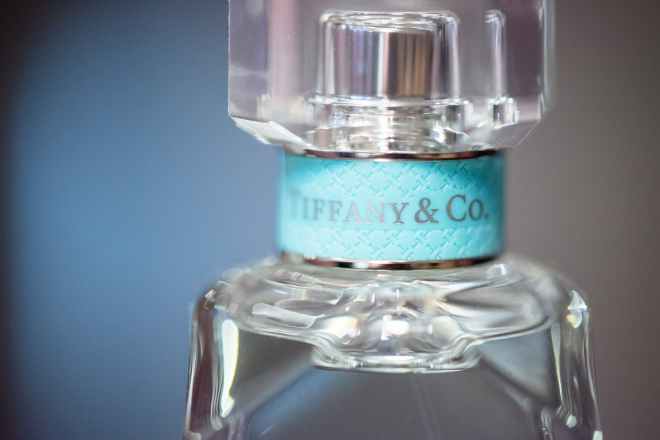
I’ll start today, claiming one “thunk point” for my sample of Tiffany & Co. Intense EDP. I loved everything about it: the strong iris note, the packaging, the ad campaign. Maybe I should have to deduct points from myself, though, since I got a full bottle of it for Christmas based on my love of the store sample! Oh well. We all know what paves the road to … you know the rest.
How many thunk points have you accumulated so far in 2019? If you need a few days to think and thunk, come back on Thunking Thursday and comment there! Happy New Year!
So here we are, on the very last day of 2018! This year has been an odd one – the world feels as if it is collapsing in on itself and for that reason, it has been quite stressful. Personally and professionally it has been turbulent – lots of great ups and some downs too. […]
Now that 2019 is almost here, it’s the perfect time to give you a recap of our top best-selling perfumes this year. Here are the ten fragrances that our scent tribe has been adding to their queues: Bright Crystal by Versace Average Rating 4.5 out of 5 Bright Crystal is a refreshing and sensual fragrance that combines…
For a different kind of list, here is Scentbird’s list of its top ten bestsellers among fragrances in 2018, regardless of when they debuted. It’s interesting to see what is selling well!
Her big, boisterous laugh. Her even bigger heart. Her dauntless style. The free spirit that only comes with the second spring of age… We’ve lost Vero Kern. I’ve lost a friend. In one of our last conversations, an interview for the exhibition catalogue of « Nez à Nez » at the mudac in Lausanne, she told me:…
I thought it was lovely that Grain de Musc dedicated its “Best of 2018” to the late Vero Kern. I never got the chance to meet her, but I know that her passing has been a big loss to the fragrance community, and especially to several bloggers who knew her.
It was 110 posts ago (this one being 111) when we were welcoming 2018 with our arms wide open but it really feels as if the year started just a few days ago. While indeed 12 months have passed in a blink of an eye. Today many of us feel tired of current year and […]
2018 was a year in which the perfume companies more firmly tuned their fragrances towards a younger generation. I tried 701 new perfume releases this past year. If there was one dominant trend it was towards transparent styles; especially in the mainstream sector. It also meant simpler constructs using three to five ingredients. The difficulty…
Every year when I sit down to summarize the best of the launches, I look at perfumes I’ve reviewed and check my notes for whether I’ve changed my mind about the ratings. Although one could complain about too many launches, too much sameness in the market, too little creativity, the truth is that some fragrances…
I don’t feel qualified to list the “best of 2018”, as I haven’t tried that many of the new launches, so I plan to share the lists of bloggers I follow and enjoy! And then maybe I will post a very idiosyncratic list of the scents I’ve enjoyed this year, without any claim to being expert or comprehensive.
So here is Portia’s “Best of 2018” from the blog Australian Perfume Junkies — if you haven’t read the blog before, check it out! It’s a very friendly fragrance community. Happy New Year!
In the growing world of niche and “exclusive” perfumes, there are not many bargains. Prices seem to go up and up, into the realm of the ridiculous. And, may I say, some of the most expensive bottles of fragrance are also — if not hideous, tacky. House of Sillage, I’m looking at you, and Clive Christian, you’re not far behind (apologies to any readers who love those bottles, this is imho only!). The House of Sillage bottles look to me like demented cupcakes. I’m sorry, they do.
By contrast, some of my favorite bottles contain inexpensive but enjoyable fragrances. For instance, one of the first fragrances I blind-bought when I went down the perfume rabbit-hole was Vicky Tiel’s Sirene. Its frosted glass bottle, with a bas-relief of caryatids, is just gorgeous; and I like the scent itself very much. It is a rosy floral with a sharp opening and soft drydown. At about $20 for 100 ml, why not take a chance on it? The bottle alone makes it worth the price.
At Christmas, my kids now ask me what fragrance I’d like them to get me that’s within their price range. I try to keep that under $25, and luckily there are some bargain fragrances out there to be had for that price. This year, my two daughters gave me Salvador Dali’s La Belle et l’Ocelot, in both the eau de toilette and eau de parfum formats. Friends, these are two of the prettiest bottles I own!
And the fragrances themselves aren’t bad either — not strong loves for me, but definitely likeable and wearable. The EDP (2014) is a warm, balsamic, slightly spicy scent, with top notes of Sicilian bitter orange, davana (artemisia), and elemi (a resin), heart notes of osmanthus, rose, night-blooming jasmine, and tonka, and base notes of patchouli, benzoin, and incense. It reminds me a bit of a lighter, less complex Opium or Obsession. Believe it or not, many of its notes are the same as those of Chanel’s Coromandel, which was launched two years later, in 2016. It’s very appealing in this season’s colder weather, and it is light enough that I think it will still appeal even in the summer, especially on warm, balmy evenings.
The EDT is a completely different fragrance from the EDP — not, as the website says, a softer version of it. The EDT’s top notes are apple blossom, nashi pear and grapefruit; heart notes are iris, Turkish rose and Egyptian jasmine, base notes are cedar and musk. Really, the only thing these two have in common is the beautiful design of their bottles. One intriguing fact is that both fragrances are meant to evoke an olfactory recreation of Beauty and the Beast, according to the website, but one can also perceive the EDP as more animalic (“beastly”) and the EDT as more floral (“beauty”). The EDT is a light, soft floral, with some fruitiness but not so much as to make it overly sweet. I think it would wear best in late spring and throughout the summer. I tend to prefer sharper, greener florals generally but especially in the spring, so this would be more of a summer scent for me.
Salvador Dali was well-known for his eccentricities, in his life as well as his art, one of which was that he kept a pet ocelot (which is a kind of tiny leopard) named Babou. He took Babou to many places and was often photographed with the animal:
Dali with Babou
Another fun fact is that the popular culture we most associate now with “Beauty and the Beast” is the Disney Company’s animated film — but in real life, Walt Disney and Salvador Dali not only knew each other, but collaborated briefly on a short film called “Destino.” It was shelved during WWII, and revived in the 21st century by Walt Disney’s nephew, Roy Disney.
I got interested in Dali fragrances first by reading Luca Turin’s review of the original Dali, created in 1983 by Alberto Morillas, which he gave four stars. I have a mini of the parfum, and it is beautiful as a fragrance; its bottle is also lovely, as are all the Dali perfume bottles that are based on the sculptured lips and nose of Dali’s Aphrodite in his work Apparition of the Face of Aphrodite of Knidos. (I must say, though, I think the bottles for La Belle et l’Ocelot are even more lovely). Some well-know perfumers in addition to M. Morillas have created Dali fragrances: Mark Buxton created Laguna (also awarded four stars by M. Turin) early in his career, in 1991, and Francis Kurkdjian created Purplelight in 2007. Have you tried any of the Salvador Dali fragrances? Do you think any are “discount diamonds”?
Featured image: model Donyale Luna with Dali’s pet ocelot Babou.
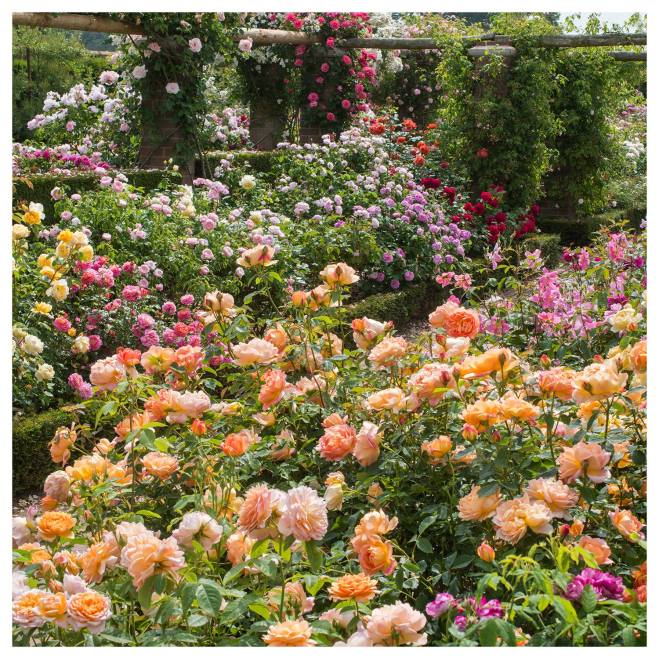
One of the giants of horticulture died this week: David Austin, OBE, creator of the “English Roses.” What does this have to do with fragrance, you ask? One of Mr. Austin’s major goals in hybridizing roses was to reinstate the powerful fragrances of “old roses” into modern roses with some of the best traits of newer rose hybrids: disease resistance, repeat bloom, a wider range of colors. And he succeeded, probably even beyond his own dreams, in creating “the perfect garden worthy rose that combines beauty, fragrance, repeat-flowering ability and good disease resistance with great charm – the quality his English Roses are most renowned for.” As he wrote in his book The English Roses, he had one preeminent objective, “… that we should strive to develop the rose’s beauty in flower, growth and leaf.” Of fragrance: “[It] may be said to be the other half of the beauty of a rose”.
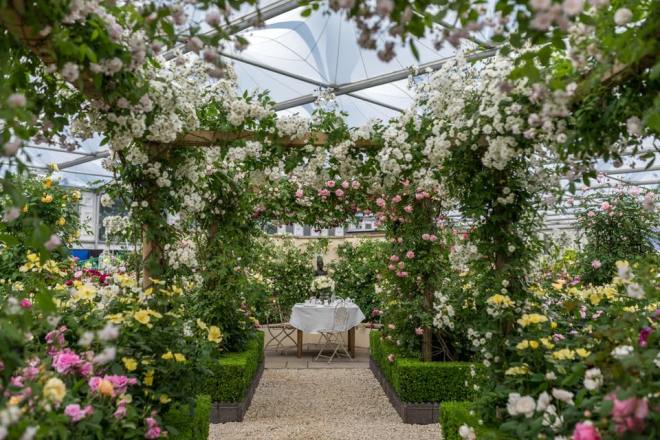
Mr. Austin’s English Roses won 24 gold medals at the RHS Chelsea Flower Show, the greatest flower show on earth. I’ve been privileged to visit that show twice, and the David Austin Roses display was always glorious!
David Austin Roses display at RHS Chelsea Flower Show, 2018
When he was awarded the Order of the British Empire (OBE) in 2007 for his services to horticulture, he said “Every day, I marvel at my good fortune to have been able to make a life out of breeding roses. My greatest satisfaction is to see the pleasure my roses give to gardeners and rose lovers around the world”. What a legacy to leave! Legions of lovers of the English Roses included H.M. Queen Elizabeth II, who visited his displays at Chelsea:
I grow some of his roses, although I have to choose carefully which ones, as my gardening climate is more hot and humid than they prefer. But I have had some gorgeous blossoms from them, and whenever I cut a few and bring them indoors, they scent an entire room with true, beautiful rose fragrance. The company’s website says:
The English Roses are famous for the diversity and strength of their fragrances, with many varieties having won awards, both nationally and internationally, for their delicious fragrances which can be Old Rose, Tea, fruity, myrrh, musky or almost any mixture of these elements.
The website and catalog describe each rose’s fragrance in specific detail: one has a scent that is a mix of “tea, myrrh, and fruit”; another has a “strong, delicious Old Rose fragrance, often with overtones of strawberry.” There is an entire chapter in his book devoted to fragrance.
Nearly all the basic scents of the rose are to be found somewhere among English Roses and, as a rose of one scent is hybridised with a rose of another, new scent combinations become evident. So it is that we find one scent merging into another, as we move through the varieties of English Roses. I regard this as one of the greatest pleasures they have to offer us. One problem arising out of this great diversity of fragrances is the difficulty in describing them. It is rather like writing about wines; in fact, taste is, as we all know, very close to the sense of smell. We can but do our best, by means of classification and reference to other scents that most of us know. As with wines, there is the danger of sounding pretentious.
Wonderful! Mr. Austin also wrote with gratitude of benefiting from the expertise of Robert Calkin as a fragrance consultant. Mr. Calkin is the author of a classic text on perfumery, Perfumery: Practice and Principles, and apparently “a great lover of roses.” With his guidance, the English Roses are loosely grouped into these categories of fragrance: Old Rose, Tea Rose, Myrrh, Musk, Fruit, and “Myriad.” The latter prompted the following description:
Sometimes it seems as though the fragrance of all the flowers are to be found somewhere in English Roses. The scent of lilac is found in ‘Heather Austin’ and ‘Barbara Austin’; that of lily of the valley in ‘Miss Alice.’ The scent of peach blossom is found in a number of roses. Sometimes, as we cast hither and thither for a name for our fragrances, we refer to them in terms of the bouquet of wine or the fragrance of honey. Clove scent occurs in certain varieties, as, for example, in ‘Heritage’. Seldom are these comparisons exact. Not always can any two people agree on the right term, but this only adds to the many charms of English Roses.
Mr. Austin was clearly a gifted writer, and some of the tributes to him have noted his deep love of books. I’ve always been charmed by the names of the English Roses, so many drawn from English literature (“William Shakespeare”), places (“Winchester Cathedral”), history (“Fighting Temeraire”), and even horticulture (“Gertrude Jekyll”).
Online tributes are flooding in; this obituary aptly describes his contributions. I will just say that although I never had the pleasure of meeting him or being in communication with him, Mr. David Austin brought much joy to me through the beauty AND fragrance of his lovely roses. I hope that heaven had bouquets of them awaiting his arrival. May “flights of angels sing thee to thy rest,” Mr. Austin.




 Serenity Now Scents and Sensibilities