Notes on Notes: Tropical Fruits

Notes on Notes: Tropical Fruits

Welcome to another monthly installment of “Notes on Notes”, a collaboration between me and Portia Turbo of Australian Perfume Junkies! This month, we focus on tropical fruits. For me in the Northern Hemisphere, this seems very appropriate given the sweltering summer heat and humidity we’ve been enduring lately, complete with afternoon torrential downpours.

“Tropical fruits” covers a lot of territory — everything from bananas to pineapples, both of which are easily available in American supermarkets. We almost always have bananas on hand, and as it happens, I have fresh pineapple in the house right now because we had our three young adult children here for brunch, and I usually buy a readymade fruit salad to serve with brunch, which often contains pineapple. The fruit is much sweeter and fresher than any fragrance I’ve tried manages to convey. Fresh-squeezed pineapple juice is a treat I enjoyed on our one trip to the Bahamas many years ago. Come to think of it, we rarely travel to tropical locales, even Florida which is a nearby state; South Florida is considered “tropical.”

Did you know that coconuts are technically fruits, in a category called “drupes”? And they’re certainly tropical. Unlike pineapples and bananas, I rarely eat coconut. I don’t dislike it, I just don’t come across it very often, other than as an ingredient in baked goods or candy. In fragrance, the scent of coconut immediately reminds me of suntan lotion.

My impression is that the widely varying scents of tropical fruits are most often used in perfumery to convey “sunshine”, “summer” or “beach”, although Zoologist’s famous Bat used a banana accord and notes of other soft tropical fruits to refer to fruit bats in the tropics. (Bat was discontinued by Zoologist, but the perfumer who created it, Ellen Covey, now sells it online through her business Olympic Orchids Artisan Perfumes, under the name Night Flyer). Jean-Claude Ellena famously built his first fragrance as Hermès’ in-house perfumer, Un Jardin Sur le Nil, around an accord of green mango, as recounted in Chandler Burr’s book “The Perfect Scent”, not to evoke the tropics or a beach, but instead, a garden island in the Nile River.
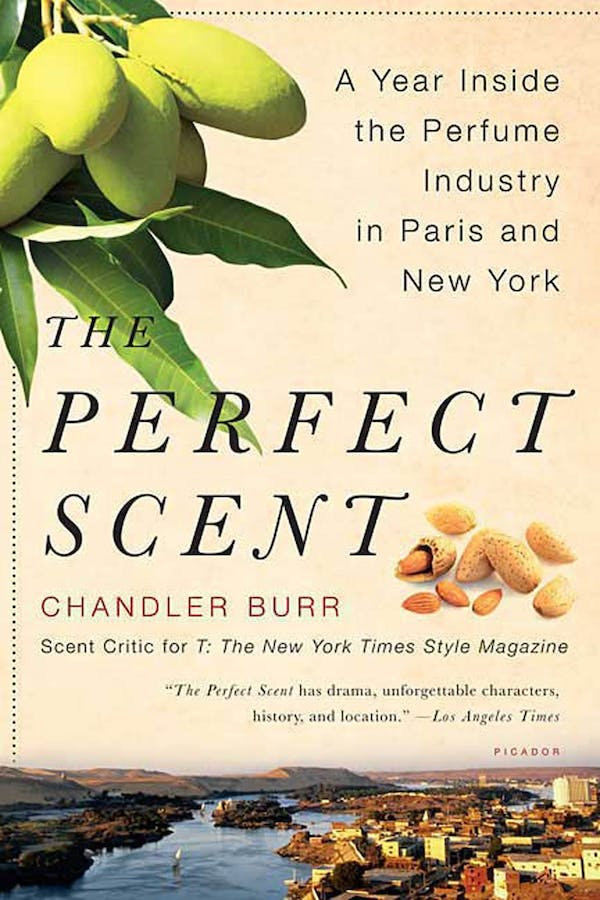
Book cover of The Perfect Scent by Chandler Burr
The Perfect Scent; image from macmillan.com.

A classic example of how tropical fruits may be used in fragrance is CK One, often presented as a summer scent — so much so, that the brand frequently issues a summer flanker of CK One. It includes pineapple and papaya among its top notes, with citrus fruits such as lemon, bergamot, and mandarin orange.

Bottle of CK One fragrance with fruits, flowers, other notes
CK One; image from highstreetpakistan.com

The full list of notes, per Fragrantica, is: top notes of Lemon, Green Notes, Bergamot, Mandarin Orange, Pineapple, Cardamom and Papaya; middle notes of Lily-of-the-Valley, Jasmine, Violet, Nutmeg, Rose, Orris Root and Freesia; base notes of Green Accord, Musk, Cedar, Sandalwood, Oakmoss, Green Tea and Amber. Created by Alberto Morillas and Harry Fremont, launched in 1994, M. Morillas has said it may be his favorite of the hundreds of fragrances he has created, in a 2022 interview with Fragrantica’s Patric Rhys:

“I created this perfume for the States, but it’s a very European style, my style – the Spanish style. It’s very fresh, easy to wear, but it can be appropriated. It smells different on each skin, when a man wears it, when a woman wears it… And for me, it’s still very modern, and doesn’t smell old fashioned, but of the actual time.”

I would agree — CK One is still modern, fresh, and unisex. I don’t find the pineapple to be a main player in the opening, though — the citrus fruits dominate. However, I think the pineapple accord contributes to the sweetness they convey in CK One in addition to the usual citrusy brightness. CK One moves through its opening stage quite rapidly; the heart notes are mostly floral, at least on my skin. To my nose, the combination of base notes just adds up to “green and woody” and I can’t say that I really detect separate notes. All in all, CK One doesn’t last very long, but the journey is very pleasant and does bring to mind a sunny vacation.

M. Morillas likes it so much that when he was asked to name the three fragrances he would want to keep personally, of all his creations, if he could only have those three, he named CK One first, saying that it captures his “sunny personality.”

In a 2017 interview with blogger Richard Goller at Fragroom.com, M. Morillas explained how he has used tropical fruits in creating summer flankers of L’Eau d’Issey, which was originally created by his friend Jacques Cavallier:

“Both the masculine and the feminine Eau d’Issey personalities remain so distinctive I can play with new modern freshness by inviting novel ingredients into the composition, while staying true to their unique signatures. Pineapple and kiwi bring the new exotic twist to the masculine scent. Summer is also played by exotic fruits for the feminine version. I introduced a new invigorating brightness throughout the colourful cocktail of dragon fruit, mango and guava.”

Another fragrance with a detectable pineapple note is Birmane, by Van Cleef & Arpels. Unlike CK One or many other scents using tropical fruits, it is not meant to be a summery or beachy fragrance. Now discontinued, I’ve read that it was designed as a “light oriental”. It is lovely! “Birmane” means Burmese, i.e. from the country now known as Myanmar and formerly known as Burma. Myanmar does in fact have a tropical climate and sits in the monsoon region of Asia; it is a top producer of tropical fruits. I suspect this is why Birmane was created as a “light” oriental fragrance, with no spice notes (more characteristic of scents meant to evoke the Middle East). Top notes include bergamot, pineapple, rosewood and lemon. The heart has notes of rose, orchid, iris, and heliotrope. The base notes include vanilla, tonka, sandalwood, and musk. Orchids, of course, are tropical flowers, and vanilla also comes from an orchid that grows in tropical environments.
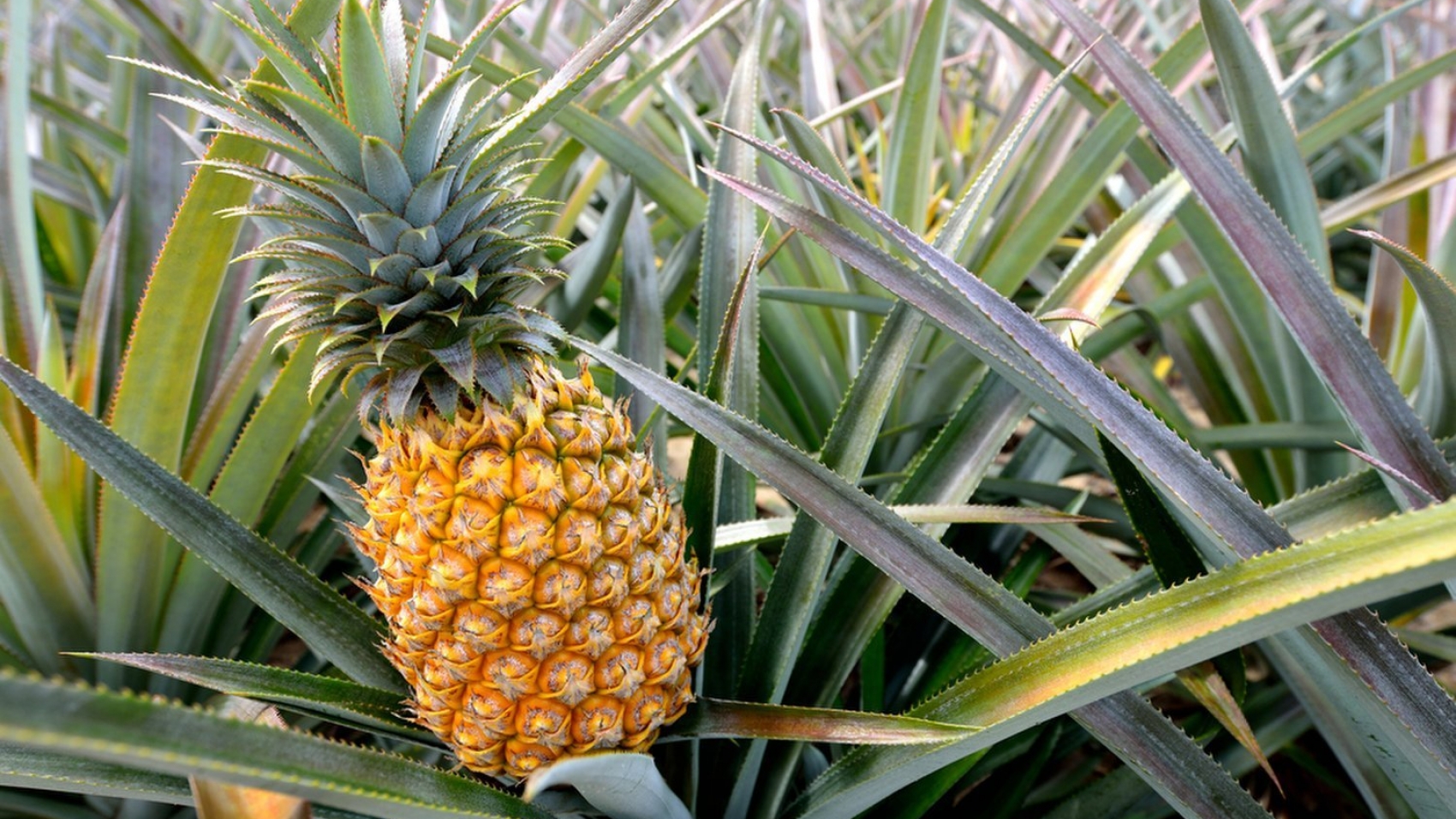
Pineapple fruit growing in Myanmar
Pineapple growing in Myanmar

Birmane was launched in 1999, which is interesting as it smells to me more like a classic fragrance of an earlier era. Not musty at all, no aldehydes, but it is rich and multi-layered in a way that was starting to go out of style among designer fragrances in the 1990s. As it dries down, the fruits give way to the flowers which then give way to sandalwood with a touch of vanilla and warm musk. It’s a very soft, appealing fragrance when judiciously applied. I can see that it might be a bit overwhelming if heavily sprayed.

There are other, more famous fragrances that incorporate a pineapple accord: Creed’s Aventus is one, and Jean Patou’s Colony is another. I don’t own Aventus; I do have a bottle of Colony, from the Collection Heritage that perfumer Thomas Fontaine created to bring back some of the house’s legendary fragrances, but I haven’t discussed it here because it has been tucked away with some of my collection while we have some repairs done.

Do you have or love any pineapple fragrances? Or scents with any other tropical fruit(s)? And please jump over to Australian Perfume Junkies to get Portia’s “Notes on Notes”!
Notes on Notes logo
Notes on Notes; image by Portia Turbo.
Roses de Mai Marathon: Rose Goldea

Roses de Mai Marathon: Rose Goldea

Some fragrances just make you happy, from their packaging to their perfume. Bvlgari’s Rose Goldea is one of those for me. I love the color pink, but I especially love the less purply pinks, and I really love light pink with a sprinkle of gold. Ka-ching! Rose Goldea comes in the most beautiful boxes and bottles, with just that shade of pink; and the right fragrance to match. Continue reading

Scent Sample Sunday: Farmacia SS Annunziata dal 1561

Scent Sample Sunday: Farmacia SS Annunziata dal 1561

Florence is full of wonderful stores and boutiques in historic locations and buildings, but some of the businesses themselves are also historic. One of them is Farmacia Santissima (“SS”) Annunziata dal 1561, an Italian apothecary and perfumery that dates back to the 16th century. The perfumery creates its own fragrances as well as cosmetics and lotions. It has its own page on Fragrantica, with 33 perfumes listed there. I was able to visit the actual store a few weeks ago, on a long-awaited first trip to Florence, and it was well worth it! I discovered its existence thanks to a wonderful article by The Perfume Society about perfume-shopping in Florence.

The Farmacia is right around the corner from Florence’s Galleria dell’Accademia, home of Michelangelo’s David, which we were able to see early in the morning, at the first opening of the museum. We were the first visitors into the gallery that day, which was an unforgettable experience — looking down the whole length of the beautiful gallery at that magnificent statue, without anyone else in sight, then slowly approaching it and realizing just how tall David is. It reminded me, in reverse, of how much smaller the painted Mona Lisa looks in real life than how one imagined.

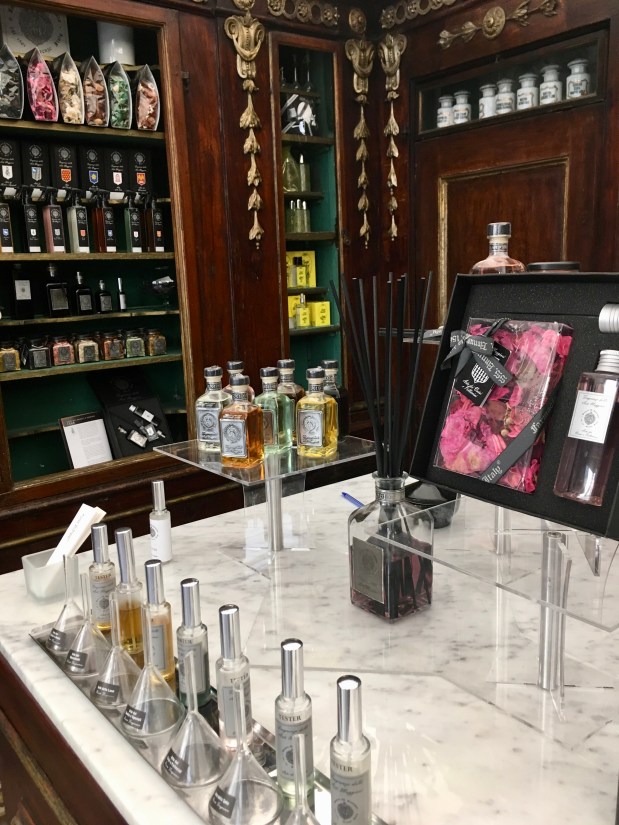
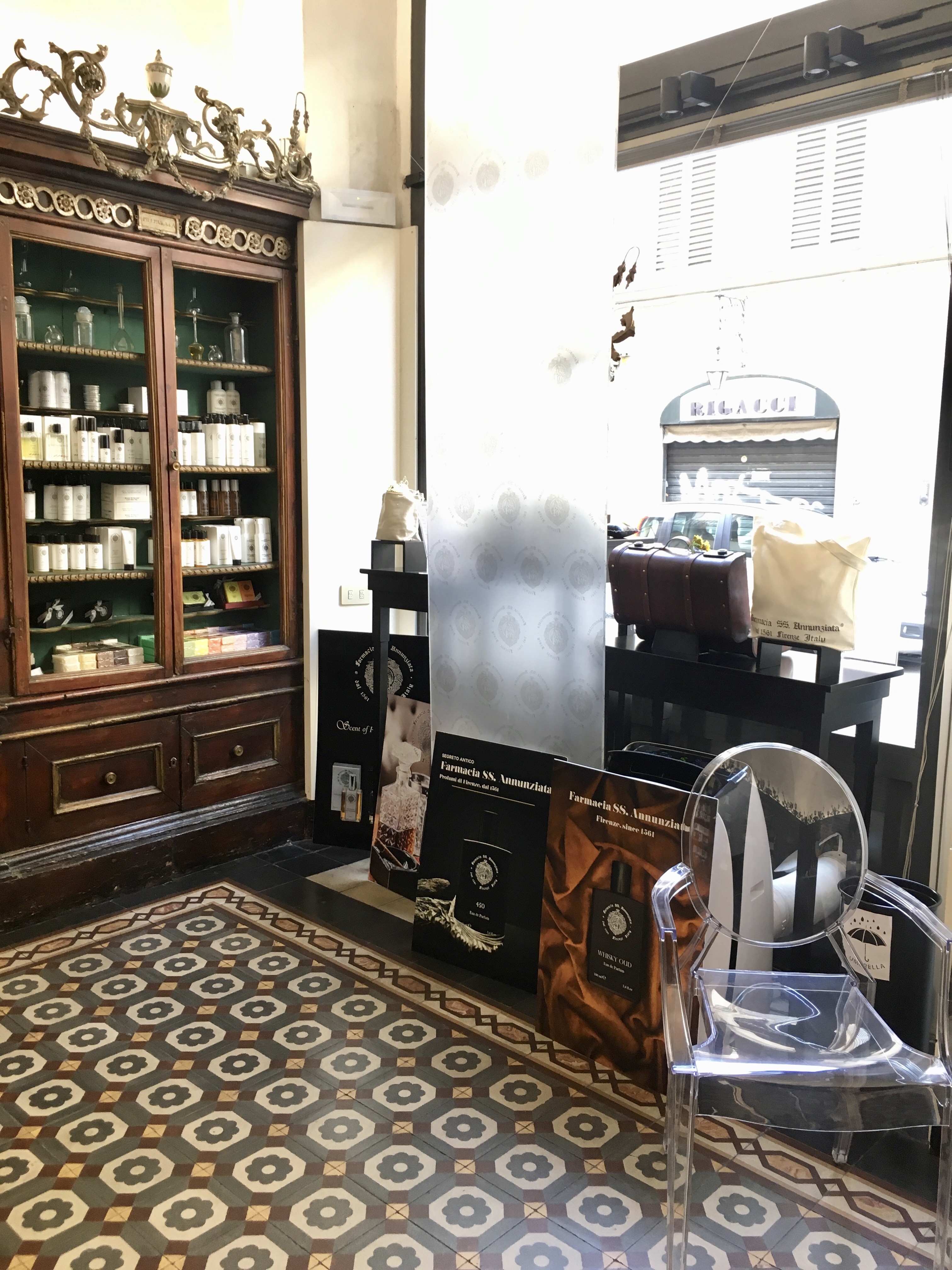
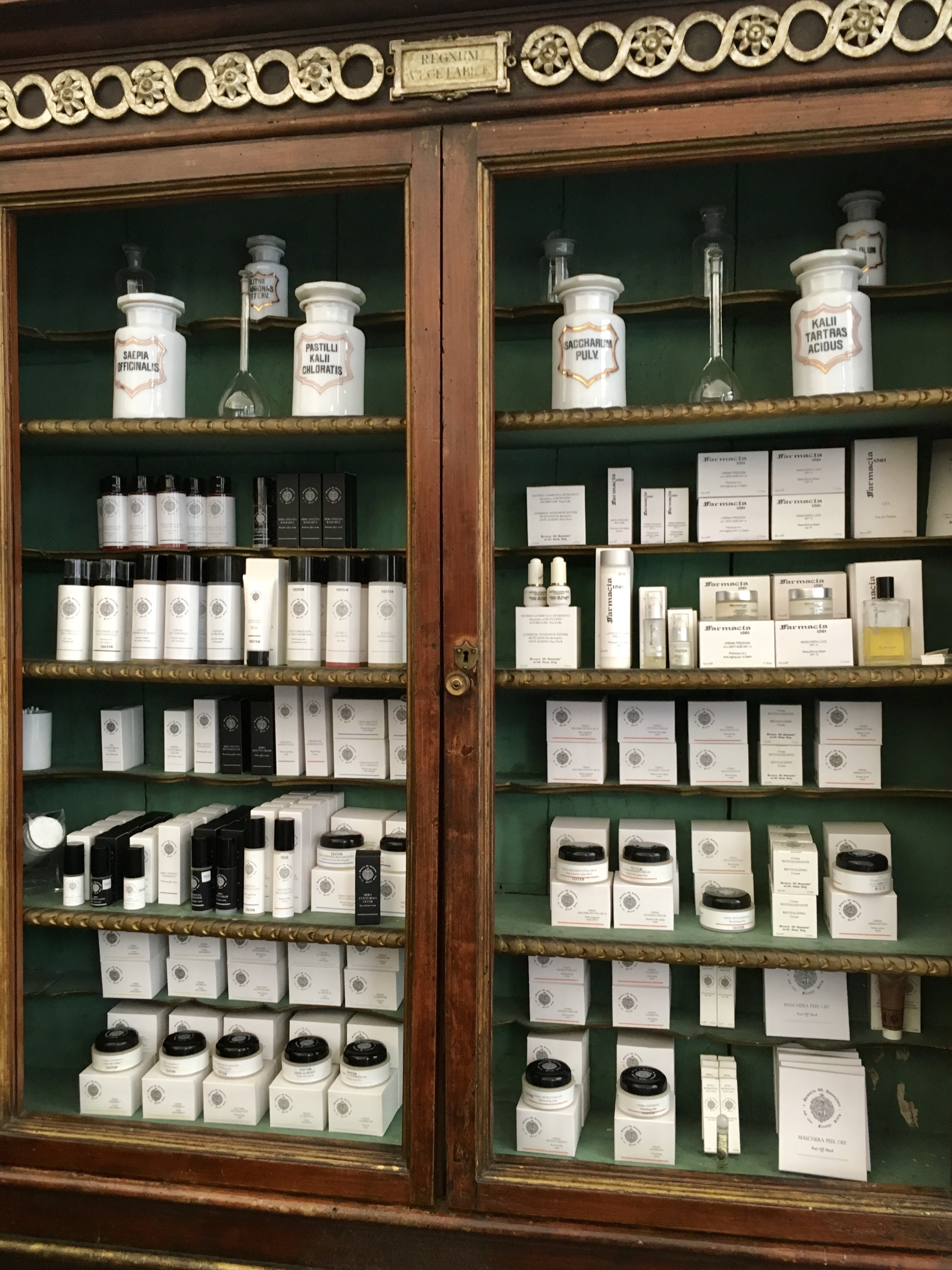
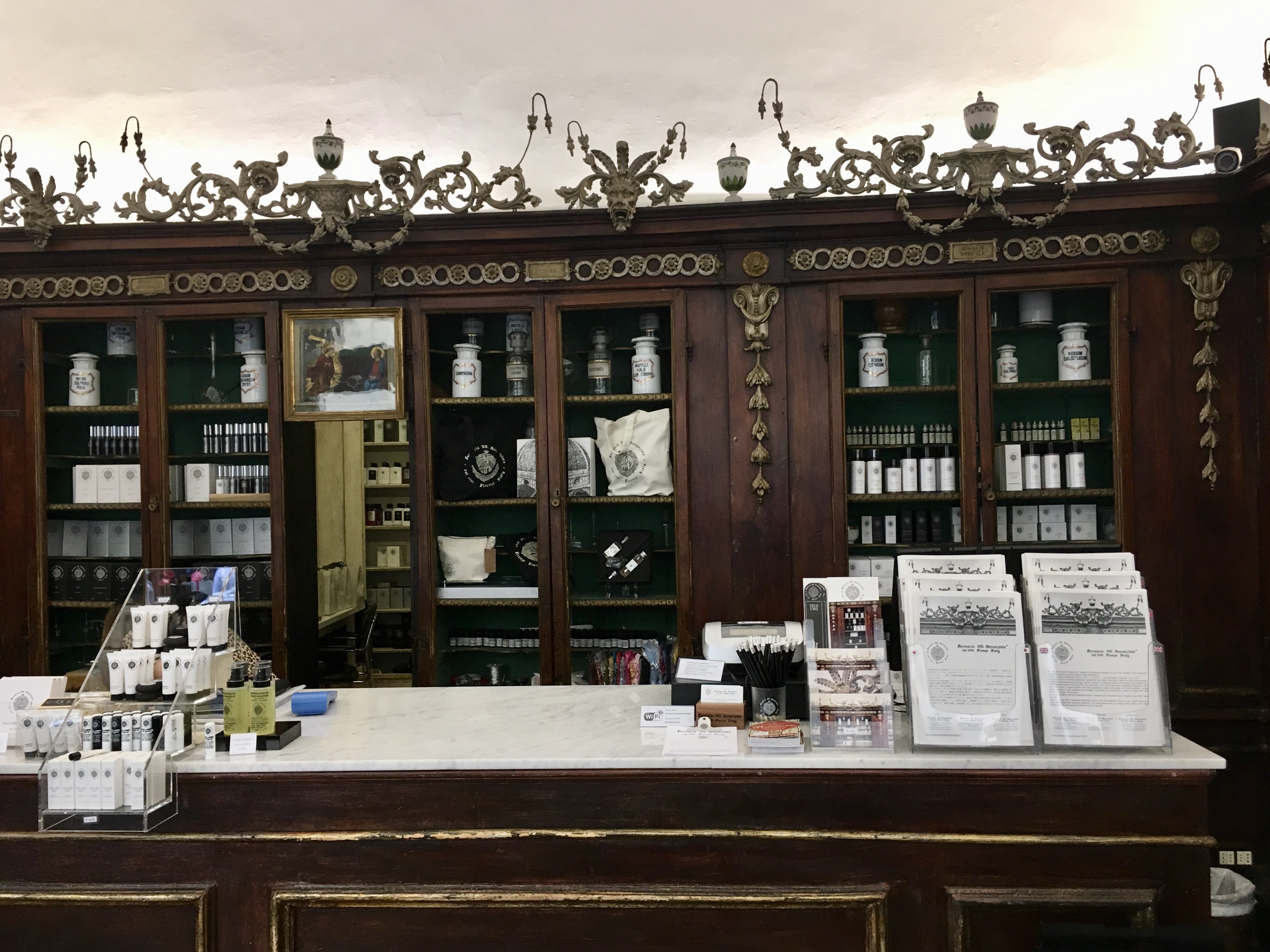
The store itself is charming and beautiful. It is paneled on every wall with floor-to-ceiling cabinets full of bottles and jars, and it has a gorgeous long counter across almost the full length of the back. The staff are friendly, knowledgeable, and fluent in English. Honestly, just visiting the store was a treat in itself. But of course, I couldn’t resist trying several of the fragrances!

img_9175

Bottles of products at Farmacia SS Annunziata dal 1561

One I particularly liked is Regina, an eau de toilette with notes of rose, unnamed “floral notes”, ylang-ylang, honey, rice, amber, iris, and chamomile. The most prominent notes are iris, rice, and honey, but ylang-ylang and chamomile are noticeable also. The strongest impression I get from it on my skin is that of a lovely, flowery powder. It is soft and honeyed without being sugary. The iris note is based, of course, on Florentine iris, a traditional and costly source of the prized orris butter that goes into many fragrances; its preeminence in Regina is a beautiful remembrance of lovely Florence.

I don’t really smell rose in isolation from the other notes; in fact, when I first spray Regina, I smell iris right away. But it is an iris supported by other flowers, so I’m sure the rose is there! The ylang-ylang adds a polleny yellow flower aspect to the scent, which enhances the notes of rice and honey, lending Regina a golden tone that is both light and warm.

This is an unusual combination of notes, especially with the chamomile that is so rarely used today in fragrances. One exception is the much commented-on recent release from Gucci, Memoire d’Une Odeur, which I tried the other day and liked very much; there has been a lot of online chatter about Alberto Morillas’ use of chamomile in that fragrance. I love green and herbal notes in fragrance, so chamomile appeals to me (and I like chamomile tea, so I’m predisposed to like it as a scent). Regina feels quite linear to my nose, which I don’t mind at all because it is such a pretty, appealing scent.

When we visited Florence and the Farmacia, Italy was suffering from the same heat wave that affected all of Europe in late July. Upon our return, the weather here at home has been almost as hot, and twice as humid. Regina is an ideal summer fragrance, with its light touch and notes of summery blossoms. It has a base note of amber, but this amber is delicate and does not overwhelm or overpower the rice, powder, and summer flowers. I often turn to one of Hermes’ Jardin fragrances in this kind of heat, or Penhaligon’s Blasted Bloom, as they both have a cooling, refreshing effect, but Regina will join my regular summer rotation.

Blogger Kafkaesque has written about Farmacia SS. Annunziata, noting the quality and reasonable prices of its fragrances. Have you tried any of them? If you were to choose a fragrance for a hot summer day in Florence, what would you choose?

img_9174

Thunking Thursday: Gucci Bloom Nettare di Fiori

In full candor, I haven’t QUITE thunked this yet, as of this morning, but will have done so by tonight! Gucci Bloom Nettare di Fiori is my thunk of the week, and it’s lovely. It is described as more intense and darker than the original Gucci Bloom, with additional notes of rose, ginger, osmanthus and patchouli. I experience it as somehow “fresher” than Bloom, and I think it’s because of the ginger. Also, while the tuberose is still prominent, to my nose it is toned down a bit in Nettare di Fiori; and that makes it seem lighter to me.

No surprise to me, the nose behind it is M. Alberto Morillas, whose fragrances rarely disappoint me (for instance, I love Blasted Bloom). As with Bloom, I don’t feel an urgent need to own a full bottle of Nettare di Fiori, but I have really enjoyed my sample! And I fully intend to thunk the rest of it today. How about you?

Fragrance Friday: Fragrance Fantasy

Fragrance Friday: Fragrance Fantasy

For something completely unique, however, there’s Penhaligon’s Bespoke by Alberto Morillas, spearheaded by the man behind some of the world’s most recognisable scents including Calvin Klein’s CK One, Tommy Hilfiger’s Tommy and Marc Jacobs’s Daisy. Comprising eight months of trial-and-error testing and costing from £35,000, it’s a process that requires both a significant monetary and…

Oh, how I long to be able to do this, given how often I have gravitated to Penhaligon’s fragrances! Alas, it will remain nothing more than a lovely fantasy. What choices would you make, if you pursued the less expensive option of having specific bases and notes combined for you, as described in the article? I am consoling myself with a few photos from my visit to the Penhaligon’s boutique in the Burlington Arcade last fall, and a few spritzes of my beloved Blasted Bloom.

via A significant monetary and personal commitment — Now Smell This

Fragrance Friday: Custo Barcelona L’Eau

Fragrance Friday: Custo Barcelona L’Eau

It was a long week. My husband had to be out of the country all week on business and I had to resolve a very challenging situation at work with lots of ramifications. But now it’s Friday! My work challenge appears to be successfully resolved; and my nice husband is home, bearing gifts from Barcelona. For me: a large bottle of Custo Barcelona L’Eau. Lovely!

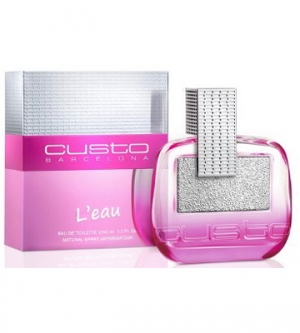
Custo Barcelona is a fashion firm that was born in Barcelona. Its style is young, funky, colorful and cheerful. So is its fragrance. According to various websites, CB L’Eau is supposed to be a lighter version of the original Custo Barcelona fragrance that came out in 2008. The same “nose”, Alberto Morillas, developed both. For L’Eau, the top notes are bergamot, grapefruit and galbanum. Heart notes are peony, jasmine and “exotic fruits.” Base notes are musk, tonka bean, woody notes. It smells very European to me but not French.   Catalan, perhaps! Definitely a citrusy floral with woody undertones: bright, cheerful, feminine, warm.

Custo Barcelona fashions, from Photoquivir 2015.

Custo Barcelona fashions, from Photoquivir 2015.

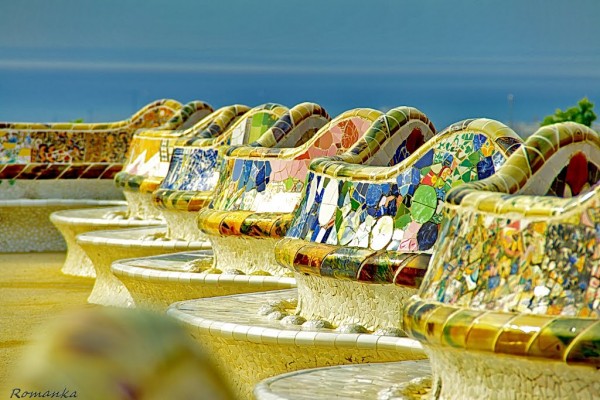
I love Barcelona, especially the Barri Gotic and the Eixample neighborhood. I love the food, especially the fresh seafood, the tapas and the different kinds of sangria.I love Antonio Gaudi’s architecture there, including the stunning Sagrada Familia cathedral, still unfinished; his signature curves, bright colors and fanciful patterns have clearly influenced later Barcelona designers like Custo Barcelona and Desigual. And Custo Barcelona L’Eau definitely evokes the city, with its playful vibe layered over complexities. It reminds me of the Parc Guell, a Gaudi masterpiece and fantastical park with gardens, mosaics and fanciful structures. The gardens contain fragrant herbs, trees, and flowers. Some of its trees are tropical; some bear fruit. The blog In Search of a Thousand Cafes describes it well, with many lovely photos, including the one above.

CB L’Eau starts off bright and juicy, but the galbanum top note gives it a green, herbal astringency that cuts the sweetness of the citrus notes. It slowly blossoms into a light, fruity floral — more flowers than fruits, which I like. This part of its progression matches the bright pink of the peony notes and the pretty bottle.

Custo Barcelona L'Eau

I love how the shape of the bottle matches the typography of the design house’s logo. The bottle is really unique, with its textured metallic inset of silver, asymmetrical cap and ombre tinted pink glass. The last phase of CB L’Eau is lightly musky, with sweetness from the tonka bean and dryness from the woody notes. I can still smell the base notes on my wrist ten hours after first spraying myself. All in all, a delightful gift from a delightful man! I’m grateful to have both.

Parc Guell benches: photo by TileMosaicGirl.com

Parc Guell benches: photo by TileMosaicGirl.com