I promise I won’t spend the whole month of May dissecting Zara Emotions fragrances, but here’s another one: Bohemian Bluebells. I like it very much and it’s certainly affordable! Also truly unisex, I think it would smell wonderful on a man as well as a woman. Its listed notes are lavender, sandalwood, and musk (nothing to do with bluebells). If you can imagine a warm lavender, that’s what it smells like to me. I do tend to associate lavender with bedtime, given its soothing properties, but I don’t usually associate it with warmth in spite of its cultivation in hot, sunny climates like Provence (there are also famous lavender fields in England and other parts of the UK). Sometimes I crave Jicky eau de toilette at bedtime, if I’m going to sit up and read for a while, but Jicky feels cool to me somehow, like the clean sheets that have been newly put on a bed, with their crisp, unwrinkled surfaces.
“Melange” is an apt word to use for Estee Lauder’s Beyond Paradise, as it is truly a melange of different florals. In their book “Perfumes: The Guide A-Z”, Luca Turin and Tania Sanchez not only gave it five stars, but also close to three full pages of discussion (most perfumes got a paragraph). He calls it a “symphonic floral.” Calice Becker was the perfumer who created it; Beyond Paradise was launched in 2003. The bottle I have is the teardrop-shaped, rainbow-tinted original. The batch number on the bottom suggests it dates to 2013. Fragrantica lists that version’s notes as: Top notes of Hyacinth, Orange Blossom, Grapefruit, Bergamot and Lemon; middle notes of Jasmine, Gardenia, Honeysuckle and Orchid; base notes of Hibiscus, Plum Wood, Ambrette (Musk Mallow) and Amber. The 2015 version in the rectangular bottle is described as having top notes of Blue Hyacinth, Orange Blossom and Jabuticaba; middle notes of Honeysuckle, Jasmine, Orchid and Mahonia; and base notes of Ambrette (Musk Mallow), Plum Blossom, Paperbark, and Woody Notes.
Both versions of Beyond Paradise are meant to be “fantasy florals” with a tropical theme; part of the length of Turin’s review is a long digression into the nature of abstract floral fragrances and how challenging they are to create, with a tip of the hat to perfumer Calice Becker, an acknowledged master of the art. According to contemporaneous press and PR coverage when it was launched, it included “proprietary notes” gleaned from a collaboration with The Eden Project, a fascinating conservation site in Cornwall, which involves massive biospheres located in and above an abandoned quarry and which I’ve had the privilege to visit. It does in fact house many rare and tropical plants, so it must be a great resource for unusual smells.
Today is Mother’s Day in the US, and I’m thinking of my own late mother and the perfume I associate most with her, Chanel No.5. No.5 is 100 years old this year, having been launched by the house of Chanel in 1921, which hardly seems possible! Here is the wonderful video Chanel released this year to celebrate No.5‘s centennial:
The version I have is the eau de toilette; in fact, it is the last bottle of No.5 that my mother owned. I brought it home with me, with its few ml of fragrance left, after her funeral and clearing out her home. Wearing a few drops now on the back of my hand, I can still smell how beautiful it is, and think peacefully of my mom.
I wrote about her and No.5 five years ago, in “My Mother’s Last Perfume“. She died in May of 2017; if she were still alive, she would be turning 90 this year — only ten years younger than No.5! We held her memorial service in July of 2017, so that all members of the family could be there, and a memory I find very consoling is that I took charge of working with the florist for the church service. I used to help my mother arrange flowers as part of the church’s “Flower Guild”, a volunteer role that she took very seriously, albeit with some humor. She loved to recount how long it took her to win the approval of the older women in the Flower Guild when she first wanted to join, in spite of her being a member of the church’s vestry! They only let her cut off the ends of stems and hand them the flowers for months.
Because of those companionable times we spent together arranging flowers, I knew her strong likes and dislikes — I don’t think my mom had any likes or dislikes that were anything but strong. I remember telling the florist that we could not have gladioli under any circumstances, because my mom hated them with a passion and she would return from the grave to haunt us all if we had them at her memorial. I was so pleased with our final selections: the roses and lilies she loved; Bells of Ireland, to recall her Anglo-Irish roots and her beloved aunts and grandmother, with whom she spent school holidays; eucalyptus as a reference to her birthplace of New Zealand; and other fragrant flowers, some of which are notes in No.5.
Because I started buying her No.5 in the 1970s, as a child, the version I recall most has the original notes (though I think by then the civet was synthetic): top notes of Aldehydes, Ylang-Ylang, Neroli, Amalfi Lemon and Bergamot; middle notes of Iris, Jasmine, Rose, Orris Root and Lily-of-the-Valley; base notes of Civet, Sandalwood, Musk, Oakmoss, Vetiver, Amber, Vanilla and Patchouli. I’m not sure of the date of the eau de toilette of hers I now have, but it’s probably from the early 2000s. And after an initial “off” opening, it is just lovely.
The aldehydes have survived the passage of time, as have the ylang-ylang and much of the neroli. Lemon and bergamot are no longer detectable. The notes of jasmine and rose are most prominent to my nose in the heart phase, with a gorgeous powdery softness provided by the iris and orris root. I can detect the lily-of-the-valley faintly, but just barely. The drydown is also lovely: it just keeps getting warmer, softer, and sexier, with those beautiful base notes. As many have noted, No. 5 is so well-blended, it is almost abstract. While it is possible to detect single notes, the overall impression is not of a particular flower, which is what perfumer Ernest Beaux and Mme. Chanel intended. No.5 is simply itself, and it is unmistakable to this day.
I don’t often wear No.5, as beautiful as it is, because I do associate it so much with my mom; but I use and love No.5 Eau Premiere as well as No.5 L’Eau. Blogger Neil Chapman of The Black Narcissus described the trio so well in his book “Perfume: In Search of Your Signature Scent” (which I highly, highly recommend!):
Chanel’s enduring, glamorous icon is a scintillation of aldehydes, rose de mai, ylang ylang, orris, jasmine and vanilla (among many other ingredients) — a caress of timeless, confident femininity…. Successful recent reiterations of the No.5 brand that aim to appeal to the younger consumer include Eau Premiere (2007) — which I like for its streamlined primness and muted, statuesque lightness that works convincingly as a chilled, contemporary flanker of the original — and No.5 L’Eau in 2016, which smells as peachy and rosy as the dawn.
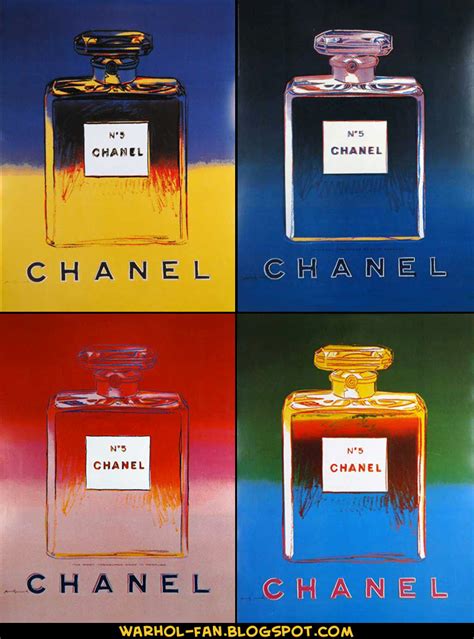
I can’t think of another perfume that has had the famous Any Warhol portrait treatment, can you? Do you like No.5, in any of its current versions or flankers? And happy Mother’s Day to all who are celebrating it today!
Chanel No.5 portraits by Andy Warhol; image from Fragrantica.com.
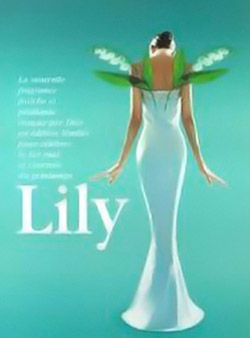
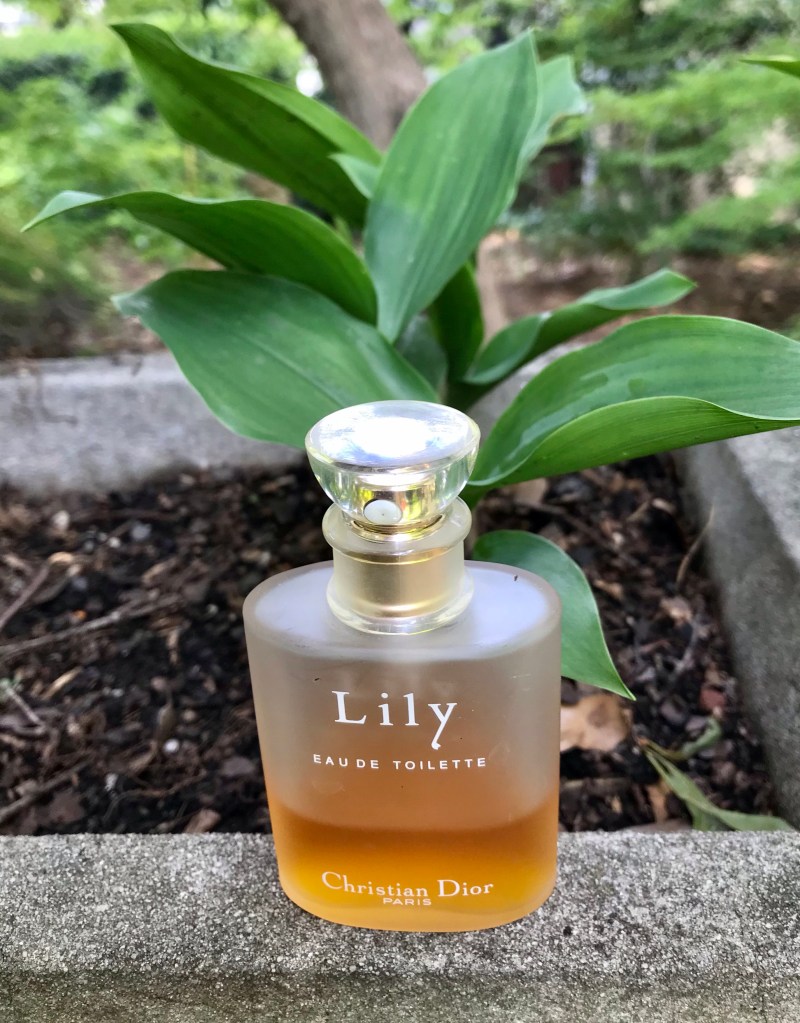
Parfums Christian Dior is responsible for possibly the most famous muguet fragrance of all time, Diorissimo. A less-known, discontinued muguet fragrance by Dior is the lovely Lily, launched in 1999. The perfumer behind it is Florence Idier, who also created Comme des Garcons’ Series 1 Leaves: Lily, another lily-of-the-valley fragrance. There is another fragrance called Lily Dior, but the one I have is just called Lily; it is an eau de toilette.
Lily, by Parfums Christian Dior; image from Fragrantica
Fragrantica (which has a photo of the wrong bottle on this fragrance’s page, btw; it shows 2004’s Lily Dior) lists its notes as: Top notes are Green Notes, Fruity Notes, Bergamot and Brazilian Rosewood; middle notes are Lily-of-the-Valley, Lilac, Lily, Jasmine and Rose; base notes are Musk and Sandalwood.
I acquired my bottle of Lily within the past year, so it has never featured in my frequent “May Muguet Marathon.” It wouldn’t be May for me without some reviews of muguet fragrances! I like Lily very much, and if I didn’t already have several true-love muguet fragrances, it would be among my top dozen. Even as a vintage eau de toilette, its top notes are clear and strong, with a noticeable fruit note at the start that reminds me of a green pear. The only listed top note that I don’t really smell is the rosewood; the opening is very fresh and green.
The lily-of-the valley note steps forward quickly and it is very natural-smelling (although LOTV notes famously rely on clever combinations of other substances, as the flowers’ natural essence cannot be extracted). The companion notes of lilac and jasmine are evident, with the lilac slightly more obvious than the jasmine. At this stage, Lily reminds me a lot of the 1998 version of Guerlain’s Muguet, which was created by Jean-Paul Guerlain and launched the year before Lily.
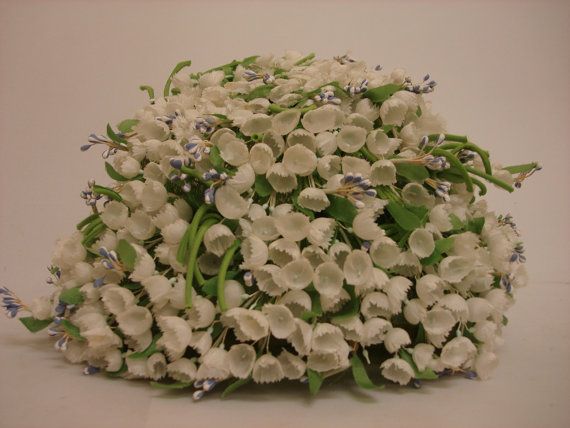
Hmmm. The list of notes for each fragrance is almost identical, according to Fragrantica. The clear presence of both lilac and jasmine in the middle stage, as part of the evocation of lily-of-the-valley, is very similar in each fragrance. Lily‘s opening is distinctive, though, with that green pear note that gives it some zing together with the bergamot. I’m going to give Parfums Dior the benefit of the doubt here, though: Christian Dior’s association with the muguet, his favorite flower, goes back decades and prompted the creation of Diorissimo; the flower appeared regularly in Dior fashions: dresses, scarves, hats, jewelry, and apparently he had a tradition of giving sprigs of lilies-of-the-valley to employees every May Day, which the fashion house continues to this day. Don’t you just love this hat?
Lily of the valley hat by Christian Dior
The Christian Dior name is also attached to a wide variety of household goods featuring lilies of the valley as his signature flower, everything from sheets to fine porcelain. A new collection of muguet-themed housewares was launched by Dior last year, and they are quite beautiful.
As my regular readers know, I truly love muguet fragrances. I struggle to grow them here in the South, as it really is too hot and humid here for them, but I have a few plants I have nursed along in dedicated planters on the shady edge of our front terrace, where I can keep them well-watered and mulched with the rich humus compost they love. Lily is very true to the natural scent of lilies-of-the-valley and it doesn’t smell soapy at all to my nose, unlike some LOTV fragrances. It doesn’t last more than a few hours, which is the norm for most muguet fragrances, especially in eau de toilette concentrations. While it lasts, though, it is very pretty. However, most of the prices you will see online for Lily are too high, considering that one can easily find lovely, newer, muguet fragrances that are more affordable, or at least fresh (see my “May Muguet Marathon” posts for some suggestions!).
For a lovely post on lily-of-the-valley scents, check out one of my favorite blogs, Bois de Jasmin. Its author, Victoria, mentions Dior’s Lily briefly in the comment section. She writes about muguet fragrances pretty regularly, as it is a favorite scent of hers. I know lily-of-the-valley scents can be polarizing; people tend to like them very much, as I do, or not at all. How do you feel about them?
Today’s floral is Serge Lutens’ La Vierge de Fer, which means “Iron Maiden” in English. The Iron Maiden was a notorious (though possibly apocryphal) medieval torture device, an upright metal box shaped like a person, in which spikes were set into the interior of the opening, which, when closed, would pierce a prisoner locked inside the device. Lovely.
I don’t follow Serge Lutens very closely although I have and appreciate several of his fragrances, and I would love to visit his boutique in the Palais-Royal in Paris some day. So I don’t really buy into the self-consciously arcane descriptions of his fragrances, but here is what the brand writes about La Vierge de Fer:
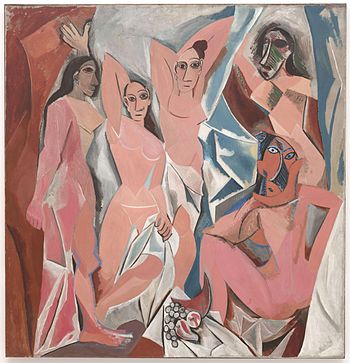
Let there be light! And darkness no more. He who wishes does not have a black soul! “I will come as a thief …” said Christ; certainly in silence and probably, for him, wearing shoes. To deserve his title, the Thief must act under the wide-open eye of the absent owners. In this case, it is not that tenuous eye with which Cain stares without regret, but another, which in some way will make an accomplice of Abel. If the fetishes, idols and charms of the Museum of Man, in Paris, had not met the 20th century, everyone would have missed that incredible mockery of Eros which The Young Ladies of Avignon certainly is. “The Negros had understood that everything which surrounds us is our enemy”, the wizard Picasso said to his paintbrush. Who, if not one of them, decided on life, by death, would dare, to unclench the teeth of this sex of the world: fear. Since it is the fruit of our entrails, it must be elevated. For that, not fearing incest, we will embrace it. In this way, she will give birth to our most beautiful monsters. That is how, a little rusty by dint of doubts, my steps have rejoined La vierge de fer (the Iron Maiden); that lily amongst the thorns.
Today’s fragrance is a true “melange”, from the Zara Emotions line, a series of fragrances created by the perfumer Jo Malone for Zara, the clothing retailer that is known for its inexpensive yet effective fragrances. In interviews, Ms. Malone has said that the line uses raw ingredients similar to the ones she uses in her own (much more expensive) line, Jo Loves, taking advantage of Zara’s enormous global buying power; there are just fewer separate ingredients in each Zara Emotions fragrance. The Zara Emotions fragrances are pretty simple but several are very appealing, and they are designed to be easy to layer with each other. So today, I am wearing one of the brand’s recommended combinations, Waterlily Tea Dress and Amalfi Sunray.
Not quite as legendary as some other Guerlains, Chamade nonetheless has its passionate devotees. Luca Turin gave it five stars in the original “Perfumes: The A-Z Guide”, though it’s not clear whether he was reviewing parfum or eau de toilette. The most recent version I have is the eau de toilette in the “bee bottle”; it has recently been reissued by Guerlain as part of its 2021 “Patrimoine Collection”, for which six of its most famous fragrances have been bottled in the design of the original Mitsouko bottle with its hollowed heart stopper. (The list of notes for the reissued Chamade, by the way, is much shorter than that for the original, and puts some of them in a different order).
Originally created by Jean-Paul Guerlain in 1969, Chamade seems to have been an attempt to bridge earlier generations of Guerlain fragrances to a new generation of fragrance that would appeal to the ascendant youth culture, catering to the Baby Boomers who entered their 20s during the 1960s. Chamade is by no means an avant-garde or hippie scent, though. It reminds me of the most senior girls at the Belgian convent school I attended for a couple of years as a young child — young ladies from good families, many of them minor aristocrats, who were picked up after school on Fridays by dashing, slightly older boyfriends driving small sports cars. The senior girls were also allowed to change out of their school uniforms on Friday afternoons, and I have a dim memory of admiring their bright A-line dresses: ladylike, expensive, but youthful. That is how Chamade strikes me: like the kind of fragrance a chic European mother or grandmother would have given then to an 18 year-old as her “first Guerlain.”
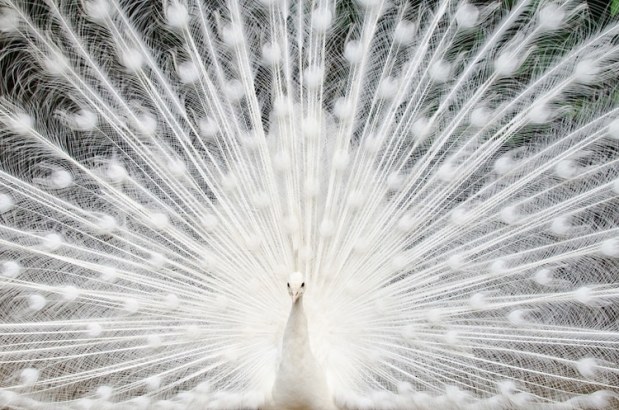
D.S. & Durga is a niche brand I haven’t experienced very much, partly because of their price point (high, even for samples). But when I had an opportunity to buy a reasonably priced decant of White Peacock Lily, I jumped at it, because it sounded so intriguing when it was launched in 2016. It is indeed a very lovely lily-focused fragrance. Its notes include: Top notes of Oleander, Cabreuva Rouge, and Grapefruit Pith; middle notes of White Lily, Egyptian Jasmine, Cream and “Alabaster Violet” (which I assume means white violet); base notes of Ambrette (Musk Mallow), Vanilla, and Fog. The perfumer, D.S. of D.S. & Durga, also mentions on the website that it has notes of bergamot, melon, and rose Otto.
One thing I like about the brand’s website is that each fragrance comes with detailed “liner notes”, describing the inspiration for it, with references to literature, music, etc. The liner notes for White Peacock Lily state:
The piece that inspired this perfume is called “The White Peacock” by Fiona Macleod — a Scottish woman famous throughout the highlands for her dreamy works—and set to music by Griffes. It is one of the few tone poems based on an actual poem. The music, scored for a small orchestra, takes direction from the words. Mercurial/magic harps, winding strings, quirky brass horns, and the comical buzz of clarinets describe the beautifully soft language: “cliffs of basalt, fronds of cactus, where the bulbul singeth, cream-white poppies.” In Griffes music, the listener can hear the cream white poppies, the sweeping seas of flowers, and most important the silent noble glide of the grand bird that floats above the fields of flowers.
The composer mentioned is unfamiliar to me: Charles Tomlinson Griffes. Sadly, he died of pneumonia at the age of 35, at the outset of a very promising career, in 1920 at the height of the last century’s global pandemic, influenza. Apparently one of a few of his works that are still performed is “The White Peacock”, inspiration for today’s “May Melange Marathon” fragrance.
As regulars here know, in addition to being somewhat obsessed with fragrance, I’m also a gardener. I would say, perhaps, a longtime or experienced gardener, except that one is brought up short by Thomas Jefferson, who wrote to a friend: “Tho’ an old man, I am but a young gardener.” So true! One is always learning in a garden, always making new discoveries.
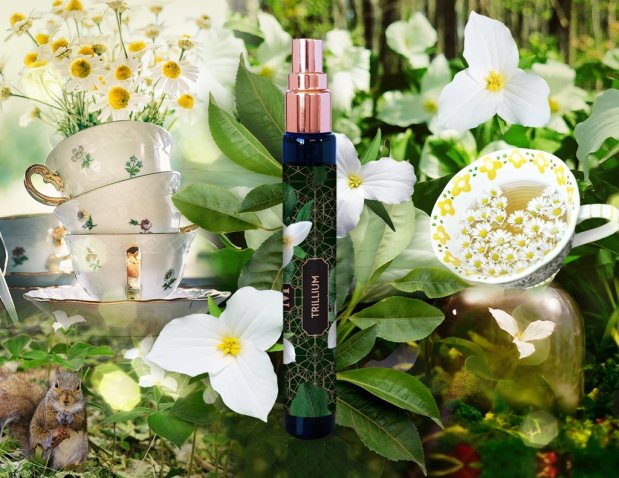
However, the house we bought so many years ago (our first and only) came with an old garden that had been lovingly cultivated over decades by a couple who raised their own family here. They were master gardeners, and a former neighbor who knew them told me that she thought the husband had actually been a landscape architect. For years after we first moved in, every season brought new discoveries of their plantings and how cleverly they had designed and planted our garden. One such discovery was a planting of the American native wildflower, the trillium. I call it a discovery because trilliums famously appear suddenly in the early spring, then go dormant and disappear completely until the next year. I was so surprised when I came across a large clump in the wooded, back part of our garden that had seemingly come out of nowhere, and then equally surprised when I went back several weeks later and it was completely gone, like magic.
Happy May Day, and welcome to the May Melange Marathon! In previous years, I have written blogging marathons in the month of May, celebrating the lovely lily of the valley in a “May Muguet Marathon“, and my beloved roses in a “Roses de Mai Marathon.” This year, I wanted to write about a number of the green fragrances I love, but I didn’t think I had enough to post about one daily for 31 days. Also, I have some new (to me) muguet and rose fragrances. So the solution is to go with the theme of “April showers bring May flowers” and write about a melange of scents that evoke different aspects of a garden, with a mix of florals and greens.
First up: Christian Dior’s La Colle Noire. Launched in 2016, it is named for the Provence estate of designer Christian Dior, outside the legendary perfume city of Grasse. One of the reasons that Grasse became so important in perfumery is the abundance and quality of the roses that are grown there for their essential oil, especially the “Rose de Mai”, or centifolia rose, also known as the Provence rose. Perfumer Francois Demachy wrote of La Colle Noire:
“In the springtime, the Centifolia Rose takes over the garden of La Colle Noire, Christian Dior’s beloved home in the Grasse region. It is an extraordinary time, when the flower’s plump, honeyed and fruity scent lingers in the air. This fragrance is an ode to that magical place and the unique rose that grows in the land of my childhood.”






 Serenity Now Scents and Sensibilities