November’s “Counterpoint” fragrance is Estée Lauder’s Beyond Paradise, in its original bottle and formulation. In many ways, it is a unique fragrance: almost a hologram of an imaginary tropical flower.
Beyond Paradise by Estée Lauder; image by Portia Turbo.
1. How did you first encounter Estee Lauder Beyond Paradise, and what was your first impression?
Old Herbaceous: Like a few other scents I’ve described, I first encountered Beyond Paradise because Luca Turin and Tania Sanchez rated it with five stars in their book “Perfumes: The A-Z Guide.” That book was a big part of my going down the rabbit-hole with fragrance, and I sought out several of the five-star fragrances as part of educating myself and my sense of smell. Although Beyond Paradise is still available (though apparently discontinued now), what one usually finds is a reformulation dating from 2015, in a standardized rectangular clear glass bottle. The original, in the ovoid rainbow-tinted bottle, was launched in 2003, created by Calice Becker. That’s the one I sought, with eventual success.
My first impression was “Wow – white floral alert!”, though I wouldn’t describe it as the proverbial “Big White Floral” that strikes terror into so many perfumistas’ hearts (or noses). I have mixed feelings about white florals. I love many white floral notes and accords, like jasmine and gardenia, and their corresponding flowers in real life, especially outside. Many white flower fragrances smell more like hothouse plants, grown in humid greenhouses and conservatories, warm and somewhat stifling. I wonder if this is because many perfumers encounter the blooms of plants like jasmine and gardenia in those settings?
Interestingly, Beyond Paradise is supposed to have been inspired by the largest conservatory in Europe and the UK, possibly in the world: the Eden Project in Cornwall, which I’ve actually visited with my family some years ago.
The Eden Project, Cornwall
This origin is reflected in the 2003 list of its notes:
Top Notes: Eden’s Mist, Blue Hyacinth, Orange Flower Templar, Jabuticaba Fruit Middle Notes: Laelia Orchid, Crepe Jasmin, Mahonia Japonica, Pink Honeysuckle Base Notes: Natal Plum Blossoms, Ambrette Seed, Zebrano Wood, Golden Melaleuca Bark
The accord “Eden’s Mist” is supposed to be based on the scent of the air inside one of the Eden Project’s domes. More prosaically, Fragrantica gives the following notes list: Top notes: Hyacinth, Orange Blossom, Grapefruit, Bergamot and Lemon; middle notes are Jasmine, Gardenia, Honeysuckle and Orchid; base notes are Hibiscus, Plum Wood, Ambrette (Musk Mallow) and Amber.
Portia: Many years ago on my first visit to India after Varun had moved back to help run the families’ hotels, I was shopping in the Sydney Airport Duty Free for gifts to give him and the family. Because I’d spent some serious money the SA was unbelievably generous with the samples. One of those was a spray mini of Beyond Paradise. When I first sprayed it on me I couldn’t believe anything could smell so good and fell madly in love on the spot. Nothing in my history of loving perfumes prepared me for what Beyond Paradise is.
Funnily, when I arrived in India Varun loathed it. He couldn’t understand why I would want to smell exactly like the jasmine, tuberose and marigold that Indian women wore woven into their hair and that Indians gave to their deities’ statues.
Obviously I ignored him and wore the whole mini over the next two weeks. I think I bought my first bottle on the way home.
2. How would you describe the development of Estee Lauder Beyond Paradise?
Portia: JASMINE! with some other florals and a citrus burst running underneath. It’s so over the top I can’t help but laugh and then once that dies down I continue to huff my wrist and smile the smile of a happy perfumista. There is even a squeal-y urinous hit from the grapefruit and a breathy poopiness. To me this is the most French of the Lauder summer oeuvre. Definitely not the super clean of many American perfumes. There is the dewy cool fresh water aspect though, like the cold rivulets on a bottle of white wine.
How are marigolds not a note, I can smell their sharp funkiness clear as day.
While Beyond Paradise does have a trajectory it’s not a large one and the noted amber in the base seems to pass me by completely. There are some green broken branches or twigs, white flowers and shitloads of vegetal musks with still pretty hints of pithy citrus right to the end.
Old Herbaceous: Given that my first impression is of exotic flowers growing in a conservatory, I think my nose is actually picking up on “Eden’s Mist”. I don’t smell any hyacinth, and I couldn’t tell you what jaboticaba fruit smells like. The closest I can describe to what I smell at first is a combination of jasmine and tropical orchids. Although Mahonia japonica is listed as a middle note, I don’t smell that. I grow mahonias in my garden, and to me they smell most like lily of the valley. That’s not what I smell in Beyond Paradise. In fact, the whole development of Beyond Paradise most resembles its origin story: a walk through a fantasy conservatory with abstract, imaginary flowers. I agree with Portia, though, that of all the floral components, the strongest is a jasmine accord.
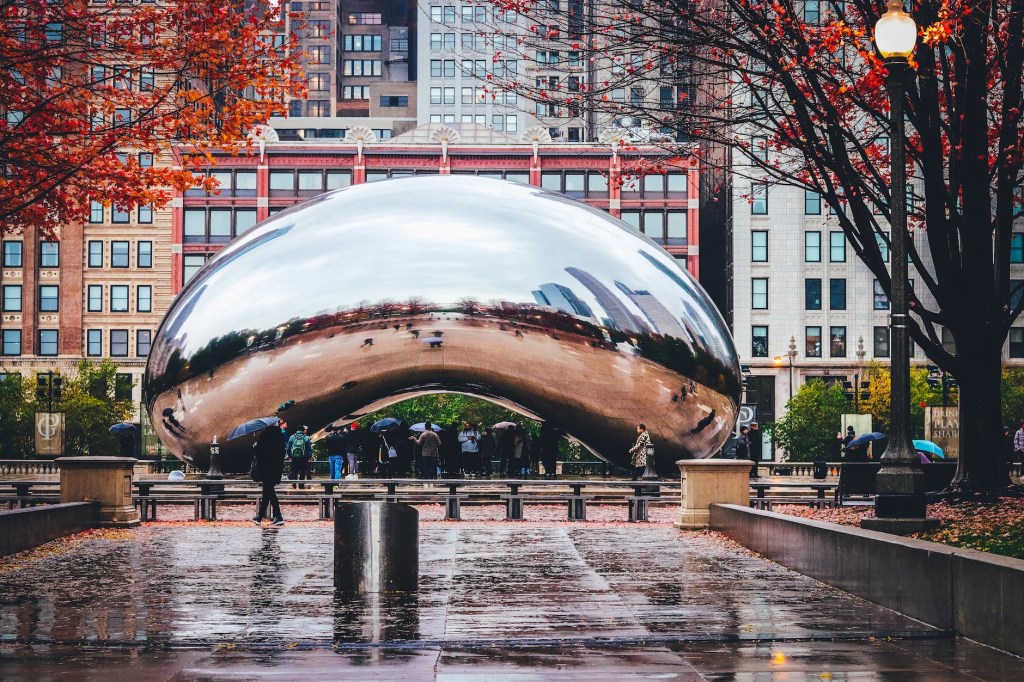
Lauder initially described the fragrance and its flankers as “prismatic florals”. The word “prismatic” usually refers to the image created when a prism refracts a beam of light, separating into its color constituents. I experience Beyond Paradise as a sort of prism in reverse, with its many notes coalescing into a smoothly abstract whole. The image that comes to my mind is the modern sculpture “Cloud Gate”, by Anish Kapoor, in Chicago’s Millennium Park. It is made up of almost two hundred stainless steel plates, welded together so seamlessly that it appears as an unbroken polished surface (shaped like a giant bean, which is its nickname). To my nose, Beyond Paradise is almost linear, though it warms slightly after about an hour or two. That’s also when I smell some underlying fruitiness and green, and a bit of the funk that Portia describes.
Cloud Gate, by Anish Kapoor
3. Do you or will you wear Estee Lauder Beyond Paradise regularly? For what occasions or seasons?
Old Herbaceous: I don’t wear it often, but it’s a lovely fragrance for warm weather or a beach vacation. It also works well in an office, since it doesn’t shout BWF. I think it would be great for a romantic dinner outside on a terrace on a warm summer evening. It is quite elegant, in its streamlined abstraction.
Portia: The last couple of summer seasons Beyond Paradise did not come out of the Lauder box even once. I always think of Lauder as winter perfumes like Youth Dew, Azuree, and Cinnabar and forget this, Modern Muse and Beyond Paradise in the warmer months. This year as the weather heats up I’m leaving it in the grab tray so it does get a bunch of wears. It’s way too gorgeous and holds too many happy memories to leave it languishing, all forlorn in the cupboard.
Spring and summer seem like the perfect and obvious seasons to wear Beyond Paradise but I think it might be nice on any sunshiny day. It could also be a breath of nature and cool water in an office environment. So bright and refreshing without feeling like a regular freshie.
4. Who should/could wear Estee Lauder Beyond Paradise?
Portia: This is perhaps one of the girliest non-confectionary perfumes that’s available. I will say though that when I wear it the incongruity of a dude walking around smelling like this works in my favour. It’s one of the perfumes that people ask about. Mainly because it jumps out as not something you often smell on gents.
The change of bottle from gorgeous to boring AF will also mean that men will probably have less trouble having it on their dresser or in the collection.
Old Herbaceous: The opening of Beyond Paradise puts it squarely in the “feminine floral” camp, but as it dries down, it becomes more unisex to my nose and reminds me of some classic aquatic fragrances. I think it would especially suit anyone on a warm summer evening, when its fantasy florals would blend with the night air, especially in a humid climate. If you come across it at a reasonable price, sometimes still found online, it’s a nice addition to a fragrance collection unless you just loathe florals.
How do you respond to white florals, big or otherwise? Any favorites? Have you tried Beyond Paradise?
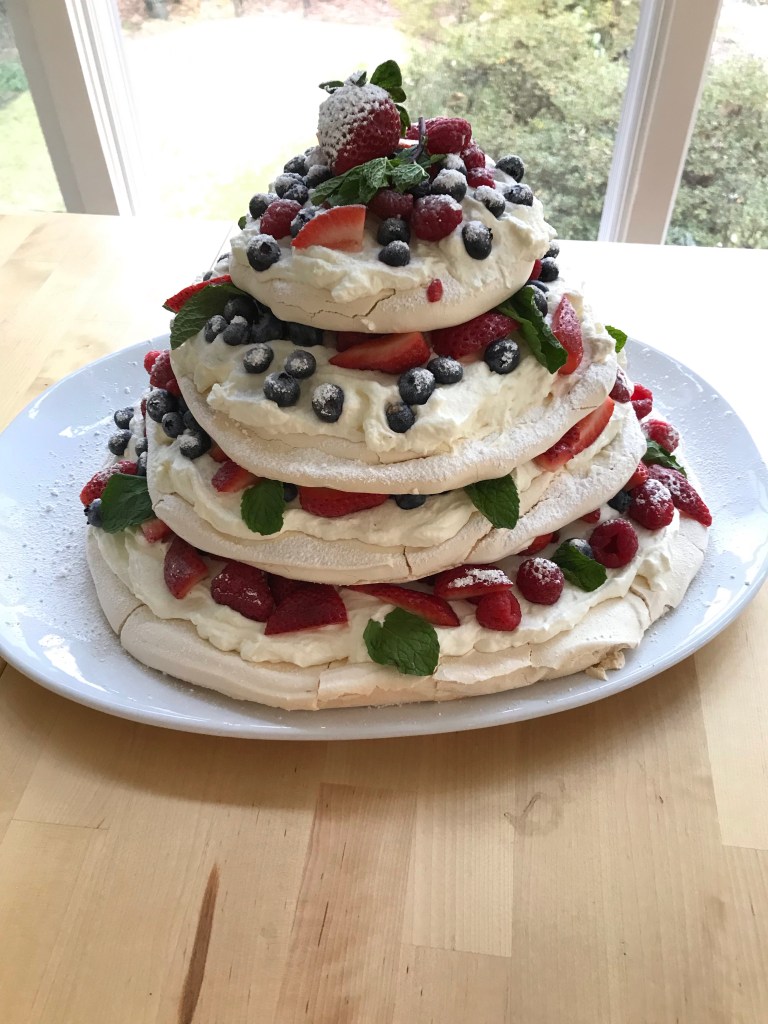
Welcome to this month’s installment of “Scent Semantics“, a group blogging project! The participating blogs are: Scents and Sensibilities (here), The Plum Girl, The Alembicated Genie, Eau La La, Undina’s Looking Glass, and A Bottled Rose. I hope you’ll all check out the Scent Semantics posts on each blog! The word of the month is “luscious.” I’ve struggled a bit with this, as luscious often implies something edible or juicy, and I don’t have many gourmand or fruity fragrances. I thought about riffing off my newly opened “January Joy Box” from 4160 Tuesdays, which is in fact bringing me much joy; it extends the holiday season in the nicest way but so far the offerings haven’t been gourmand or fruity. We have been eating many luscious holiday foods and treats for a few weeks now, including this amazing Pavlova my oldest daughter made, from Mary Berry’s recipe:
My daughter’s holiday Pavlova; recipe by Mary Berry
If that doesn’t say “luscious” to anyone, I don’t know what will. And it tasted as delicious as it looked! The flavor and the aroma combine the lightness and sweetness of meringue with the tartness and sweetness of the berries, to great effect. In fact, it occurs to me that a gifted perfumer could make a wonderful fragrance based on that combination, as long as the sugar took a back seat to the berries. The closest thing I have in my fragrance collection is probably Esteé Lauder’s Modern Muse Le Rouge Gloss, a flanker of Modern Muse which is a sweet, fruity, cherry-based fragrance with a modern chypre vibe. I wouldn’t go so far as to call it a chypre, but it has a similar structure, with top notes of Sour Cherry, Carrot Seeds, Pink Pepper and Mandarin Orange; middle notes of Vinyl, Rose, Leather and Jasmine; and base notes of Honey, Vanilla, Patchouli, Styrax, Saffron and Labdanum, according to Fragrantica.
I had picked up a small bottle of this from a discounter’s clearance shelf, out of curiosity, but hadn’t yet tried it, so this month’s Scent Semantics assignment gave me a good reason to sample it. I think it has been discontinued, but it is still readily available online. The cherry I smell at the opening isn’t sour at all, by the way. What pops out right away is the pink pepper note, underwritten by red fruit and a bit of sweet citrus. I don’t know what the “carrot seed” note adds, since it’s not clear to me what “carrot seed” is supposed to smell like, as opposed to carrot. It has been described as soft and musky, and it seems to accompany iris or orris accords quite often in fragrances. Here, I think it adds a musky note to the opening stage of Modern Muse Le Rouge Gloss. The opening is lively and disarming, clearly designed to appeal immediately to someone trying a tester in a store like Sephora.
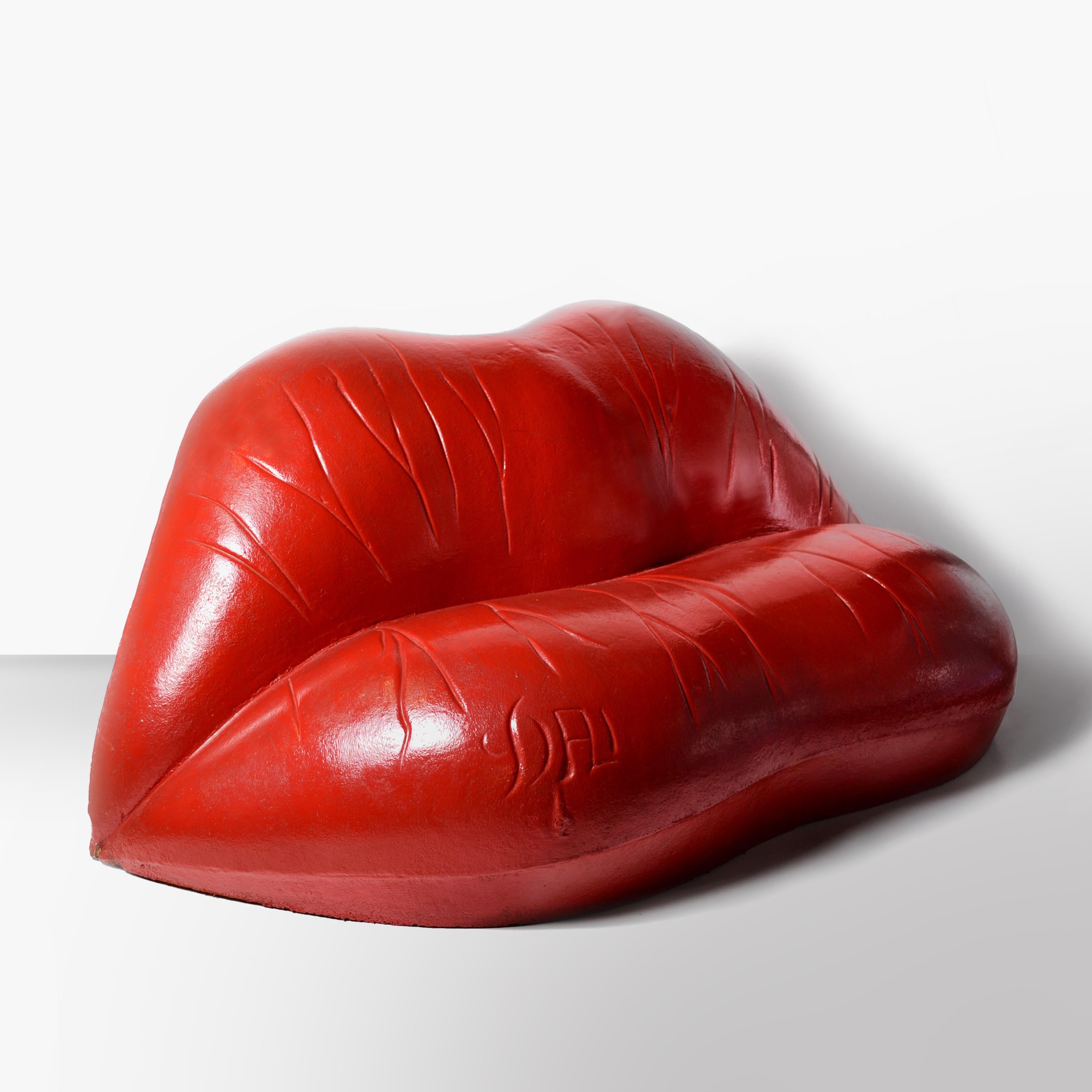
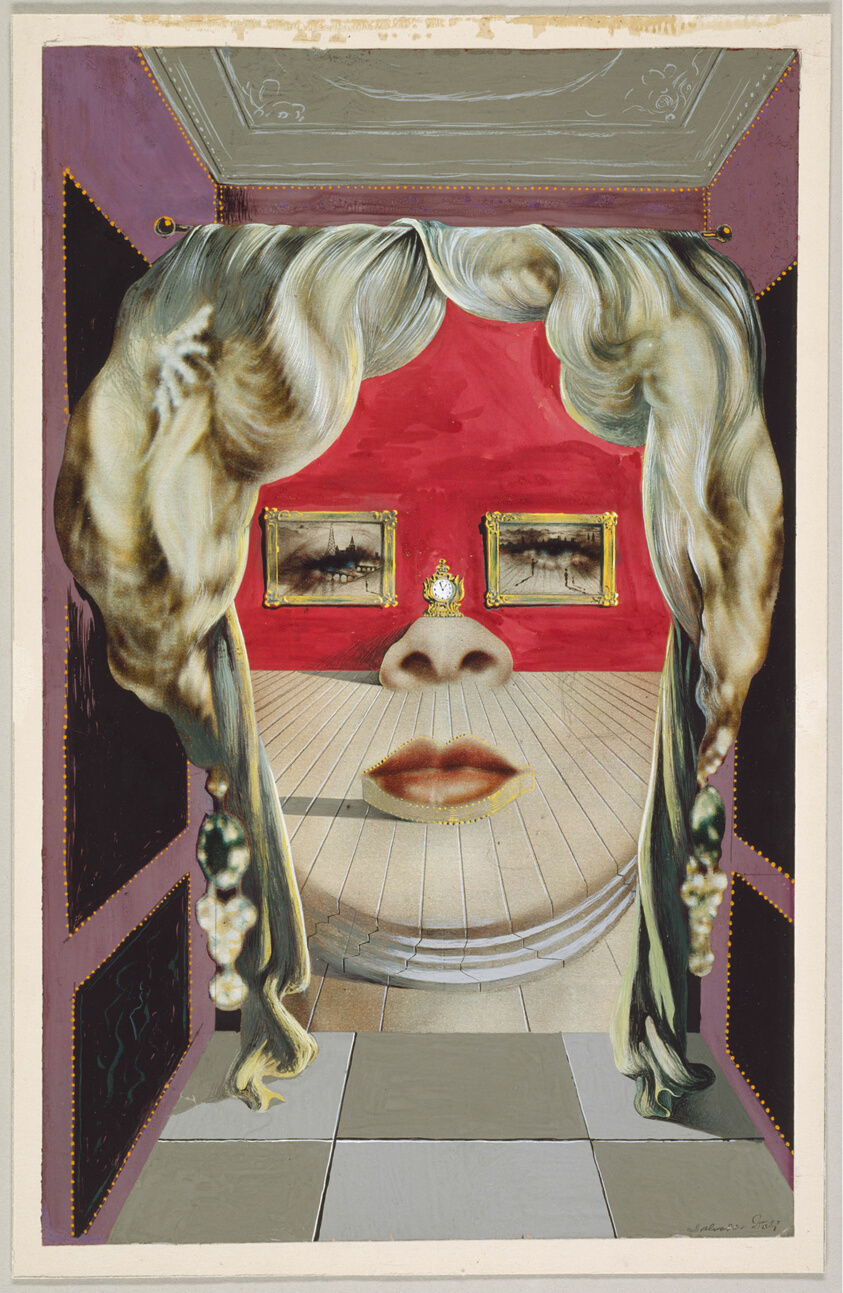
The heart stage is intriguing; the cherry note continues, but this phase does in fact suggest the “gloss” of the scent’s name, as if the red cherry and vinyl accords had combined in some mad re-creation of Salvador Dali’s famous “lips” sofa, originally inspired by a photograph of Mae West with her signature full, pouty lips, which he turned into a Surrealist portrait.
Lips sofa by Salvador Dali
Luscious and glossy, indeed! And it seems that Mae West qualifies as a “modern muse”, at least to Salvador Dali.
Mae West’s Face which May be Used as a Surrealist Apartment, by Salvador Dali; image from Art Institute of Chicago, artic.edu.
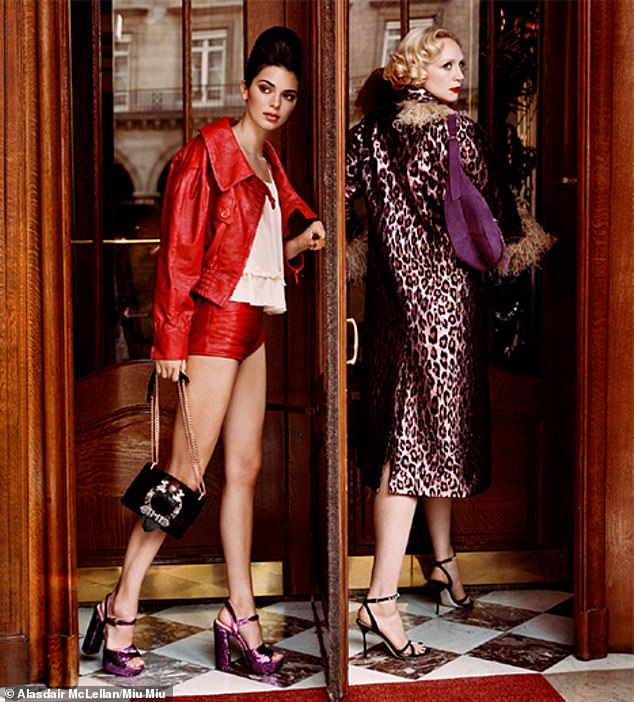
As it dries down further, the cherry accord morphs into a rose; the transition is very subtle, as roses can indeed smell like different fruits, including cherries. (I grow a very pretty rose called “Cherry Parfait“, but the name is because of its colors more than its fragrance). At this point, most of what I smell is a light, fruity rose with an undercurrent of vinyl. I don’t notice leather, or jasmine. If there’s any leather here, it is the shiny patent leather seen in this shoot of Kendall Jenner, who is Esteé Lauder’s model for Le Rouge Gloss, here modelling Miu Miu fashions, but the patent leather in Le Rouge Gloss is faux leather, made from vinyl.
Kendall Jenner for Miu Miu; image by Alasdair McLellan.
In the final stage, I clearly smell honey and a bit of vanilla. These base notes are well blended, they don’t hit you over the head with sweetness. However, the final stage of Le Rouge Gloss is a bit weak compared to its opening. It doesn’t have the “oomph” of a real chypre, and although patchouli is listed as a featured base note, I don’t smell it, or the listed styrax and labdanum. I do smell a hint of saffron, which warms the overall impression.
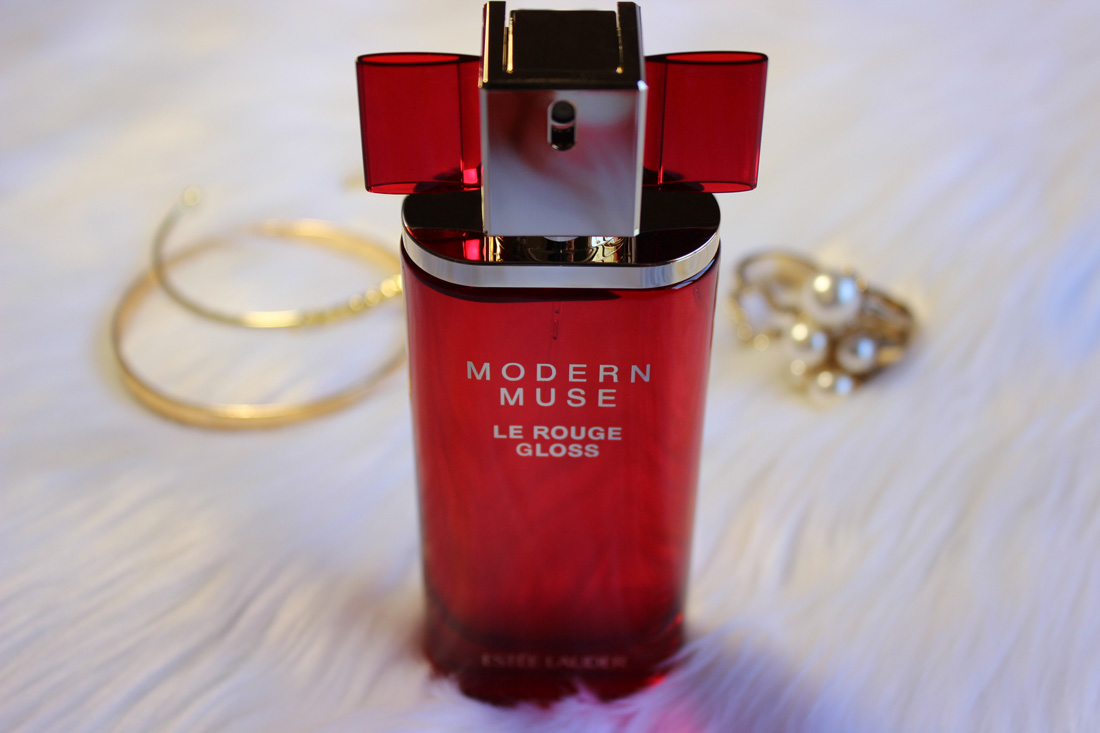
I will say that, consistent with Esteé Lauder’s design tradition, the bottle of Le Rouge Gloss is really pretty (also clearly meant to appeal to a potential buyer on first sight). I don’t particularly care for the shape of the Modern Muse line’s bottle, with its square top, but it has a certain Art Deco appeal. The version for Le Rouge Gloss, though, is in a deep red glass with the sheen of the lacquer the scent is supposed to evoke, and it looks gorgeous. In the small size I have, it’s like a lovely accessory. I think it might be a bit overpowering in the full 100 ml size, but I do love that red glass.
Modern Muse Le Rouge Gloss; image from ireallyreallylove.com
All in all, I’m glad to have my small, discounted bottle of Le Rouge Gloss, and I can see wearing it occasionally when I just want something light, pretty, and undemanding. I won’t be seeking out another bottle, but I’ll enjoy this one!
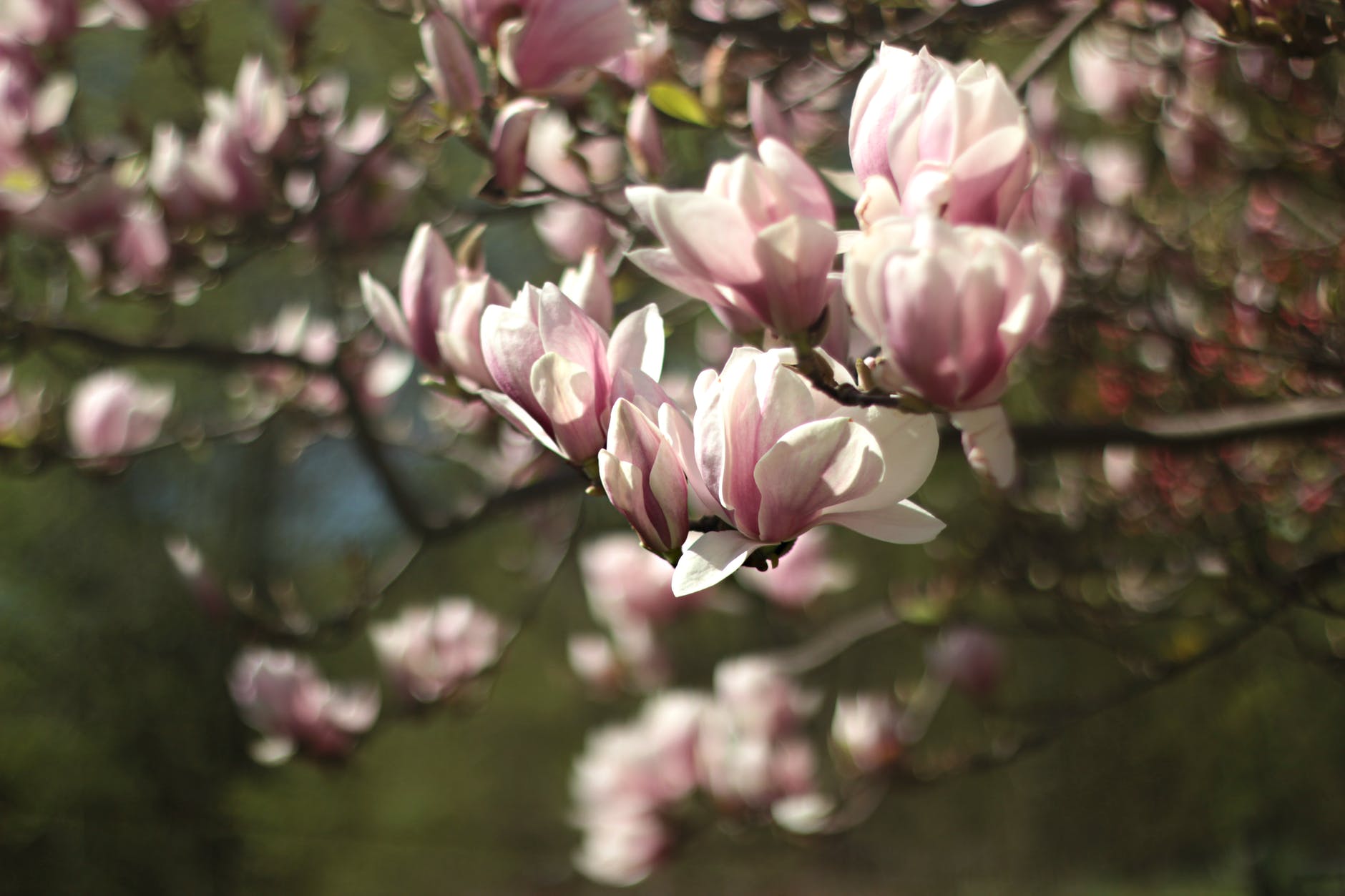
This is one of the few new 2021 fragrances I’ve tried this year. I was excited to get a sample from a kind sales associate, because I love the scent of real magnolias, especially the pink ones that bloom in my neighborhood, and I hoped this might resemble it. Sadly, it doesn’t. Beautiful Magnolia doesn’t live up to its predecessor, Beautiful, either, unfortunately. To my nose, it smells like a pleasant but nondescript flanker of Elizabeth Arden’s Sunflowers, and I wouldn’t be able to tell you which one. It’s pretty, and light, and it may do very well in some markets, but it’s not really for me, and I think its price is too high.
Fragrantica classes Beautiful Magnolia as a “floral aquatic” and lists its notes as follows: Top notes are Magnolia Petals, Lotus and Mate; middle notes are Magnolia, Gardenia, Solar notes and Turkish Rose; base notes are Musk, Cedar and Sandalwood. What I smell are: a bit of citrus, a bit of unnamed white flower, a hint of mate, white synthetic musk, and something slightly fruity. What I don’t smell are magnolia, lotus, gardenia, rose, or wood. I think the bit of citrus I smell is supposed to be “solar notes.” I can’t say much about dry-down, because Beautiful Magnolia doesn’t seem to have a true “drydown”, it just fades away, humming the same few wordless notes as when it entered the room. It is a very linear scent.
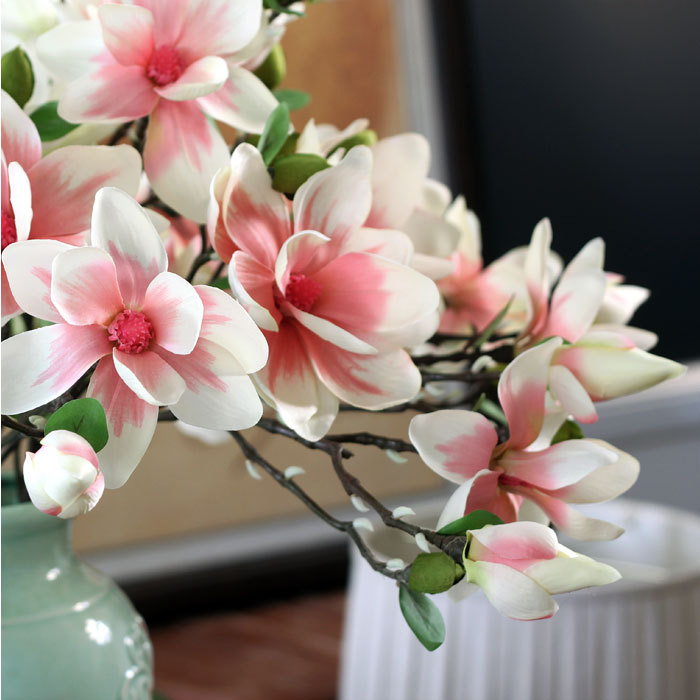
What a disappointment! I don’t often write reviews of scents I don’t care for, and this isn’t a “dislike” for me, it’s just that I expect better from Estee Lauder, a brand that has created so many memorable and classic scents. What I do dislike is the price for what Beautiful Magnolia is — $128 for 100 ml. I also dislike its recycling of the name “Beautiful” — the original Beautiful was a gorgeous 1980s floral, and even reformulated, it is so much more interesting and lovely than this. Comparing the two is like comparing artificial plastic flowers to the real thing. They may serve a purpose, and even be likeable, but they’re not on the same level.
Artificial magnolia flowers
Real magnolia flowers; photo by Deena on Pexels.com
Every spring, I eagerly await the blossoms of the pink magnolias. Some years, I am bitterly disappointed because a late frost comes along just as they’re about to bloom, and ruins the flowers. Nothing can be done about that; you just have to wait another year, until the next spring and the next magnolia flowers come. It’s a missed opportunity. That’s how I feel about Beautiful Magnolia. As Luca Turin once wrote about a different fragrance, “Encore un effort!” Please!
Do you have any recent fragrance disappointments? Or unexpected delights?
“Melange” is an apt word to use for Estee Lauder’s Beyond Paradise, as it is truly a melange of different florals. In their book “Perfumes: The Guide A-Z”, Luca Turin and Tania Sanchez not only gave it five stars, but also close to three full pages of discussion (most perfumes got a paragraph). He calls it a “symphonic floral.” Calice Becker was the perfumer who created it; Beyond Paradise was launched in 2003. The bottle I have is the teardrop-shaped, rainbow-tinted original. The batch number on the bottom suggests it dates to 2013. Fragrantica lists that version’s notes as: Top notes of Hyacinth, Orange Blossom, Grapefruit, Bergamot and Lemon; middle notes of Jasmine, Gardenia, Honeysuckle and Orchid; base notes of Hibiscus, Plum Wood, Ambrette (Musk Mallow) and Amber. The 2015 version in the rectangular bottle is described as having top notes of Blue Hyacinth, Orange Blossom and Jabuticaba; middle notes of Honeysuckle, Jasmine, Orchid and Mahonia; and base notes of Ambrette (Musk Mallow), Plum Blossom, Paperbark, and Woody Notes.
Both versions of Beyond Paradise are meant to be “fantasy florals” with a tropical theme; part of the length of Turin’s review is a long digression into the nature of abstract floral fragrances and how challenging they are to create, with a tip of the hat to perfumer Calice Becker, an acknowledged master of the art. According to contemporaneous press and PR coverage when it was launched, it included “proprietary notes” gleaned from a collaboration with The Eden Project, a fascinating conservation site in Cornwall, which involves massive biospheres located in and above an abandoned quarry and which I’ve had the privilege to visit. It does in fact house many rare and tropical plants, so it must be a great resource for unusual smells.
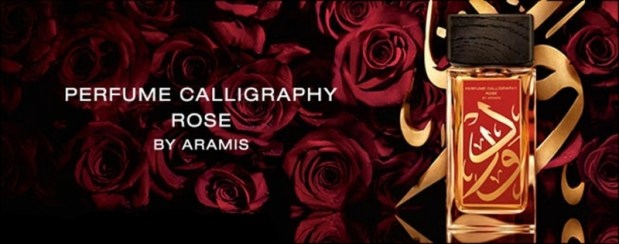
Several of the perfume blogs I follow are featuring lists and questions about favorite autumn fragrances, and I’ve found myself mentioning, more than once, Aramis’ Calligraphy Rose, which I like to wear in the fall and winter as a “floriental” — still floral, which is probably my most favored category of fragrance, with added oriental fragrance aspects like spices, myrrh, frankincense, etc. Per Fragrantica, its top notes are oregano, saffron and honeysuckle; middle notes are turkish rose, myrrh, styrax and lavender; base notes are labdanum, musk, ambergris and olibanum (frankincense).
Calligraphy Rose was one of a trio of Aramis eaux de parfum launched from 2012-2014: Calligraphy (2012), Calligraphy Rose (2013) and Calligraphy Saffron (2014). It was created by perfumer Trudi Loren, who is listed with Maurice Roucel as co-creator of 2006’s Missoni, awarded five stars by Luca Turin in his original “Perfumes: The A-Z Guide.” It has been discontinued but is still widely available online for reasonable prices.
To my nose, Calligraphy Rose starts out green and sweet, which makes sense given the top notes listed. The oregano I smell is the green, growing plant, not the dried herb. The sweetness must come from the honeysuckle note, which Gail Gross wrote about in a wonderful review of Calligraphy Rose last January at CaFleureBon. For her, the honeysuckle was very dominant. It is less so for me, though its underlying sweetness never leaves. On my skin, the rose note emerges quickly and strongly, and it persists for a long time, which I love. I have layered Calligraphy Rose with other rose scents such as Taif Roses by Abdul Samad Al Qurashi, a powerful rose attar, on occasions like Christmas Eve, with happy results; any lasting rose fragrance will have the same effect of amplifying the already-strong rose note. I bet it would layer beautifully with Viktor&Rolf’s Flowerbomb Rose Twist, a perfume layering oil, or with Tauerville’s Rose Flash, with its 20% concentration. One could emphasize other notes in a similar fashion, such as adding a lavender or frankincense layer, pushing it in any direction one prefers. Calligraphy Rose is a bit of a chameleon.
As it dries down, Calligraphy Rose on its own becomes less floral and more balsamic, like a lovely balsamic glaze. This “glaze” was made with honey, and includes herbs. Having started out quite green, it becomes warmer, thanks to those warm base notes. In fact, its progression is not unlike the progression of autumn itself, from the lingering green of still-living plants, to the late flushes of rose blooms, to the warmth and spice of winter dishes. P.S. It lasts for hours and hours! One spray on my wrist is still wafting faintly off my skin almost 24 hours later as a warm, sweet skin scent. Use with a light hand, but you’ll smell marvelous for a long time.
Calligraphy Rose is a truly unisex fragrance. Launched under Estee Lauder’s men’s brand of Aramis, it suits both men and women. It is less gourmand than Montale’s Intense Cafe, more herbal. I love it!
Great news! Estee Lauder has announced that prima ballerina Misty Copeland will be the new face for their fragrance Modern Muse. I am so pleased! You can see a couple of wonderful videos with her at that link.
I love ballet generally; I have long been a fan of American Ballet Theater; and I admire Ms. Copeland. I also appreciate that this new role for her adds to diverse images of beauty and fashion, including not only race but also the strength and grace of her physique. The tag line for the campaign is “Be An Inspiration.” Misty Copeland is the perfect embodiment of that. Well played, Estee Lauder, well played!






 Serenity Now Scents and Sensibilities