Welcome to the weekly Perfume Chat Room, perfumistas! I envision this chat room as a weekly drop-in spot online, where readers may ask questions, suggest fragrances, tell others their SOTD, comment on new releases or old favorites, and respond to each other. The perennial theme is fragrance, but we can interpret that broadly. This is meant to be a kind space, so please try not to give or take offense, and let’s all agree to disagree when opinions differ. In fragrance as in life, your mileage may vary! YMMV.
Today is Friday, July 18, and WordPress tells me today is my tenth anniversary on WordPress! Wow. It honestly doesn’t feel as if I began that long ago! I so appreciate those of you who have come on the blogging journey with me, whether years ago or just this year. Special thanks to my regular commenters: you make every post so much more interesting! Even more special thanks to Portia Turbo of Australian Perfume Junkies, who has so kindly involved me in some really fun fragrance blog projects. Let’s do that again some time! The past week also brought Bastille Day: Vive la France!
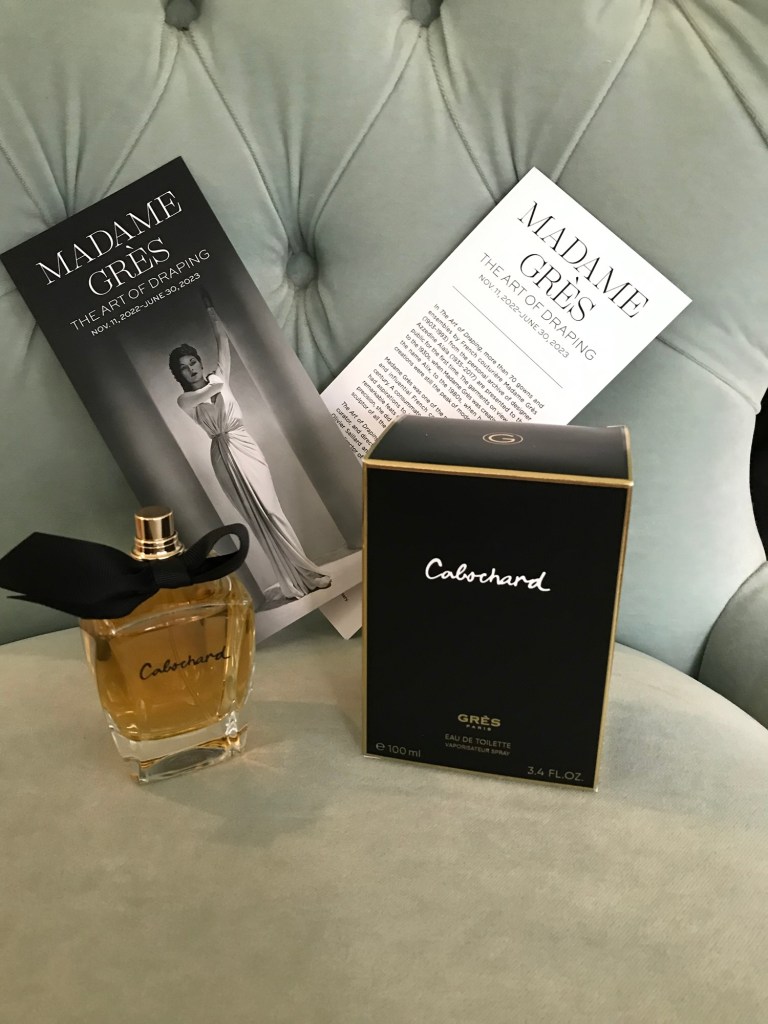
On another topic, I’m eagerly looking forward to a fashion exhibit that I plan to go see with friends next week. It is the first ever American retrospective exhibit of the work of the French couturiere Madame Jeanne Lanvin. As some of you will remember, the same venue hosted a major exhibit of the work of Madame Grès two years ago, which was, as they say, to die for. She was also known for a legendary fragrance, Cabochard.
Madame Lanvin was also the inspiration for a legendary fragrance: Arpège. Arpège premiered in 1927, so it is almost 100 years old! It is a floral aldehyde, like its contemporary Chanel No. 5, and it is a complex bouquet of notes that include aldehydes, lily of the valley, peach, honeysuckle, neroli, bergamot, jasmine, ylang ylang, iris, coriander, rose, lily, geranium, camellia, sandalwood, amber, vetiver, musk, benzoin, vanilla, and patchouli. It has, of course, been reformulated over the years. As recently as 2008, though, perfume critic Luca Turin still gave it four stars, calling it a “unisex classic”, and “an elegant, nutty, woody floral with an overall cashmere beige tonality that would be vey dowdy on all but a guy.”
The beautiful classic Arpège bottle of black with gold shows a stylized Art Deco figure of a mother and daughter, which is supposed to represent Mme. Lanvin and her daughter, who chose the fragrance’s name. I must confess, I’ve never really worn Arpège. Have you? What are your thoughts?
Welcome to the weekly Perfume Chat Room, perfumistas! I envision this chat room as a weekly drop-in spot online, where readers may ask questions, suggest fragrances, tell others their SOTD, comment on new releases or old favorites, and respond to each other. The perennial theme is fragrance, but we can interpret that broadly. This is meant to be a kind space, so please try not to give or take offense, and let’s all agree to disagree when opinions differ. In fragrance as in life, your mileage may vary! YMMV.
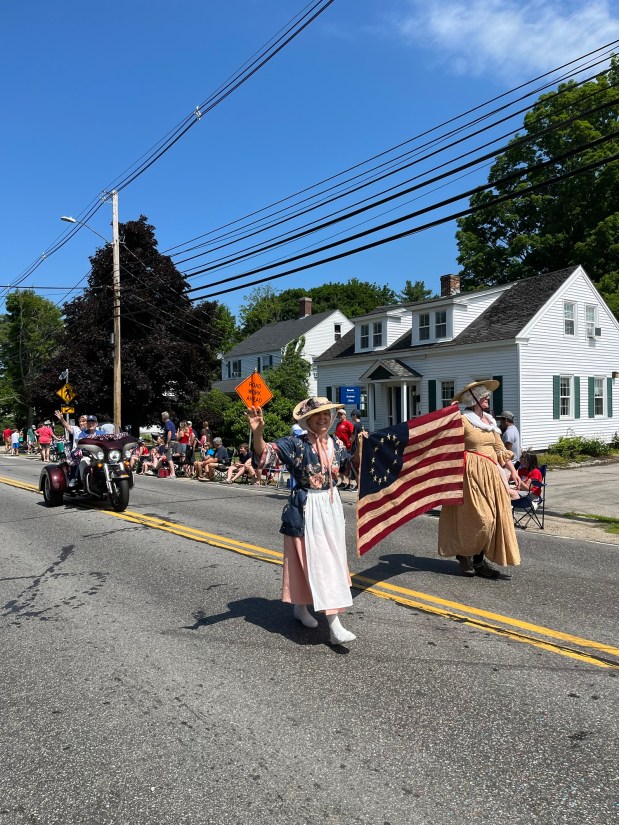
Today is Friday, July 4, and it has been a week. Suffice it to say, I’m not feeling particularly celebratory — but by God, my family has served the United States since before there even was a United States, so I’m trying to keep things in perspective and not let the Fourth of July and its meaning get taken from me. Independence and freedom cost too many too much to let them go without a fight, as we were reminded last summer on our trip to Normandy and the D-Day beaches.
On a lighter note, one of my multi-great grandfathers, after whom my father was named, like his father and grandfather and a few more ancestors before that, is mentioned in the Papers of George Washington for having complained to the General that he had been beaten by an officer in the Continental Army. My ancestor was in the state militia and viewed himself as independent of the regular army officers. Apparently he had sassed the officer, who took it upon himself to inflict corporal punishment. General Washington, bless him, took the complaint seriously and ordered an investigation. As if he had nothing else on his mind!
So for the Fourth, I thought I’d write about an all-American fragrance: Tommy Hilfiger’s Tommy Girl. Created by Calice Becker and launched in 1996, it is sold in a red, white, and blue striped bottle, presented as just the kind of youthful, fresh fragrance a true American Girl would wear.
But, of course, there’s much more to it than that, and Luca Turin gave it five stars in the first edition of his book “Perfumes: The Guide.”
Fragrantica lists its notes as follows: “Top notes are Apple Tree Blossom, Mandarin Orange, Camelia and Black Currant; middle notes are Lemon, Honeysuckle, Grapefruit, Rose, Lily, Mint and Violet; base notes are Magnolia, Jasmine, Cedar, Sandalwood and Leather.”
M. Turin describes Tommy Girl as a tea base “clothed … in a fresh floral accord so exhilaratingly bright that it could be used to set the white point for all future fragrances.” I assume that in this case, “camellia” refers to camellia sinensis, the plant from which tea leaves are derived. Apparently, the base tea accord was inspired by the complex scents in the famous Paris tea store, Mariage Frères. Some of the notes listed absolutely appear in various tea blends, such as lemon, jasmine, rose, mint.
Not surprisingly, since I love tea, I find Tommy Girl very pleasant to wear, especially in the heat and humidity we’re having here now. It goes on fresh and it stays fresh, just with different citrus and floral notes emerging as it evolves. My nose doesn’t pick up any leather accord, though.
Have you tried Tommy Girl lately? Are there any other fragrances you consider “All-American”?
The flag at half mast for Memorial Day, the American Cemetery, Normandy
Welcome to the weekly Perfume Chat Room, perfumistas! I envision this chat room as a weekly drop-in spot online, where readers may ask questions, suggest fragrances, tell others their SOTD, comment on new releases or old favorites, and respond to each other. The perennial theme is fragrance, but we can interpret that broadly. This is meant to be a kind space, so please try not to give or take offense, and let’s all agree to disagree when opinions differ. In fragrance as in life, your mileage may vary! YMMV.
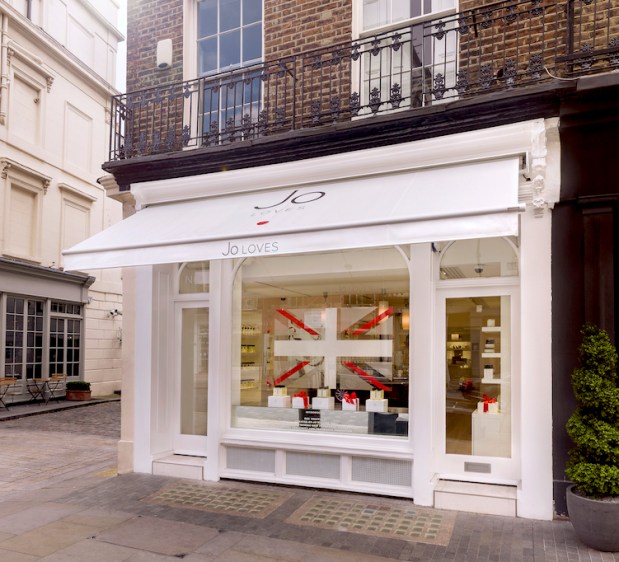
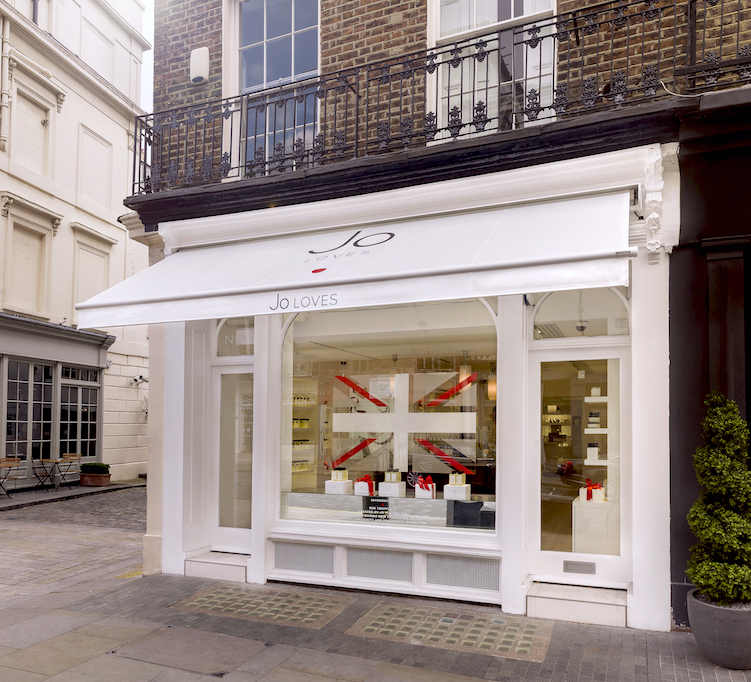
Today is Friday, September 13, and I wish you all the best of good luck today! I’ve never really understood why Friday the 13th is supposed to be unlucky, but here we are. I’m happy to share the recent announcement below of an online (Zoom) Bois de Jasmin class with Victoria and Luca Turin. I’m sure this will be most interesting, and it’s for a good cause. I will not be taking part, because I’ll be on my way to London! I have a full week planned of cultural outings, which will include seeing the cinema release of the National Theatre production of “Prima Facie” with Jody Comer, which I’ve been dying to see and which hasn’t been announced for any showings near me in the US. And yes, there will be at least one perfume-related outing — a trip to Les Senteurs with my friend who lives in London, at her request. And since we’ll be so close by, a stop at Jo Loves too! Stay tuned for any more additions to the list …
Jo Loves boutique
Since I’m currently in Ukraine, I see the dire need in my local community for the most basic things. While there are plenty of charities and government-level programs, the only way to ensure that money goes to the people in need is to locate those communities and help them directly. I’ve been doing this ever since my arrival to Ukraine two weeks ago.
Raising money for local school to supply their bomb shelters with water.
Purchasing art supplies for the free-of-charge art studios that rehabilitate children suffering from post-traumatic shock.
Supporting animal shelters run by the individuals I know.
Working with local outreach programs to respond to the lonely elderly and their needs.
Supporting local cultural preservation projects and traditional crafts. I will share more information about these and other projects as I continue my work.
Full disclosure: 50% of the funds raised will be donated to these charitable initiatives. The rest will cover our time and my Belgian tax obligations.
The session will take place online via Zoom and will last for 1 hour. If you have questions for me and Luca, you can email them beforehand. You’ll receive full instructions before the start of the class. No recordings will be made available for these sessions. Thank you for your understanding.
Location: Zoom Class duration: 1 hour September 14, Saturday, 18:00-19:00 CET (12:00-13:00 EST) 50€ Book Now
For more information on Bois de Jasmin classes and other course offers, please visit the Perfume Classes page.
Do you have any special plans for this weekend, fragrant or otherwise?
Welcome to the (late!) October installment of “CounterPoint”! I was thrown off by how early the first Monday of the month was, and various other distractions, but here we are, to discuss Christian Dior’s Diorella. Thank you, Portia, for being so patient!
Launched in 1972, Diorella is a “lemon chypre”, a narrow and specialized category of fragrance, given that chypres generally are a specific category. Perfumer Edmond Roudnitska created Diorella in 1972 at the peak of his powers, having already created for Dior the legendary fragrances Diorama, Diorissimo, and Eau Sauvage.
Diorella; image by Christian Dior.
Interestingly, Diorella was the inspiration for Meet Me On The Corner, a crowd-funded fragrance by Sarah McCartney of 4160 Tuesdays that she created to capture the vibe of 1970s chypres and named after a 1972 pop song.
Tye-dye girls, Doreen Spooner/Getty Images
How did you first encounter Diorella and what was your first impression?
Portia: When Old Herbaceous asked if we could do Diorella my first internal response was “Diorella? Sure I’ve heard of it but have no memory of ever seeing it or smelling it.” Dutifully I went to the DIOR box and rummaged around just to be sure. Lo and behold, there is a 100ml, extremely vintage looking beat up houndstooth box of Diorella EdT. There’s clearly been some leakage, the sprayer and surrounds have residue and some eating away of the silver. The moment I touched the very bleached out label it just fell off. This bottle is O L D. Even on spritzing I have no memory of smelling this beauty. So while I may have smelled Diorella in the past I’m coming at it as a newbie. First impression is that I’m really surprised that the top seems to be intact.
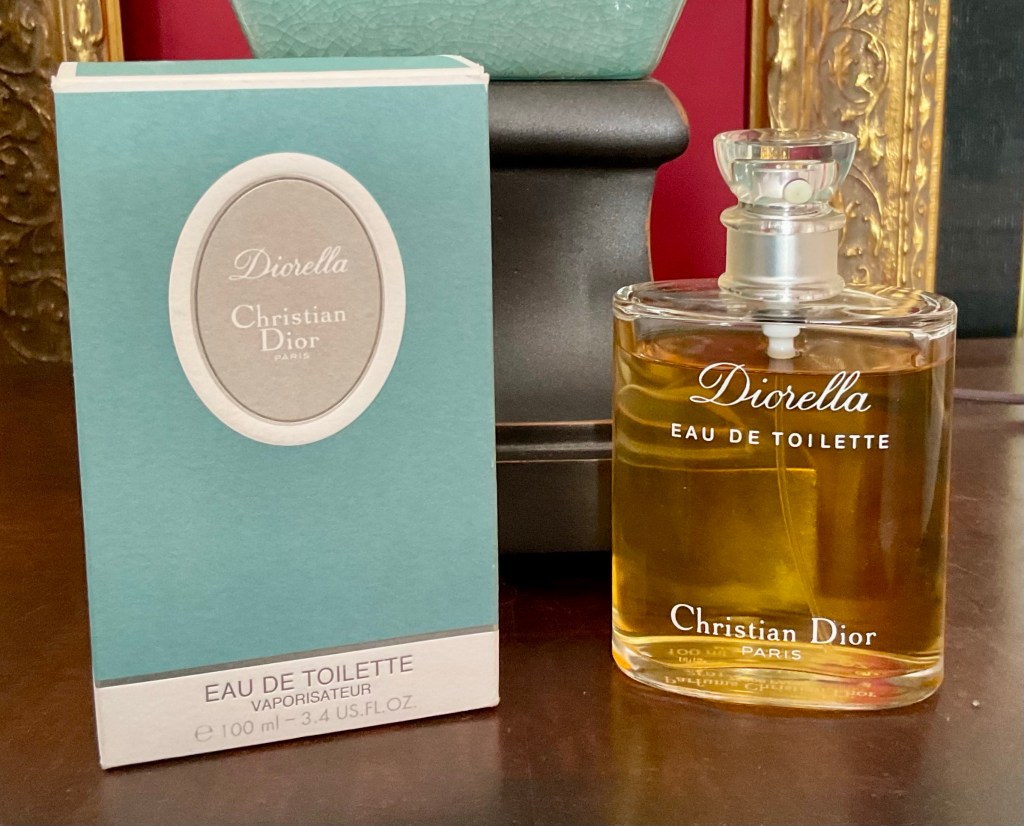
Old Herbaceous: My perfumista journey began when I read “The Perfect Scent” by Chandler Burr, then moved on to “Perfumes: The A-Z Guide” by Luca Turin and Tania Sanchez. I was fascinated by their witty insights and their rating system of stars, so I started to seek out the fragrances they had awarded five stars, their top rating. One of those was Diorella, in its pre-2009 formulation. As I learned more about fragrances, I started to figure out how to find vintage fragrances (sadly, without access to the amazing Japanese flea markets that Neil Chapman describes in his blog The Black Narcissus!). I found an intact bottle of Diorella eau de toilette that dates from 2002, as best I can tell, based on its box, bottle, and batch number. It was a reasonable price, so I snapped it up.
My Diorella
My first impression was “Yes, this is a true chypre!” I happen to love most chypres (I can’t think of one I have disliked yet), with their classic structure of citrus top notes, floral heart notes, and base notes that include oakmoss. Per Fragrantica, the structure of the original Diorella is: top notes of green notes, Sicilian lemon, bergamot, melon, and basil; middle notes of honeysuckle, Moroccan jasmine, peach, carnation, cyclamen, and rose; and base notes of oakmoss, vetiver, patchouli, and musk. While the top notes of my bottle have faded somewhat with age, the combination of citrus and green notes is still evident and lively.
2. How would you describe the development of Diorella?
Old Herbaceous: The top notes aren’t as vivid in my bottle as I’m sure they were when it was new, but they are vivid enough to indicate the lemony/green opening accord intended by M. Roudnitska. The melon and green notes have taken precedence in my bottle, including a lovely basil accord. I think the basil is what may have prompted Turin and Sanchez to declare that if Guerlain’s fragrances are desserts, Diorella is a Vietnamese beef salad. Fear not! It smells nothing like rare meat. I think I can smell a couple of the base notes right from the start, specifically the vetiver and oakmoss, humming in the background.
In the heart phase, I smell honeysuckle and jasmine. The jasmine isn’t heavy or narcotic, it stays light. The hum of vetiver and oakmoss becomes more noticeable, and soon they take over from the floral notes entirely. In the drydown and base stage, Diorella moves from fresh toward warm without becoming spicy, supported by patchouli and musk. It also lasts a good long time, surprising in a fragrance that also smells very fresh.
Portia: Fizzy opening with bright green citruses and aldehydes, leaning slightly waxy like putting your fingernail into the peel and getting that luscious burst of fresh and sunshiny goodness. The greenery is both camellia leafy and tulip stemmy, crushed to let their greenness explode.
As the initial heady notes calm, I have a very modern masculine waft of cucumber/melon intertwined with the bouquet. It’s a surprise to have something so stuck in my mind as a 1980/90s gym men’s changeroom smell be lurking so significantly in this epitome of female beauty. It does not detract from the femininity at all and makes me think of how many of the men would also swoon for Diorella.
I will say that Diorella is very cologne-ish. This is not a complaint, merely an observation. For some reason I was expecting a very fruity/mossy chypre in the style of Mitsouko. This is as far from that as you can imagine while still bearing many of the same notes.
The heart and base take a long time merging and there’s plenty of crossover during this time, plus the citruses are subtly tenacious.
The crisp, green, oily grassiness of vetiver is tempered by the earthy patchouli and moss but there is much more going on here. I’m getting wafts of quite astringent eucalyptus, the fresh green of shady creeks as you trudge through the greenery. There’s a cooling, slightly salted seaside breeze hiding below.
The last gasps are a very vegetal musk and sweet greenery.
Diorella is so tapestried and I think it will take a dozen more wears to even get a hold of what’s happening here.
3. Do you or will you wear Diorella regularly? For what occasions or seasons?
Portia: Honestly, now that I’ve found this gorgeous unicorn it might be too special to wear willy nilly. Though it feels like an excellent sunny day spritz and could give me blue sky reminiscences in winter, I think just holding the bottle and sniffing the cap will be all I’m capable of doing.
Old Herbaceous: I haven’t been wearing Diorella regularly, but it has been such a good fit for the beautiful October weather we’re having that I plan to keep it out and within reach for at least a while (keeping it in its box, of course, to protect it from light!). It partners beautifully with these crisp, sunny, dry autumn days, although I often think of it more as an early summer scent. Diorella works well for a whole range of occasions, from casual to elegant, from daytime to evening. It’s like a Diane von Furstenburg wrap dress, the kind that were so fashionable in the 1970s (my mother wore them) and that you could dress up or dress down, endlessly versatile but with a distinct, chic personality.
4. Who should/could wear Diorella?
Old Herbaceous: Well, here’s what Luca Turin wrote on that topic: “Diorella was intended as a feminine and was the very essence of Bohemian chic, with an odd, overripe melon effect that still feels both elegant and decadent. The modern version, no doubt fully compliant with all relevant health-and-safety edicts since the fall of the Roman Empire, is drier and more masculine than of old, no bad thing since I have always seen it as a perfected Eau Sauvage and one of the best masculines money can buy.”
So there you have it! Diorella will work well for many perfume-lovers and can be spritzed for just about any occasion.
Portia: A truly unisex beauty that is cologne related but so much more. I need to go sniff a modern bottle to see if it still smells as good. Then if it does I might buy a bottle and wear it regularly through the warmer months. I’ll be most interested to read OH’s description of how it has survived.
Old Herbaceous: Borrowing again from Luca Turin with regard to the 2009 reformulation: “Great perfumery accords share with holograms the strange property of being damage resistant; the picture remains legible even though noise increases and fine detail is swept away. Diorella is one of those accords, and while the latest version is less caressingly decadent and lush than of old, it still conveys much of what made the original great.” Note that his comment is about the 2009 version; I think this is still the current edition, as I haven’t been able to find anything about a later formulation despite new IFRA restrictions on oakmoss. I wonder whether the oakmoss was already greatly reduced in 2009, with vetiver taking a more prominent role in the base, so more changes weren’t necessary.
Welcome back to the weekly Perfume Chat Room, perfumistas! I envision this chat room as a weekly drop-in spot online, where readers may ask questions, suggest fragrances, tell others their SOTD, comment on new releases or old favorites, and respond to each other. The perennial theme is fragrance, but we can interpret that broadly. This is meant to be a kind space, so please try not to give or take offense, and let’s all agree to disagree when opinions differ. In fragrance as in life, your mileage may vary! YMMV.
Today is Friday, January 21, and we had snow a few days ago! It didn’t last beyond one day and night, but it was so pretty while it was falling. I’m thankful that we were able to get some needed masonry done in our garden before the cold temperatures and precipitation; and I was able to run around and add mulch to the root zone of some precious plants. I also clustered pots on the ground together as a small measure of protection. Our cold spells are rarely so cold that outside plants are actually threatened, as long as one takes some simple measures. I do keep some garden “frost blankets” on hand in case of need.
The fragrance blog and community Now Smell This had as its Friday “community project” to wear a Dior fragrance in honor of Christian Dior’s birthday, which resulted in a discovery — I may have more fragrances from the house of Dior than any other, which I learned as a result of looking for options to wear this week. This did surprise me, as I hadn’t really planned such a focus, but it results from a few things.
One, two of my earliest fragrance loves — the first two high-end scents I bought for myself — were Chanel No. 22 and Dior’s Diorissimo. Of the two, I wore Diorissimo more often, as it felt less formal than No. 22, much as I do love that. So I’m inclined to take an interest in Dior fragrances.
Two, I have a monthly scent subscription that has been offering decants of Dior’s “Collection” fragrances, and I’ve been collecting those. I like several of them very much, including La Colle Noire and Gris Dior. (The decants may tempt me toward a full bottle at some point — shhhhh! Don’t tell.).
Three, my trip down the fragrance rabbit-hole began when I read Turin & Sanchez’ “Perfumes: The A-Z Guide” and decided to renew my acquaintance with today’s Diorissimo. I made the rookie error of sampling the eau de parfum, a later creation, instead of the eau de toilette, which is closer to the original, and was taken aback at how much it seemed to have changed. So I went on a quest for a substitute, and thus the madness began. As part of that, I started to seek out vintage Dior fragrances, often in minis, so that added to my Dior stash.
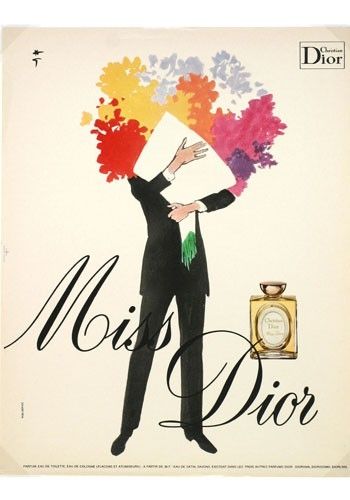
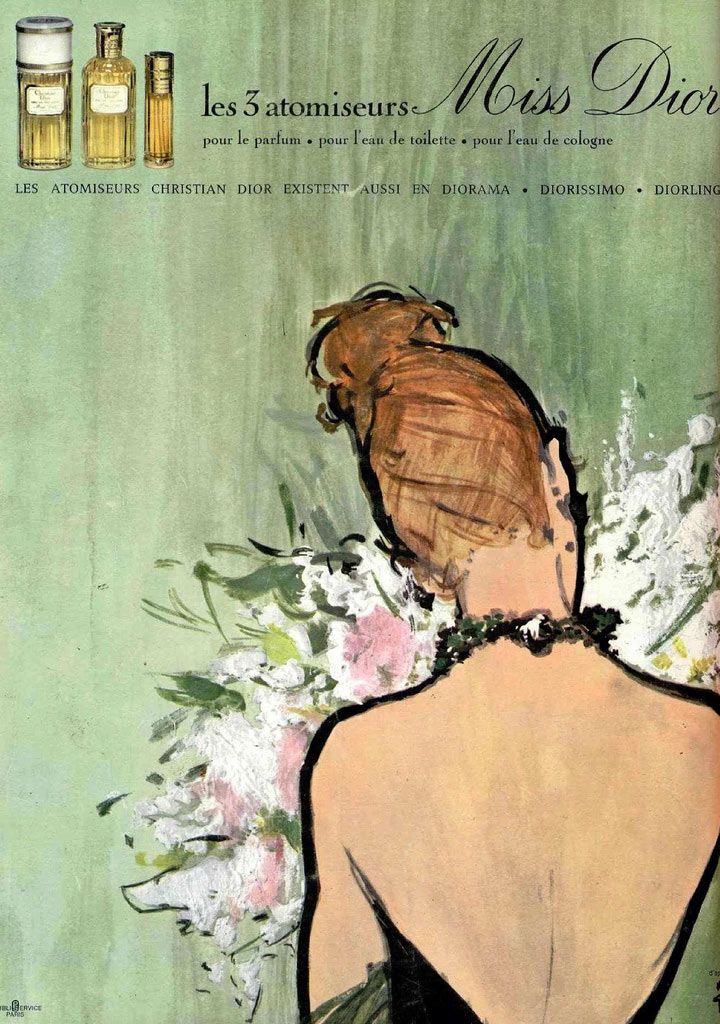
Today, I’ll wear vintage Miss Dior in honor of M. Dior’s birthday today and his heroic sister Catherine, for whom the fragrance was named and whose love of flowers inspired it.
Having survived the Nazis’ torture, prisons, and a concentration camp, she came home to Paris after the war and became a noted florist and wholesaler of flowers, together with the man she loved, also a Resistance fighter.
Miss Dior perfume, vintage ad
I know some of you, like Undina, deliberately track exactly how many fragrances you have from a given house. Which ones show up most often in your collection? Any surprises?
Chanel’s Cristalle came to me later in life; my earliest Chanel “love” (for myself) was No.22, which I still love and wear, then No.19, also still a strong love and in regular rotation on my skin. I’m not sure why it took me so long to discover Cristalle; I probably thought my need for a green Chanel was fully met by No.19. Regardless, I first tried Cristalle a few years ago, and yes, it’s love. I wear Cristalle on days when I need a good snap of green but No. 19 feels like overkill. Both were created by perfumer Henri Robert: No. 19 in 1970, and Cristalle in 1974. (I refer to the eau de toilette; Jacques Polge created an eau de parfum version for Chanel twenty years later).
The two share some notes. Cristalle‘s notes are: Top notes — Sicilian Lemon and Bergamot; middle notes — Hyacinth, Brazilian Rosewood, Honeysuckle and Jasmine; base notes — Oakmoss and Vetiver. No.19‘s notes are: Top notes of Galbanum, Hyacinth, Bergamot and Neroli; middle notes of iris, Orris Root, Rose, Lily-of-the-Valley, Narcissus, Jasmine and Ylang-Ylang; base notes of Oakmoss, Vetiver, Leather, Cedar, Musk and Sandalwood. No.19 was launched the year before Coco Chanel died; it seems to be the last fragrance that she personally approved.
“Melange” is an apt word to use for Estee Lauder’s Beyond Paradise, as it is truly a melange of different florals. In their book “Perfumes: The Guide A-Z”, Luca Turin and Tania Sanchez not only gave it five stars, but also close to three full pages of discussion (most perfumes got a paragraph). He calls it a “symphonic floral.” Calice Becker was the perfumer who created it; Beyond Paradise was launched in 2003. The bottle I have is the teardrop-shaped, rainbow-tinted original. The batch number on the bottom suggests it dates to 2013. Fragrantica lists that version’s notes as: Top notes of Hyacinth, Orange Blossom, Grapefruit, Bergamot and Lemon; middle notes of Jasmine, Gardenia, Honeysuckle and Orchid; base notes of Hibiscus, Plum Wood, Ambrette (Musk Mallow) and Amber. The 2015 version in the rectangular bottle is described as having top notes of Blue Hyacinth, Orange Blossom and Jabuticaba; middle notes of Honeysuckle, Jasmine, Orchid and Mahonia; and base notes of Ambrette (Musk Mallow), Plum Blossom, Paperbark, and Woody Notes.
Both versions of Beyond Paradise are meant to be “fantasy florals” with a tropical theme; part of the length of Turin’s review is a long digression into the nature of abstract floral fragrances and how challenging they are to create, with a tip of the hat to perfumer Calice Becker, an acknowledged master of the art. According to contemporaneous press and PR coverage when it was launched, it included “proprietary notes” gleaned from a collaboration with The Eden Project, a fascinating conservation site in Cornwall, which involves massive biospheres located in and above an abandoned quarry and which I’ve had the privilege to visit. It does in fact house many rare and tropical plants, so it must be a great resource for unusual smells.
Not quite as legendary as some other Guerlains, Chamade nonetheless has its passionate devotees. Luca Turin gave it five stars in the original “Perfumes: The A-Z Guide”, though it’s not clear whether he was reviewing parfum or eau de toilette. The most recent version I have is the eau de toilette in the “bee bottle”; it has recently been reissued by Guerlain as part of its 2021 “Patrimoine Collection”, for which six of its most famous fragrances have been bottled in the design of the original Mitsouko bottle with its hollowed heart stopper. (The list of notes for the reissued Chamade, by the way, is much shorter than that for the original, and puts some of them in a different order).
Originally created by Jean-Paul Guerlain in 1969, Chamade seems to have been an attempt to bridge earlier generations of Guerlain fragrances to a new generation of fragrance that would appeal to the ascendant youth culture, catering to the Baby Boomers who entered their 20s during the 1960s. Chamade is by no means an avant-garde or hippie scent, though. It reminds me of the most senior girls at the Belgian convent school I attended for a couple of years as a young child — young ladies from good families, many of them minor aristocrats, who were picked up after school on Fridays by dashing, slightly older boyfriends driving small sports cars. The senior girls were also allowed to change out of their school uniforms on Friday afternoons, and I have a dim memory of admiring their bright A-line dresses: ladylike, expensive, but youthful. That is how Chamade strikes me: like the kind of fragrance a chic European mother or grandmother would have given then to an 18 year-old as her “first Guerlain.”
I recently obtained a mini of vintage Dioressence eau de toilette, in a blue-marbled box with a small, squarish splash bottle that resembles the vintage houndstooth bottles of other Dior fragrances from the 1980s. It is so well-suited to the current fickle weather we’re having in mid-February! I love all my spring floral fragrances but I don’t yet feel ready to pull them out again, other than an occasional spritz of Ostara to remind me that the daffodils are on their way. We’ve had weeks of cold and rain, though I’m thankful to have missed the deep freeze and unexpected snowstorms that hit other parts of the country this month. But Dioressence feels right today, as the sun shines brightly over a still-chilly landscape and my garden, where I have new raised beds that are full of soil but not yet planted.
The version I have dates from the 1980s, and it is a 1979 rework of the original, done by Max Gavarry, who worked with Guy Robert to create the original in the 1960s. I love the story of its origins, as told by Luca Turin to Chandler Burr and described in Burr’s book “The Emperor of Scent.” Apparently Guy Robert had been tasked with creating a new scent for Christian Dior that would launch with a new collection of Christian Dior ready-to-wear furs, and the brief was to create something very animalic but related to earlier Dior fragrances like Miss Dior while also contrasting with them. He was wrestling with this problem when he went to a broker’s office in London to assess some real ambergris for potential purchase. Turin’s recounting, via Burr:
There is only one perfume house totally dedicated to the Rose, and it is Les Parfums de Rosine. I previously reviewed its beautiful Clair Matin. One of the house’s classic fragrances is Rose d’Amour, which Luca Turin and Tania Sanchez gave four stars in their book Perfumes: The A-Z Guide (referring to the 2006 version, the one I have). Continue reading →











 Serenity Now Scents and Sensibilities