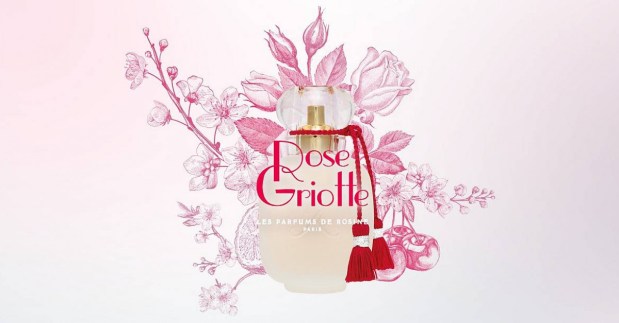
Thanks to a kind reader, I have a generous sample of Les Parfums de Rosine‘s latest fragrance, Rose Griotte. It is lovely! Launched in February of this year (2021), it was created by perfumer Nicholas Bonneville with Marie-Helene Rogeon. Interestingly, it is really a cherry blossom fragrance, but it has been anchored by a rose accord, as Mark Behnke explains on his blog, Colognoisseur:
The keynote floral is cherry blossom. There is little chance any rose essential oil wouldn’t trample the delicacy of that. So they make the clever choice to use a rose accord of three fresh florals as its balancing partner. It begins with a juice dripping, fruity top accord around pear. There is a bit of citrus and baie rose to provide some rounding effect, but the earliest moments are a ripe pear. Then the heart finds the beautiful powdery fragility of the cherry blossom matched with an expansive rose accord of peony, jasmine, and heliotrope. The last also has a bit of cherry in its scent profile which allows it to act as complement.
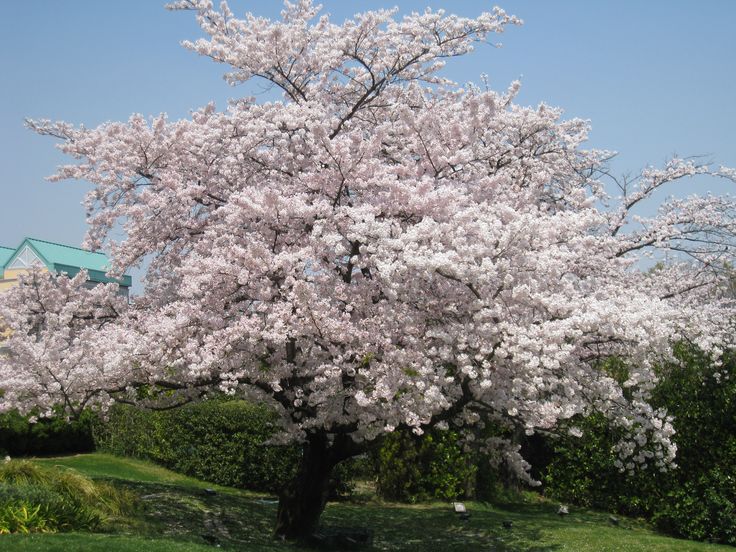
“Griotte” is apparently a wild cherry, sometimes called a Morello cherry, whose fruit is more sour than the cherries we commonly buy at the market. Like tart apples, the sour cherries make for very flavorful pies, clafoutis, and preserves. It has blossoms that are just as beautiful as the famous cherry blossoms in Washington, D.C. Most of those thousands of trees are Yoshino Cherry. Other species include Kwanzan Cherry, Akebono Cherry, Takesimensis Cherry, Usuzumi Cherry, Weeping Japanese Cherry, Sargent Cherry, Autumn Flowering Cherry, Fugenzo Cherry, Afterglow Cherry, Shirofugen Cherry, and Okame Cherry.
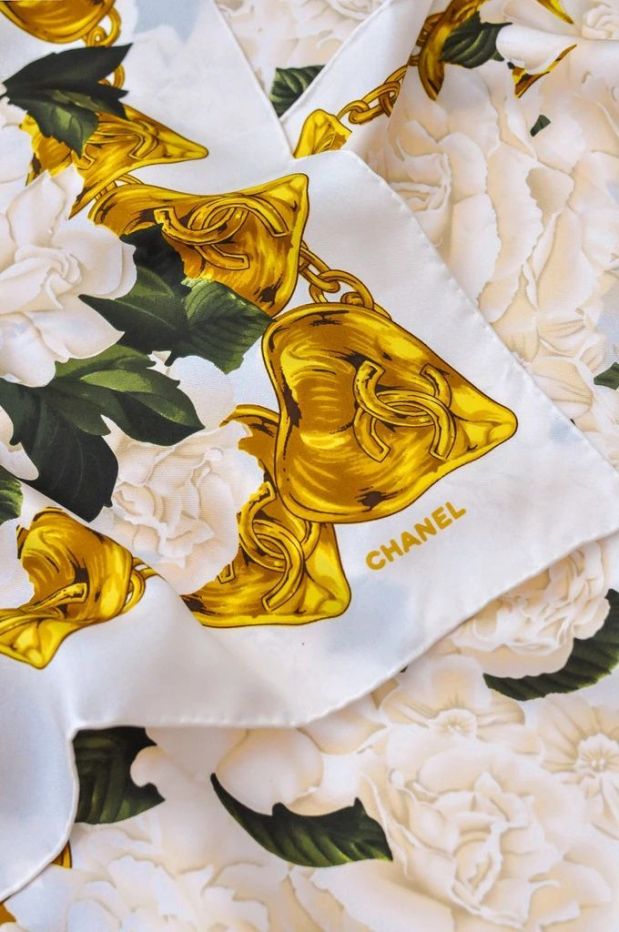
Today was crazy busy, so I won’t have much to say right now, except that my second daughter got her long-delayed college graduation ceremony (she graduated in May 2020), and we were so happy for her! I wore my longtime favorite, the first Chanel I ever bought for myself, No. 22 in the eau de toilette formulation. I have worn it off and on, to greater or lesser degrees, since my own 20s. It is like a familiar scarf at this point — but an elegant silk one with Parisian flair.
No. 22 is a sumptuous Chanel floral with plenty of aldehydes, white flowers, and iris. Top notes are Aldehydes, Neroli, Lily, Tuberose, Lily-of-the-Valley and Orange Blossom; middle notes are Ylang-Ylang, Jasmine, White Rose and Nutmeg; base notes are iris, Vanilla and Vetiver.
I’ll say more about it tomorrow!
Continuation: One of the things that puzzles me about No.22 is how often other commenters talk about an incense note. I don’t smell any incense at all! And I remember when I bought it, the sales associate told me it was based on white roses. I was thankful to see white roses listed among its notes! I don’t, however, think the white roses are dominant, certainly not the way they are in Jo Loves’ White Rose & Lemon Leaves. Nor is incense listed among its notes.
I do smell something sort of woody, sort of spicy, and I think it’s the nutmeg listed as part of the heart phase of No.22. It’s an unusual note to combine with all the white flowers in No.22. Aldehydes dominate the opening notes, an overdose for which No. 22. is famous. It was created by Ernest Beaux at the same time as the legendary No.5, and was one of the finalists presented to Coco Chanel for her house’s first fragrance. She chose No.5 instead, which launched in 1921; No.22 launched the next year (1922). The aldehydes and iris have led my daughter to declare that it smells like baby powder. Sure, honey, the world’s most elegant and expensive baby powder!
I know some of the regulars here share my love for No.22, such as Kathleen and Portia. Anyone else? Care to share your thoughts and experiences in the comments?
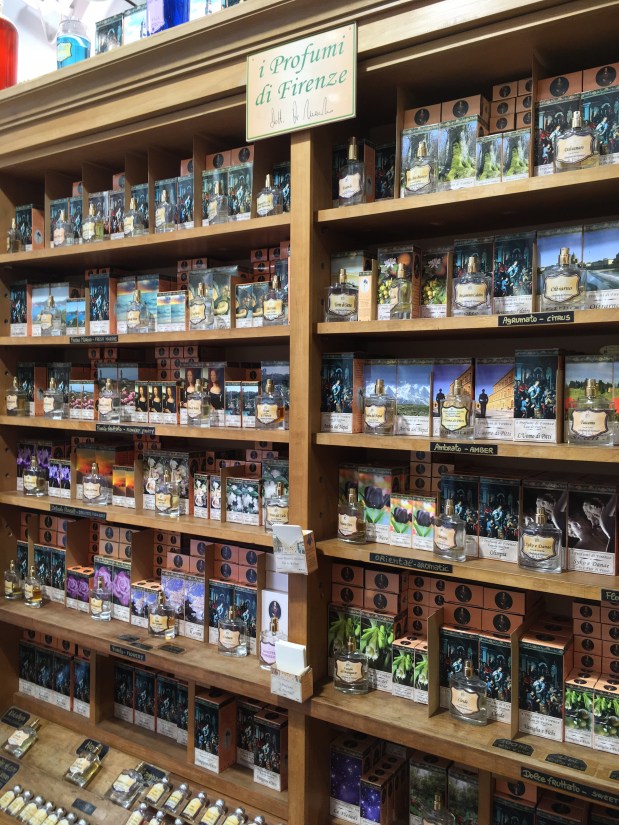
One of my greatest pleasures is to travel with my husband, and until 2020, his work required him to travel a LOT. I couldn’t go on most trips during the academic year, due to my own job, but I was able to go with him usually at least once a year. 2019 was a banner year for such trips — I was able to go with him on business trips to Nice, then London, then Tuscany. The Tuscany trip happened in the summer, so we extended it for a real vacation and spent several days in Florence and Venice, which we had never seen before.
One of the bottles from the latter that came home with me was Jeunesse Il Giorno e La Notte, which is formulated as an eau de parfum. The notes list from the brand’s website includes Citrus, Italian Bergamot, Lily Of The Valley, Lavender, Floral Notes. Fragrantica adds that the base notes are white musk, and musk.
I should start this mini-review by noting that my 19 year-old son, who is usually pretty oblivious to his mom’s fragrance habits and applications, walked over to me today around noon to ask about yardwork, and immediately said, “You smell so nice!”. Music to a mother’s ears.
Chanel’s Cristalle came to me later in life; my earliest Chanel “love” (for myself) was No.22, which I still love and wear, then No.19, also still a strong love and in regular rotation on my skin. I’m not sure why it took me so long to discover Cristalle; I probably thought my need for a green Chanel was fully met by No.19. Regardless, I first tried Cristalle a few years ago, and yes, it’s love. I wear Cristalle on days when I need a good snap of green but No. 19 feels like overkill. Both were created by perfumer Henri Robert: No. 19 in 1970, and Cristalle in 1974. (I refer to the eau de toilette; Jacques Polge created an eau de parfum version for Chanel twenty years later).
The two share some notes. Cristalle‘s notes are: Top notes — Sicilian Lemon and Bergamot; middle notes — Hyacinth, Brazilian Rosewood, Honeysuckle and Jasmine; base notes — Oakmoss and Vetiver. No.19‘s notes are: Top notes of Galbanum, Hyacinth, Bergamot and Neroli; middle notes of iris, Orris Root, Rose, Lily-of-the-Valley, Narcissus, Jasmine and Ylang-Ylang; base notes of Oakmoss, Vetiver, Leather, Cedar, Musk and Sandalwood. No.19 was launched the year before Coco Chanel died; it seems to be the last fragrance that she personally approved.
We interrupt our regularly scheduled programming, because the following New York Times Style Magazine article popped up in my news feed, and I got totally distracted by it! It is called The Fragrances That Changed the Field, by Aatish Taseer. It starts with a childhood memory, from India, of a first encounter with oudh, and travels a winding path from there through the “Orientalism” of fragrances in the 1970s, to the power statement fragrances of the 1980s, circling back to previous centuries and the use of florals and musks in fragrances. It includes insight from several modern perfumers.
I highly recommend this article! You’ll want to set aside a good block of time to read it. The opening paragraph:
I REMEMBER AS IF it were yesterday that distant afternoon on which I first smelled oudh. I was in my grandmother’s house in Delhi. I was 13, maybe 14. We had a family perfumer, or attarwallah, a man of some refinement, who came to us from Lucknow — a city that is a metonym for high Indo-Islamic culture. We didn’t know the attarwallah’s name, or how he knew to follow us from address to change of address. But he came without fail two or three times a year. A slim, gliding figure, with a mouth reddened from paan, or betel leaf and areca nut, the attarwallah produced his wares from carved bottles of colored glass that he carried in a black leather doctor’s bag. He showed us scents according to which season we were in. So in winter, musk and patchouli; in summer, white-flowered varieties of jasmine — of which there are some 40 odd in India — as well as rose and vetiver. In the monsoon, he brought us mitti attar, which imitates the smell of parched earth exhaling after the first rain (“mitti” means “mud” in Hindi). The perfumes came from the medieval Indian town of Kannauj, which is a 75-mile drive west of Lucknow and which, like its French counterpart, Grasse, has a tradition of perfume manufacturing several centuries old. Once he had drawn his perfume out on white cotton buds at the tips of long, thin sticks, the attarwallah lingered over his customers, telling stories of the various scents and reciting the odd romantic couplet of Urdu poetry.
If that doesn’t intrigue you, as a person interested in fragrance, I don’t know what will! Enjoy. BTW, my scent of the day today was Cristalle, and I’ll write about it tomorrow instead.
I promise I won’t spend the whole month of May dissecting Zara Emotions fragrances, but here’s another one: Bohemian Bluebells. I like it very much and it’s certainly affordable! Also truly unisex, I think it would smell wonderful on a man as well as a woman. Its listed notes are lavender, sandalwood, and musk (nothing to do with bluebells). If you can imagine a warm lavender, that’s what it smells like to me. I do tend to associate lavender with bedtime, given its soothing properties, but I don’t usually associate it with warmth in spite of its cultivation in hot, sunny climates like Provence (there are also famous lavender fields in England and other parts of the UK). Sometimes I crave Jicky eau de toilette at bedtime, if I’m going to sit up and read for a while, but Jicky feels cool to me somehow, like the clean sheets that have been newly put on a bed, with their crisp, unwrinkled surfaces.
“Melange” is an apt word to use for Estee Lauder’s Beyond Paradise, as it is truly a melange of different florals. In their book “Perfumes: The Guide A-Z”, Luca Turin and Tania Sanchez not only gave it five stars, but also close to three full pages of discussion (most perfumes got a paragraph). He calls it a “symphonic floral.” Calice Becker was the perfumer who created it; Beyond Paradise was launched in 2003. The bottle I have is the teardrop-shaped, rainbow-tinted original. The batch number on the bottom suggests it dates to 2013. Fragrantica lists that version’s notes as: Top notes of Hyacinth, Orange Blossom, Grapefruit, Bergamot and Lemon; middle notes of Jasmine, Gardenia, Honeysuckle and Orchid; base notes of Hibiscus, Plum Wood, Ambrette (Musk Mallow) and Amber. The 2015 version in the rectangular bottle is described as having top notes of Blue Hyacinth, Orange Blossom and Jabuticaba; middle notes of Honeysuckle, Jasmine, Orchid and Mahonia; and base notes of Ambrette (Musk Mallow), Plum Blossom, Paperbark, and Woody Notes.
Both versions of Beyond Paradise are meant to be “fantasy florals” with a tropical theme; part of the length of Turin’s review is a long digression into the nature of abstract floral fragrances and how challenging they are to create, with a tip of the hat to perfumer Calice Becker, an acknowledged master of the art. According to contemporaneous press and PR coverage when it was launched, it included “proprietary notes” gleaned from a collaboration with The Eden Project, a fascinating conservation site in Cornwall, which involves massive biospheres located in and above an abandoned quarry and which I’ve had the privilege to visit. It does in fact house many rare and tropical plants, so it must be a great resource for unusual smells.
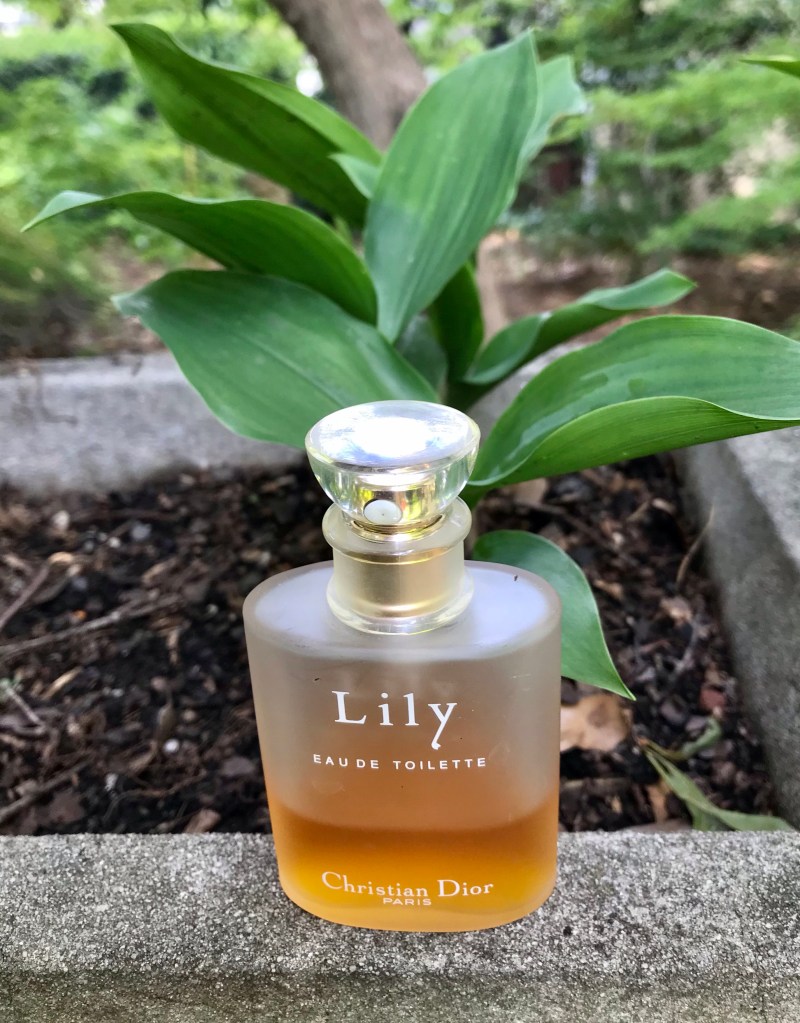
Parfums Christian Dior is responsible for possibly the most famous muguet fragrance of all time, Diorissimo. A less-known, discontinued muguet fragrance by Dior is the lovely Lily, launched in 1999. The perfumer behind it is Florence Idier, who also created Comme des Garcons’ Series 1 Leaves: Lily, another lily-of-the-valley fragrance. There is another fragrance called Lily Dior, but the one I have is just called Lily; it is an eau de toilette.
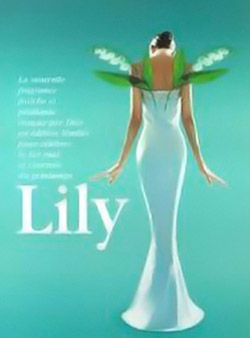
Lily, by Parfums Christian Dior; image from Fragrantica
Fragrantica (which has a photo of the wrong bottle on this fragrance’s page, btw; it shows 2004’s Lily Dior) lists its notes as: Top notes are Green Notes, Fruity Notes, Bergamot and Brazilian Rosewood; middle notes are Lily-of-the-Valley, Lilac, Lily, Jasmine and Rose; base notes are Musk and Sandalwood.
I acquired my bottle of Lily within the past year, so it has never featured in my frequent “May Muguet Marathon.” It wouldn’t be May for me without some reviews of muguet fragrances! I like Lily very much, and if I didn’t already have several true-love muguet fragrances, it would be among my top dozen. Even as a vintage eau de toilette, its top notes are clear and strong, with a noticeable fruit note at the start that reminds me of a green pear. The only listed top note that I don’t really smell is the rosewood; the opening is very fresh and green.
The lily-of-the valley note steps forward quickly and it is very natural-smelling (although LOTV notes famously rely on clever combinations of other substances, as the flowers’ natural essence cannot be extracted). The companion notes of lilac and jasmine are evident, with the lilac slightly more obvious than the jasmine. At this stage, Lily reminds me a lot of the 1998 version of Guerlain’s Muguet, which was created by Jean-Paul Guerlain and launched the year before Lily.
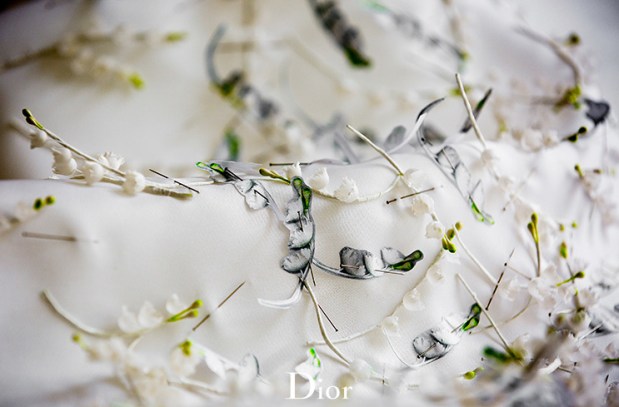
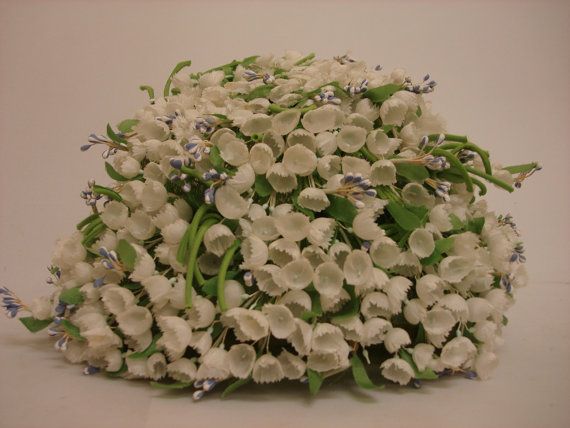
Hmmm. The list of notes for each fragrance is almost identical, according to Fragrantica. The clear presence of both lilac and jasmine in the middle stage, as part of the evocation of lily-of-the-valley, is very similar in each fragrance. Lily‘s opening is distinctive, though, with that green pear note that gives it some zing together with the bergamot. I’m going to give Parfums Dior the benefit of the doubt here, though: Christian Dior’s association with the muguet, his favorite flower, goes back decades and prompted the creation of Diorissimo; the flower appeared regularly in Dior fashions: dresses, scarves, hats, jewelry, and apparently he had a tradition of giving sprigs of lilies-of-the-valley to employees every May Day, which the fashion house continues to this day. Don’t you just love this hat?
Lily of the valley hat by Christian Dior
The Christian Dior name is also attached to a wide variety of household goods featuring lilies of the valley as his signature flower, everything from sheets to fine porcelain. A new collection of muguet-themed housewares was launched by Dior last year, and they are quite beautiful.
As my regular readers know, I truly love muguet fragrances. I struggle to grow them here in the South, as it really is too hot and humid here for them, but I have a few plants I have nursed along in dedicated planters on the shady edge of our front terrace, where I can keep them well-watered and mulched with the rich humus compost they love. Lily is very true to the natural scent of lilies-of-the-valley and it doesn’t smell soapy at all to my nose, unlike some LOTV fragrances. It doesn’t last more than a few hours, which is the norm for most muguet fragrances, especially in eau de toilette concentrations. While it lasts, though, it is very pretty. However, most of the prices you will see online for Lily are too high, considering that one can easily find lovely, newer, muguet fragrances that are more affordable, or at least fresh (see my “May Muguet Marathon” posts for some suggestions!).
For a lovely post on lily-of-the-valley scents, check out one of my favorite blogs, Bois de Jasmin. Its author, Victoria, mentions Dior’s Lily briefly in the comment section. She writes about muguet fragrances pretty regularly, as it is a favorite scent of hers. I know lily-of-the-valley scents can be polarizing; people tend to like them very much, as I do, or not at all. How do you feel about them?
Today’s floral is Serge Lutens’ La Vierge de Fer, which means “Iron Maiden” in English. The Iron Maiden was a notorious (though possibly apocryphal) medieval torture device, an upright metal box shaped like a person, in which spikes were set into the interior of the opening, which, when closed, would pierce a prisoner locked inside the device. Lovely.
I don’t follow Serge Lutens very closely although I have and appreciate several of his fragrances, and I would love to visit his boutique in the Palais-Royal in Paris some day. So I don’t really buy into the self-consciously arcane descriptions of his fragrances, but here is what the brand writes about La Vierge de Fer:
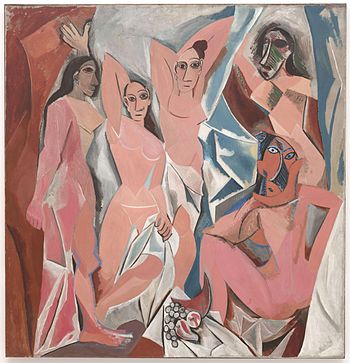
Let there be light! And darkness no more. He who wishes does not have a black soul! “I will come as a thief …” said Christ; certainly in silence and probably, for him, wearing shoes. To deserve his title, the Thief must act under the wide-open eye of the absent owners. In this case, it is not that tenuous eye with which Cain stares without regret, but another, which in some way will make an accomplice of Abel. If the fetishes, idols and charms of the Museum of Man, in Paris, had not met the 20th century, everyone would have missed that incredible mockery of Eros which The Young Ladies of Avignon certainly is. “The Negros had understood that everything which surrounds us is our enemy”, the wizard Picasso said to his paintbrush. Who, if not one of them, decided on life, by death, would dare, to unclench the teeth of this sex of the world: fear. Since it is the fruit of our entrails, it must be elevated. For that, not fearing incest, we will embrace it. In this way, she will give birth to our most beautiful monsters. That is how, a little rusty by dint of doubts, my steps have rejoined La vierge de fer (the Iron Maiden); that lily amongst the thorns.
Today’s fragrance is a true “melange”, from the Zara Emotions line, a series of fragrances created by the perfumer Jo Malone for Zara, the clothing retailer that is known for its inexpensive yet effective fragrances. In interviews, Ms. Malone has said that the line uses raw ingredients similar to the ones she uses in her own (much more expensive) line, Jo Loves, taking advantage of Zara’s enormous global buying power; there are just fewer separate ingredients in each Zara Emotions fragrance. The Zara Emotions fragrances are pretty simple but several are very appealing, and they are designed to be easy to layer with each other. So today, I am wearing one of the brand’s recommended combinations, Waterlily Tea Dress and Amalfi Sunray.





 Serenity Now Scents and Sensibilities