May Muguet Marathon: The Nuptial Bouquet

May Muguet Marathon: The Nuptial Bouquet

It seems fitting that there is a lily of the valley fragrance called The Nuptial Bouquet, given how often lilies of the valley appear in bridal bouquets. Atkinson’s fragrance by that name includes notes of lily of the valley, violet leaves, myrtle flower, sandalwood, and musk. It is supposed to refer to the flowers carried by Queen Victoria in her own bouquet at her wedding to Prince Albert. From the website:

A cherished bouquet of ardent Romance composed of the very blooms Queen Victoria carried down the wedding aisle to her beloved Albert. Hearkening back to a time when flowers, steeped in meaning, spoke volumes…
A fragrance for royal romance, a retro contemporary interpretation of Queen Victoria’s bridal bouquet: the green and white loveliness of lily of the Valley, violet leaves and exquisite myrtle flowers enhanced with delicate white musk and sandalwood.

It’s a lovely story, but I can’t find any reliable source that confirms Victoria carried lilies of the valley on her wedding day. In fact, although the inclusion of myrtle has taken on a life of its own as a royal tradition, that too may be a myth. While it is true that there are myrtle plants in royal gardens descended from one planted by Victoria, it seems that was NOT in her own bouquet but was from a gift to her by Prince Albert’s grandmother. Nevertheless, it is true that royal brides from the 19th century forward have had at least a sprig of myrtle in their own bouquets, including Queen Elizabeth.

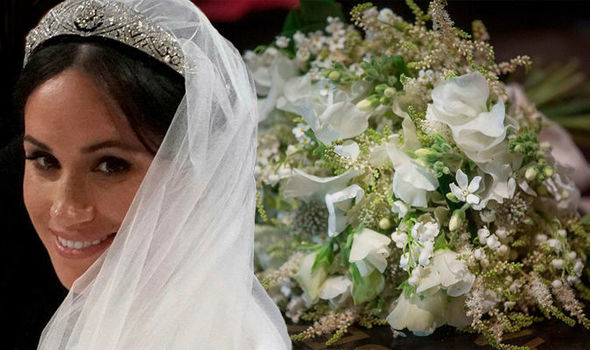
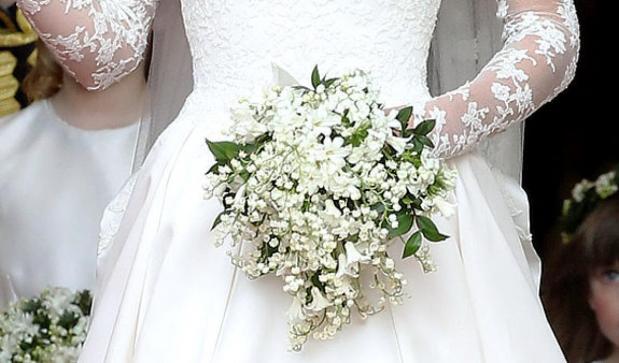
In fact, since Prince William and Kate Middleton were married in 2011, and The Nuptial Bouquet was launched in 2013, I think its floral notes refer more directly to Kate’s bouquet, not Victoria’s. And we DO know that Kate carried lilies of the valley.

Kate Middleton's wedding bouquet of lilies of the valley.

Kate Middleton’s wedding bouquet; image from http://www.TheKnotNews.com

The Nuptial Bouquet is a very lovely muguet fragrance. It opens as a light, green, lemony muguet, the green also coming from the note of violet leaves, which lend a certain crisp freshness. It is very much a bouquet of spring flowers, without being overly sweet. Its floral notes don’t last terribly long, but they do last for a while, and the drydown, which is a green-tinged musky sandalwood, lasts a long time as a skin scent.The myrtle note adds an herbal aroma that I find very appealing. I prefer aromatic florals over fruit florals; this is not a full-on aromatic floral, but it is definitely not “fruity”. It is a feminine floral, light and fresh, with a sheer, floating airiness that reminds me of a bridal veil.

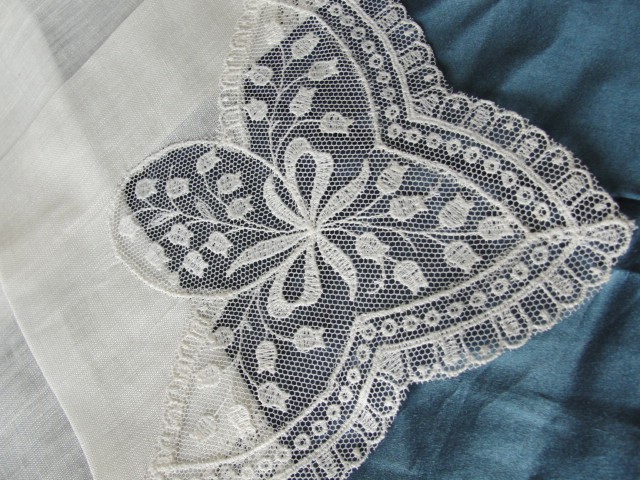
Speaking of veils, wasn’t Kate’s veil gorgeous? As we have another royal wedding coming up next weekend, let’s bask for a moment in the beauty and artistry of the craftspeople whose work will be on display. Kate’s veil was of silk tulle, embroidered by hand with garlands of flowers by the Royal School of Needlework. I was able to see the veil, and her dress, and other accessories, when they were on display at Buckingham Palace after the wedding, and they were simply beautiful. My only disappointment was that I wish the embroidered flowers had included lilies of the valley, which I did not see in the garlands, as there are many truly lovely lace and embroidery patterns for lily of the valley blossoms.

Detail of vintage lily of the valley lace pattern

Lily of the valley lace; image from http://www.sovintagelinensnlace.com.

A minor matter! If a bride wants the effect of a sheer, lacy, floating lily of the valley on her wedding day, she  might be very pleased with The Nuptial Bouquet. I am!

May Muguet Marathon: Mother’s Day

May Muguet Marathon: Mother’s Day

Happy Mother’s Day!

Old Herbaceous's avatarSerenity Now Scents and Sensibilities

Happy Mother’s Day to all who celebrate it! Just as May is the month for May Day and muguet, it is also the month when we recognize and appreciate mothers. So today, instead of commenting on a specific fragrance, I’d like to share a bit of Lily-of-the-Valley folklore. Apparently, one of its other names is “Our Lady’s Tears”, or “Mary’s Tears”. According to one website: “It was said that when Mary wept at the foot of the Cross, her tears fell to the ground and turned into the tiny fragrant blossoms of this early spring plant. In England it had the name “Our Lady’s Tears” because when viewed from a distance the white flowerets gave the appearance of teardrops falling.”

View original post 332 more words

May Muguet Marathon: Live in Love

May Muguet Marathon: Live in Love

Another affordable muguet-focused fragrance comes from Oscar de la Renta: Live in Love. Launched in 2011, it was created by Jean-Marc Chaillan, Carlos Benaim, and Ann Gottlieb, according to Fragrantica. Top notes are hyacinth, galbanum, bergamot, lily-of-the-valley and orchid; middle notes are jasmine, african orange flower and rose; base notes are sandalwood, virginia cedar, woodsy notes, amber and musk.

Racked published an interview with M. de la Renta when this fragrance was launched:

… the notes in the fragrance were inspired by his own vast garden, which includes a sparkling ginger orchid that was flown in from France. De la Renta, if you didn’t know, feels very passionate about flowers, particularly their scents: “I think that a flower that doesn’t smell is like a woman with no fragrance. For example, one flower that they say is an unbelievable flower is the camellia; it’s a shame that it doesn’t smell. It’s such a beautiful flower but it has no scent. I wonder why Chanel decided to use camellia.”

The bottle itself is very pretty, eight-sided with a sectioned top. According to the Racked interview, the name came from a tattoo that M. de la Renta glimpsed on the arm of one of his colleagues during the creation of Live in Love; he was so intrigued by the phrase that he made it his new fragrance’s name.

The opening isn’t particularly reminiscent of lily of the valley, though it is very pleasant: bright bergamot that morphs into a light, fresh floral. As it evolves, the fragrance actually gets a bit greener than that very first stage when the galbanum emerges. Fragrantica readers find the lily of the valley and hyacinth notes most prominent, but I don’t. Most of what I smell is the African orange flower. Again, very pleasant, but not muguet! As it continues to dry down, it continues to be a fresh, pleasant, light floral, but not one where it is easy to pick out specific notes. Live in Love would be a good everyday office scent, especially in spring or summer, but if you’re looking for a true muguet-centric fragrance, it will disappoint you.

May Muguet Marathon: Virgin Lily of the Valley

May Muguet Marathon: Virgin Lily of the Valley

Eric Buterbaugh has long been a “florist to the stars” with a renowned flower shop in Los Angeles. Some years ago, he branched out (pun intended) into fragrances and other lifestyle products like candles and gifts. He launched his fragrance collection, EB Florals, in 2015 with eight scents based on the flowers he knows so well, one of which was Virgin Lily of the Valley.  And here is where I am very thankful, specifically, to Scentbird. I was able to snag a nifty 8 ml sprayer of it through my monthly subscription, which was the only way I was going to own it, as a 100 ml bottle retails for $295! So although I don’t own the gorgeous bottle — which is clear and curved like a large drop of dew — I do have enough of the fragrance to try it out really well. The Eric Buterbaugh website says this:

Pierre Negrin conceived this delightful Lily like a tower of glass, where all is visible from the start, from top to bottom. The tingle of a citrus, the beauty of the Lily and the softness of musks, are all present at once. The result is a Lily floating in the air, in all its white purity.

TOP NOTES
Linden, Quince, Litchi, Fleur de Narcisse Absolute, Nectarine, Natureprint
HEART NOTES
Fleur de Oranger Supra SFE, Fleur de Tiare, Jasmin Sambac Firabsolut
BASE NOTES
Osmanthys, Tuberose Absolute, Muscenone, Ambrox
Notice that neither muguet nor lily of the valley is listed, despite the fragrance’s name! This is a very dewy floral, watery and fresh, not intensely green. It is very pretty, but I’ll confess that I don’t smell much lily of the valley at all! So I think the name is misleading; this is a fantasy lily, not a muguet. Interestingly, the notes listed on Fragrantica are quite different, though I’ll take the company’s own website’s word for what they are. Fragrantica lists top notes as bergamot,  palisander rosewood, and orange blossom; heart notes of lily of the valley, ylang ylang, and amaryllis; and base notes of sandalwood, musk, and ambrette.
Scentbird had a brief interview with Mr. Buterbaugh earlier this year. He described the link between his floral designs and his fragrances:

I first look at a floral composition as an overall shape. For me, proportions matter most, which is why I mostly like to work with one or two species of flowers only in each composition. If you mix too many kinds of flowers, you lose control over texture, dimensions, proportions. I spoke at length with the Perfumers about this concept. It fits well with the idea we had from the start to celebrate one flower per scent. Which doesn’t mean creating monolithic soliflores. Our creations are layered and complex. But they are articulated around one specific flower every time.

The opening and early stages of Virgin Lily of the Valley remind me of Lily by Lili Bermuda, probably because of the fruit notes combined with flowers. As it dries down, though, I do smell the musky basenotes, including a semi-woody, herbal note that I think is the ambrette (or Ambroxan), and I like the combination.

However, I am really intrigued by EB Florals’ new “muguet”: Floral Oud Lily of the Valley, one of a collection of floral scents combined with oud. Here’s the description:

This union of opposites opens with a fruity/ spicy combination of bergamot and cassis buds, but the lily soon starts weaving its way into the mix, supported by a subtle hint of Tuberose. The oud is there almost from the start, but tamed in a way that allows for the floral notes to breathe and blossom.

The rest is amber and sandalwood, all the way to the end.

A delightfully original creation.

Original indeed — who would think to combine muguet with oud? And talk about a gorgeous bottle:

Black bottle of EB Florals by Eric Buterbaugh, Floral Oud Lily of the Valley

EB Florals, Floral Oud Lily of the Valley; image from http://www.ericbuterbaugh.com

So now, having satisfied my curiosity about Virgin Lily of the Valley, I can only hope that Scentbird arranges to carry the new Floral Ouds, especially this one. Because I am really interested in trying this combination! Have any of you tried any of the EB Florals, and especially the Floral Ouds?

May Muguet Marathon: Gucci Envy

May Muguet Marathon: Gucci Envy

One of the great pleasures of reading Turin and Sanchez’ guide to perfumes is the occasional surprised snort of laughter when one of their reviews snarkily turns a phrase that perfectly captures their — and your — experience of a fragrance. One of my favorites: “cK IN2U Her: OMG PU. Insanely strong fruit meets insanely strong woody amber. KTHXBYE.”

The snarky humor applies evenly to perfumes they praise, such as Gucci Envy:

Envy (Gucci) ***** green floral $$

Maurice Roucel has a knack for putting together perfumes that feel haunted by the ghostly presence of a woman: Lyra was a compact, husky-voiced Parisienne, Tocade a tanned, free-as-air Amazon. These have another Roucel hallmark, the spontaneity of the unpolished gem. When subjected to the full grind of the marketing department, Roucel’s style can become cramped and tends toward brilliant pastiches of classical fragrances: 24, Faubourg; L’Instant; Insolence. Envy is to my knowledge the only time when the balance between Roucel’s magic and the real world gave rise to a work that, like a diamond, needed both heat and pressure to form. My recollection is that Envy was panel-tested again and again while Roucel adjusted it until it outperformed Pleasures, then at the top of its arc of fame. It is amusing to think that such a comparison between apples and pears could be considered meaningful. However, it did constrain the woman inside Envy to be at once seraphic and suburban, complete with the sort of suppressed anger that such a creature would feel at being reincarnated as a florist in eastern New Jersey.

Why a florist? People describing fragrances often describe very green, hyacinth-dominant scents as smelling like the inside of a florist’s refrigerator. And that is the major impression of Envy after the sharp, tangy-green opening. Envy’s heart notes are: hyacinth, lily of the valley, rose, jasmine, violet and iris, after an opening that is dominated by bergamot and freesia with support from minor top notes of peach, magnolia, and pineapple (for the record, I don’t smell pineapple, but that could be because my bottle of Envy is several years old; it was discontinued).

The muguet note is very prominent in Envy, but it isn’t soapy AT ALL, unlike some lily of the valley scents. It is green all the way, with hyacinth hot on its heels and gaining ground throughout Envy’s progression. Fragrantica has an interesting summary, describing it as a “metal accord surrounded by a floral bouquet”:

Envy could be compared to a breeze that brings spring into the city. Its architecture is modern; it denies gaudiness, accentuating minimalism. The composition starts with green notes with a cool metal note that freezes the senses. Gradually the scent warms up due to woody notes and musk.

Envy does start off as a very cool, contained, green scent, and I can understand the comparison to cold metal, given the “florist’s refrigerator” vibe it gives off, especially in the first hour or so. Maybe the seraph of Luca Turin’s imagination is trapped inside the florist’s refrigerator, not reincarnated as the suburban florist.

Gradually, Envy starts showing glimmers of — not warmth, exactly, but a mossy woodiness that grounds it. The base notes are oakmoss, sandalwood, cedar, musk, and jasmine. The green notes from the muguet, hyacinth, and freesia are still powerfully present, but the fragrance takes on an earthiness that brings them back to ground. The progression of Envy resembles the slow descent of a winged, green creature whose feet lightly touch the mossy floor of a forest.

Novel Green Angel by Alice Hoffman

Green Angel, by Alice Hoffman

I haven’t yet read the book Green Angel, whose cover is featured above, but in my search for an image that captured the final stage of Gucci Envy, this popped up and it seemed just right. The College Gardener has a brief review of the book, and it may have to go on my reading waitlist. That’s for another day. In the meantime, I have to go liberate a green seraph who has been imprisoned within a tall bottle of eau de toilette.

Bottle of Gucci Envy eau de toilette

Gucci Envy

Featured image above from Angels, by Olga Rezo.

May Muguet Marathon: Maiglockchen and Mendelsohn

May Muguet Marathon: Maiglockchen and Mendelsohn

As another brief byway in a monthlong discussion of muguet, I have learned something new: not only does Germany celebrate muguet in May similarly to the French, they have their own charming name for lily of the valley: Maiglockchen. Loosely translated, that means “May’s little bells.” Not only that, but some of Germany’s most renowned authors and poets have written about “maiglockchen”, and Felix Mendelsohn set one of those poems to music, as part of a set of six “lieder”, or songs, in the form of duets. It is called “Maiglockchen und die Blumelein” (pardon the absence of umlauts; I haven’t mastered those yet).

Sheet music for "Maiglockchen und die Blumelein" by Felix Mendelsohn.

Sheet music for “Maiglockchen und die Blumelein” by Felix Mendelsohn.

It is a duet for women’s voices, and musicologist John Palmer describes it thus:

The vivacious “Maiglöckchen und die Blümelein” (Lily of the Valley and the Little Flowers), setting a text by von Fallersleben, dates from January 23, 1844. Mendelssohn gives forward motion to the poem, about the coming of spring and the attendant round-dance, through a syncopated repeated note in the piano part. The voice parts and right hand of the piano form a melodic unit through most of the duet.

You can hear it for yourself here:

If you’d like to know more about the symbolism of the “Maiglockchen” in German culture, this blog has a nice summary. I was interested to read that the lily of the valley is associated with Ostara, the pagan goddess of spring and dawn (who also inspired one of my all-time favorite fragrances, Penhaligon’s Ostara). Do any readers know of more lily of the valley celebrations in other countries?

May Muguet Marathon: Muguet en Fleurs

May Muguet Marathon: Muguet en Fleurs

Another affordable muguet fragrance comes from Yves Rocher: Muguet en Fleurs. It is exactly what it appears to be: a muguet soliflore, priced for the mass market but with Yves Rocher’s customary good value. In other words, this is a pretty fragrance (and the nose behind it is Sonia Constant), and it smells nice while it lasts, but it doesn’t last long at all on most people.

There is no progression to describe, because the scent comes and goes so quickly; the only notes listed on Fragrantica are lily of the valley and green notes, and that is pretty much what you get, although when it launched, Now Smell This also listed bergamot, citron and pink pepper. Some Fragrantica commenters have noted that this would be a pretty scent for linens, etc., and it would. It also comes in the form of shower gel and body milk, which might extend the longevity of the eau de toilette. In its bottle, the eau de toilette is pale green, just as in the photograph above. It is part of a series, like Guerlain’s original Aqua Allegoria series, meant to evoke a morning in a garden.

It is light, fresh, and dewy, and it is muguet, but that’s about all there is to it. However, if all one wants is a little burst of lily of the valley, easy to reapply all day, this is a nice option. It would be hard to over apply Muguet en Fleurs, as it is so light and fleeting, but when you first spray it on, it is bright, cheerful and reminiscent of spring. Some days, that is all one needs or wants. But I’m definitely going to try it on my pillow!

Pillowcases with lily of the valley design by Lilly Pulitzer

Lily of the valley bed linens; Lilly Pulitzer

May Muguet Marathon: Queen

May Muguet Marathon: Queen

For such a modest looking plant, lily of the valley keeps some surprises up its green sleeves. For one thing, the power of its fragrance is surprising; its flowers are so small, often partly hidden behind its upright green leaves, that one wouldn’t necessarily expect them to send out such a strong scent. But they do, and it can waft across an entire garden, surprising the casual visitor with its presence, and not necessarily revealing its source without a search. The “pips” of the plant are unprepossessing; they look like a small bundle of tangled roots topped by a growing tip. One plants them in the faith that a green plant will emerge — and when it does emerge in the spring, it can do so overnight.

Town & Country magazine published some surprising facts about lilies of the valley a couple of years ago: 13 Things You Didn’t Know About Lily of the Valley. With another royal wedding in the offing this month, it is fun to note how many royal brides have carried lilies of the valley in their wedding bouquets: Queen Victoria, Princess Astrid of Sweden, Grace Kelly, and Kate Middleton, among others.

But here is the most surprising thing I learned from the Town & Country article: Freddie Mercury and Queen wrote and recorded a song titled “Lily of the Valley”! Who knew?

And there is a powerful story behind the song. Guitarist Brian May, a founder of Queen, told a British music magazine in 1999 (several years after Freddie Mercury’s death from AIDS): “Freddie’s stuff was so heavily cloaked, lyrically… But you could find out, just from little insights, that a lot of his private thoughts were in there, although a lot of the more meaningful stuff was not very accessible. Lily of the Valley was utterly heartfelt. It’s about looking at his girlfriend and realising that his body needed to be somewhere else. It’s a great piece of art, but it’s the last song that would ever be a hit.”

According to Wikipedia, that girlfriend was Mary Austin, to whom May had introduced him and with whom Mercury had a long live-in relationship in the early 1970s, until he began an affair with a male executive in the music industry.

Mercury told Austin of his sexuality, which ended their romantic relationship.[59][78] Mercury moved out of the flat they shared, into 12 Stafford Terrace in Kensington and bought Austin a place of her own nearby.[59] They remained close friends through the years, with Mercury often referring to her as his only true friend. In a 1985 interview, Mercury said of Austin, “All my lovers asked me why they couldn’t replace Mary [Austin], but it’s simply impossible. The only friend I’ve got is Mary, and I don’t want anybody else. To me, she was my common-law wife. To me, it was a marriage. We believe in each other, that’s enough for me.”[79] He also wrote several songs about Austin, the most notable of which is “Love of My Life“. Mercury’s final home, Garden Lodge, 1 Logan Place, a twenty-eight room Georgian mansion in Kensington set in a quarter-acre manicured garden surrounded by a high brick wall, had been picked out by Austin.[80] In his will, Mercury left his London home to Austin, rather than his partner Jim Hutton, saying to her, “You would have been my wife, and it would have been yours anyway.”[81] Mercury was also the godfather of Austin’s oldest son, Richard.[60]

The song “Lily of the Valley” has been recorded by other artists. Why the title “Lily of the Valley”? No one knows for sure, but one wonders if Mercury had in mind one of several other names for the flower, Mary’s Tears. Regardless, this surprising flower with its secrets seems like an appropriate metaphor for the dilemma of a sensitive, loving man, realizing what his true orientation was and struggling with how to tell a woman he clearly loved deeply Although at one point he had proposed marriage to Mary, they never married because he was honest with her about his sexuality. The flowers of lily of the valley seem to have had ongoing meaning to him; when he and actress Jane Seymour had a pretend “wedding” at Royal Albert Hall at the fundraiser Fashion Aid, she wore lilies of the valley in her wreath of flowers, like so many other queens and queens-to-be.

Queen's Freddie Mercury and Jane Seymour at Fashion Aid, 1985.

Freddie Mercury and Jane Seymour at Fashion Aid, 1985.

Featured image: Freddie Mercury and actress Jane Seymour, pretend wedding at Fashion Aid in 1985; photo from http://www.imgur.com.

May Muguet Marathon: Jessica McClintock

May Muguet Marathon: Jessica McClintock

Raise your hand if you’ve ever owned a garment by Jessica McClintock or Gunne Sax? That’s right — most of us females can put our hands down now. First under the name Gunne Sax, then under her own name, designer Jessica McClintock made the skirts and dresses teenaged girls wanted, from the 1960s until 2013, when she ceased manufacturing and retired. The company long dominated the market for girls’ special occasion dresses, but it also had a strong presence in the market for wedding dresses. Its specialty was figure-flattering, somewhat modest, feminine dresses, evolving from its 1970s-1980s look of prairie-style high necks and puffed sleeves. Thirty years ago, she launched her own fragrance, Jessica McClintock, and it became as ubiquitous as her dresses — maybe more so, as it appeals to a wider age range than the girls and young women who flocked to her racks for prom, special occasion, and wedding dresses. The fragrance continues to be licensed and sold, and you will find it almost everywhere, often in a gift set.

Jessica McClintock gift set

Jessica McClintock fragrance; image from http://www.evine.com

Like her dresses, Jessica McClintock is a “safe” buy, but also very pretty and reasonably priced. The Washington Post summed up the brand’s aesthetic perfectly in this article addressed to Jessica McClintock herself (yes, she’s a real person):

Your dresses set the stage for some of our most memorable and awkward high school experiences — and you let us feel picture perfect for those moments. (We might not have had Facebook, but as any ‘90s girl knows, disposable camera photos are forever.)

You were our introduction to strapless dresses, our testing ground for colorblocking. You taught us to embrace polka dots and satin ribbons and ruching at the waist (that one we really owe you for). But most importantly, you helped us feel pretty and sexy before we really knew what pretty and sexy felt like. Those sweetheart necklines, those curvy waists — we were Oscars stars, posing for our parents at backyard pre-prom ceremonies like they were red carpet paparazzi.

They were sweet, simple, attractive dresses, ones that we and our moms could both agree on. No zebra print or cutouts or questionably placed sequins — these were classic dresses that “showed off our shape,” as our mothers would say when we waltzed out of the department store dressing room. We thought we looked beautiful and grown-up in those strapless A-line frocks, and miraculously, our mothers agreed. And it’s no small feat to find common ground between a teenage girl and her mother. You, Jessica McClintock, accomplished the impossible.

But then you did more than that: You made us happy with our bodies. There is no more self-conscious creature than a teenage girl, with her ever-expanding hips and chest and her gawky arrangements of limbs. But your body-skimming frocks, cinched in at the waist with helpful boning in the bodice to remind us to stand up straight, worked with our changing bodies, not against them. We felt safe and secure in all that sturdy satin (er, polyester), feminine in those layers of tulle and beautiful with our shoulders (because who doesn’t like their shoulders?) exposed like grown-up women.

Or, as her longtime divisional designer Erena Shklovsky told Bustle magazine:

Even more relieving for parents was the fact that McClintock’s dresses flattered figures without showcasing too much of them. That made the designer an outlier in the increasingly provocative prom market, which now favors cut-outs over class. “Jessica, she had two points of view on prom: She had designs for good girls, and we had designs for sexy girls,” Shklovsky says. “But even our sexy girls were still good girls.”

And that’s what the fragrance is like: sweet but not too sweet, pretty, tasteful, a little sexy but still innocent, and something both teenagers and their mothers can like. And a bargain, too!

The fragrance has remained popular all these years because it really is good. It’s not great, it’s not a masterpiece, it won’t blow anyone’s socks off, but it’s just a really nice, wearable scent with more character than the tidal wave of fruity florals that has drenched the market in recent years. Per Fragrantica: “Top notes are cassia, basil, ylang-ylang, bergamot, black currant and lemon; middle notes are jasmine, lily-of-the-valley and rose; base notes are musk and woody notes.” When I first spray JMC, I get a burst of tart citrus, evenly divided between the bergamot and lemon. The cassia, black currant and basil add to the tartness and inject herbal greenness.

Very quickly, the lily of the valley steps to the fore. Or, as Victoria at EauMG says: “BAM. Lily of the valley all up in yo face. Plus some citrus. And some greens.” On my skin, I don’t smell much of the rose and jasmine in the middle stage, but I can sort of tell they are there, hovering around the perimeter and adding some nuance to the lily of the valley. The green, herbal notes of the opening phase persist, and make this more of an aromatic floral than, say, a white floral. Given that the citrus notes, as usual, vanish quite early, the ongoing tartness that provides the contrast to the lily of the valley note is likely from the cassia and blackcurrant. If you know what the plants look like, there is also a pleasing reference to the visual contrast between the shiny black fruit of the blackcurrant and the pure white bells of lily of the valley.

Here’s something worth noting: I ended up having much more to say about Jessica McClintock than I had expected. And that too is characteristic of this fragrance: there is more to it than one might think, and its appeal sneaks up on you.

Close up of lily of the valley flowers

Lily of the valley; image from http://www.pixabay.com

cassis-berry

Blackcurrant berries and leaves


May Muguet Marathon: Muguet Fleuri (again)

May Muguet Marathon: Muguet Fleuri (again)

Today’s lily of the valley fragrance is Oriza Legrand’s Muguet Fleuri. A very beautiful scent, it is more than a muguet soliflore. It has a classic structure anchored by a base note of oakmoss. Top notes are, yes, lily of the valley, grass, and green notes (although the Oriza Legrand website lists them more eccentrically as “feuillages vertes, herbes folles, muguet sauvage”). Middle, or heart, notes are lily of the valley (here listed by Oriza LeGrand as “muguet des bois”), violet leaf, angelica and galbanum. Base notes are lily of the valley blossoms (“clochettes de muguet frais”), oakmoss, and wild lily (“lys des pres”, or “lily of the field/meadow”). I reviewed Muguet Fleuri two years ago, in my first “May Muguet Marathon”, but that was based on a sample. A question I posed at the end of the post was whether I should spring for a full bottle. Reader, I did. So here’s a new review.

Instead of true citrus at the top of Muguet Fleuri, we get a burst of lemony fresh greenness that is the first impression, quickly followed by the lily of the valley, which is strong. The heart notes that include violet leaf, angelica and galbanum with the “muguet des bois” send Muguet Fleuri in a different direction than a straightforward floral. All of these heart note companions to the muguet are intensely green. The galbanum gives it a little “bite” as it dries down, a bit of an edge. The angelica brings in an herbal tone. The violet leaf is meant to be somewhat metallic and aqueous, though I’m not sure I would describe it that way, but it is definitely more of a crunchy green than a soft one. Violet leaf appears in many men’s fragrances, so on balance, this phase of the fragrance is where it becomes less feminine and more unisex to my nose, suitable for either a man or a woman. I think this is why Fragrantica categorizes Muguet Fleuri as an “aromatic floral.”

Kafkaesque wrote a very thorough review of Muguet Fleuri. She found violet flowers peeping between the green leaves, but I did not. In the heart phase, the only real flower I smell is the lily of the valley, surrounded by shades of green; it is very true to the actual flower, as I’ve written before. Because of the continuous presence of that lily of the valley, the fragrance doesn’t develop and evolve as much as other high-quality fragrances, but it lasts well, and the base notes are intriguing. The oakmoss seems to anchor the muguet flowers in the earth, with the green leaves and stems sturdily supporting the ethereal white blossoms that look like tiny bells (“clochettes”).

lilies of the valley planted in moss

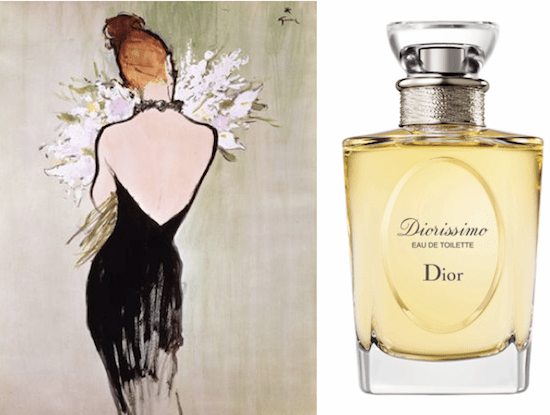
Kafkaesque found the final stage slightly woody: “Muguet Fleuri’s drydown on my skin really feels like a bouquet of lily of the valley, cedar, violet leaves, and violets, even though the latter is now a mere impression more than a distinctive, powerful, individual note. The whole thing is dusted with floral powder that feels sandier than ever, and a light touch of very expensive floral soap.” The Smelly Vagabond also had a very positive review, and an insightful comparison to the classic muguet scent, Diorissimo.

Oriza Legrand deliberately presents its fragrances in old-fashioned design and presentation, to emphasize its history and heritage. Muguet Fleuri is listed among its “Art Deco” Collection; to me, its design elements are reminiscent of the flower illustrations of Cicely Mary Barker, creator of the Flower Fairies in her series of children’s books.

Muguet Fleuri box and bottle

Oriza Legrand Muguet Fleuri; image from http://www.notino.co.uk

Taken together, Muguet Fleuri is a happy, uncomplicated fragrance that is sturdier than it might appear at first impression. I like the opening burst of green, the persistence of various forms of muguet throughout, the well-chosen companion notes, and the oakmoss base. This is a thinking woman’s muguet, but it is far from introverted. It has a warmth to it, after the dewy green opening and herbal green heart, that grounds it and makes it a grown-up muguet. It also comes with a pretty card, imprinted with the same images, and the following cheerful message:

“Que ces quelques brins de Muguet Fleuri vous portent bonheur!” or “May these few sprigs of Lily of the Valley bring you happiness!”. They did.

Featured image by Cicely Mary Barker.