May Muguet Marathon: Jessica McClintock

May Muguet Marathon: Jessica McClintock

Raise your hand if you’ve ever owned a garment by Jessica McClintock or Gunne Sax? That’s right — most of us females can put our hands down now. First under the name Gunne Sax, then under her own name, designer Jessica McClintock made the skirts and dresses teenaged girls wanted, from the 1960s until 2013, when she ceased manufacturing and retired. The company long dominated the market for girls’ special occasion dresses, but it also had a strong presence in the market for wedding dresses. Its specialty was figure-flattering, somewhat modest, feminine dresses, evolving from its 1970s-1980s look of prairie-style high necks and puffed sleeves. Thirty years ago, she launched her own fragrance, Jessica McClintock, and it became as ubiquitous as her dresses — maybe more so, as it appeals to a wider age range than the girls and young women who flocked to her racks for prom, special occasion, and wedding dresses. The fragrance continues to be licensed and sold, and you will find it almost everywhere, often in a gift set.

Jessica McClintock gift set

Jessica McClintock fragrance; image from http://www.evine.com

Like her dresses, Jessica McClintock is a “safe” buy, but also very pretty and reasonably priced. The Washington Post summed up the brand’s aesthetic perfectly in this article addressed to Jessica McClintock herself (yes, she’s a real person):

Your dresses set the stage for some of our most memorable and awkward high school experiences — and you let us feel picture perfect for those moments. (We might not have had Facebook, but as any ‘90s girl knows, disposable camera photos are forever.)

You were our introduction to strapless dresses, our testing ground for colorblocking. You taught us to embrace polka dots and satin ribbons and ruching at the waist (that one we really owe you for). But most importantly, you helped us feel pretty and sexy before we really knew what pretty and sexy felt like. Those sweetheart necklines, those curvy waists — we were Oscars stars, posing for our parents at backyard pre-prom ceremonies like they were red carpet paparazzi.

They were sweet, simple, attractive dresses, ones that we and our moms could both agree on. No zebra print or cutouts or questionably placed sequins — these were classic dresses that “showed off our shape,” as our mothers would say when we waltzed out of the department store dressing room. We thought we looked beautiful and grown-up in those strapless A-line frocks, and miraculously, our mothers agreed. And it’s no small feat to find common ground between a teenage girl and her mother. You, Jessica McClintock, accomplished the impossible.

But then you did more than that: You made us happy with our bodies. There is no more self-conscious creature than a teenage girl, with her ever-expanding hips and chest and her gawky arrangements of limbs. But your body-skimming frocks, cinched in at the waist with helpful boning in the bodice to remind us to stand up straight, worked with our changing bodies, not against them. We felt safe and secure in all that sturdy satin (er, polyester), feminine in those layers of tulle and beautiful with our shoulders (because who doesn’t like their shoulders?) exposed like grown-up women.

Or, as her longtime divisional designer Erena Shklovsky told Bustle magazine:

Even more relieving for parents was the fact that McClintock’s dresses flattered figures without showcasing too much of them. That made the designer an outlier in the increasingly provocative prom market, which now favors cut-outs over class. “Jessica, she had two points of view on prom: She had designs for good girls, and we had designs for sexy girls,” Shklovsky says. “But even our sexy girls were still good girls.”

And that’s what the fragrance is like: sweet but not too sweet, pretty, tasteful, a little sexy but still innocent, and something both teenagers and their mothers can like. And a bargain, too!

The fragrance has remained popular all these years because it really is good. It’s not great, it’s not a masterpiece, it won’t blow anyone’s socks off, but it’s just a really nice, wearable scent with more character than the tidal wave of fruity florals that has drenched the market in recent years. Per Fragrantica: “Top notes are cassia, basil, ylang-ylang, bergamot, black currant and lemon; middle notes are jasmine, lily-of-the-valley and rose; base notes are musk and woody notes.” When I first spray JMC, I get a burst of tart citrus, evenly divided between the bergamot and lemon. The cassia, black currant and basil add to the tartness and inject herbal greenness.

Very quickly, the lily of the valley steps to the fore. Or, as Victoria at EauMG says: “BAM. Lily of the valley all up in yo face. Plus some citrus. And some greens.” On my skin, I don’t smell much of the rose and jasmine in the middle stage, but I can sort of tell they are there, hovering around the perimeter and adding some nuance to the lily of the valley. The green, herbal notes of the opening phase persist, and make this more of an aromatic floral than, say, a white floral. Given that the citrus notes, as usual, vanish quite early, the ongoing tartness that provides the contrast to the lily of the valley note is likely from the cassia and blackcurrant. If you know what the plants look like, there is also a pleasing reference to the visual contrast between the shiny black fruit of the blackcurrant and the pure white bells of lily of the valley.

Here’s something worth noting: I ended up having much more to say about Jessica McClintock than I had expected. And that too is characteristic of this fragrance: there is more to it than one might think, and its appeal sneaks up on you.

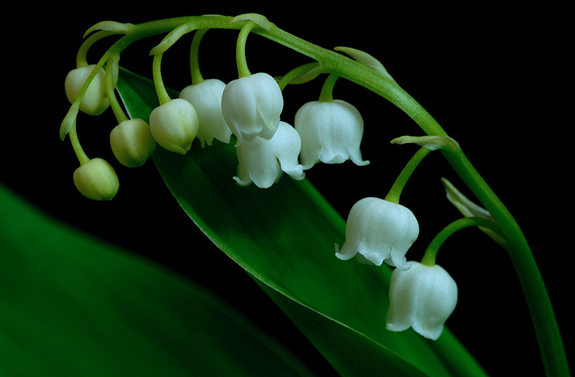
Close up of lily of the valley flowers

Lily of the valley; image from http://www.pixabay.com

cassis-berry

Blackcurrant berries and leaves


May Muguet Marathon: Muguet Fleuri (again)

May Muguet Marathon: Muguet Fleuri (again)

Today’s lily of the valley fragrance is Oriza Legrand’s Muguet Fleuri. A very beautiful scent, it is more than a muguet soliflore. It has a classic structure anchored by a base note of oakmoss. Top notes are, yes, lily of the valley, grass, and green notes (although the Oriza Legrand website lists them more eccentrically as “feuillages vertes, herbes folles, muguet sauvage”). Middle, or heart, notes are lily of the valley (here listed by Oriza LeGrand as “muguet des bois”), violet leaf, angelica and galbanum. Base notes are lily of the valley blossoms (“clochettes de muguet frais”), oakmoss, and wild lily (“lys des pres”, or “lily of the field/meadow”). I reviewed Muguet Fleuri two years ago, in my first “May Muguet Marathon”, but that was based on a sample. A question I posed at the end of the post was whether I should spring for a full bottle. Reader, I did. So here’s a new review.

Instead of true citrus at the top of Muguet Fleuri, we get a burst of lemony fresh greenness that is the first impression, quickly followed by the lily of the valley, which is strong. The heart notes that include violet leaf, angelica and galbanum with the “muguet des bois” send Muguet Fleuri in a different direction than a straightforward floral. All of these heart note companions to the muguet are intensely green. The galbanum gives it a little “bite” as it dries down, a bit of an edge. The angelica brings in an herbal tone. The violet leaf is meant to be somewhat metallic and aqueous, though I’m not sure I would describe it that way, but it is definitely more of a crunchy green than a soft one. Violet leaf appears in many men’s fragrances, so on balance, this phase of the fragrance is where it becomes less feminine and more unisex to my nose, suitable for either a man or a woman. I think this is why Fragrantica categorizes Muguet Fleuri as an “aromatic floral.”

Kafkaesque wrote a very thorough review of Muguet Fleuri. She found violet flowers peeping between the green leaves, but I did not. In the heart phase, the only real flower I smell is the lily of the valley, surrounded by shades of green; it is very true to the actual flower, as I’ve written before. Because of the continuous presence of that lily of the valley, the fragrance doesn’t develop and evolve as much as other high-quality fragrances, but it lasts well, and the base notes are intriguing. The oakmoss seems to anchor the muguet flowers in the earth, with the green leaves and stems sturdily supporting the ethereal white blossoms that look like tiny bells (“clochettes”).

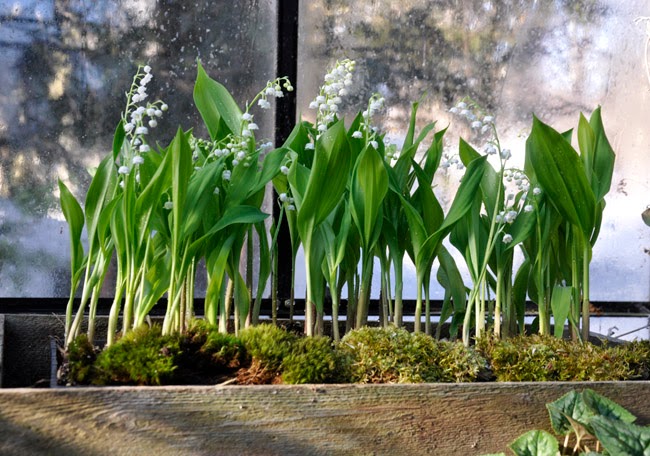
lilies of the valley planted in moss

Kafkaesque found the final stage slightly woody: “Muguet Fleuri’s drydown on my skin really feels like a bouquet of lily of the valley, cedar, violet leaves, and violets, even though the latter is now a mere impression more than a distinctive, powerful, individual note. The whole thing is dusted with floral powder that feels sandier than ever, and a light touch of very expensive floral soap.” The Smelly Vagabond also had a very positive review, and an insightful comparison to the classic muguet scent, Diorissimo.

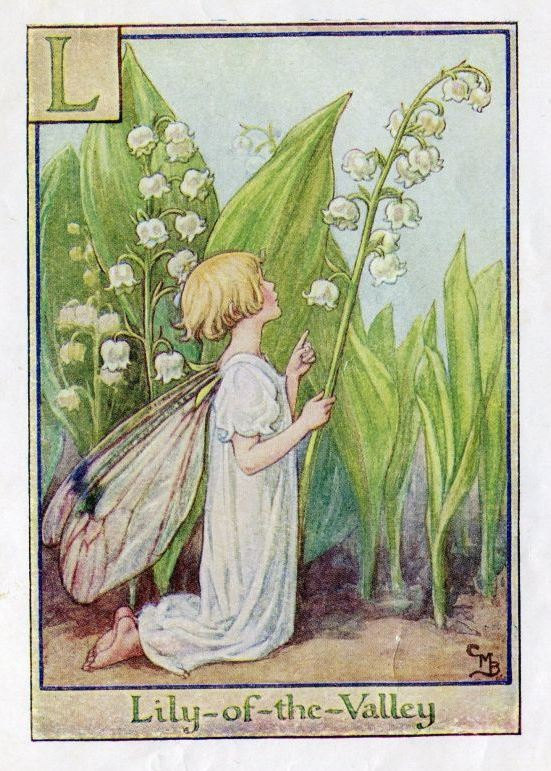
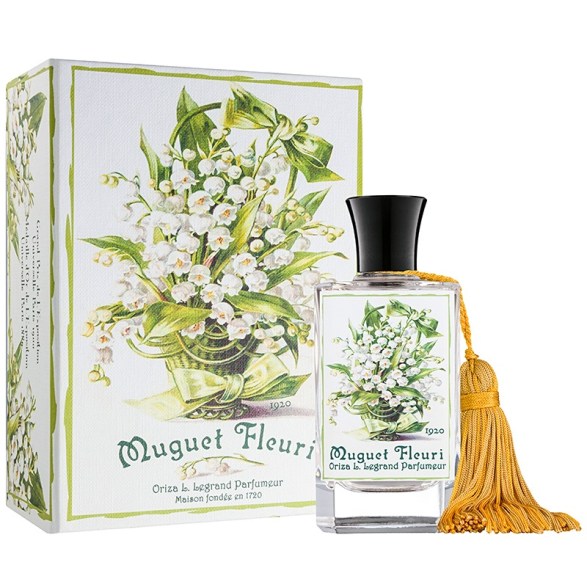
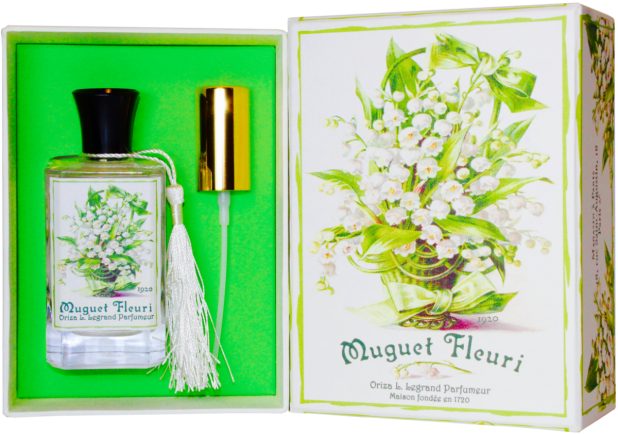
Oriza Legrand deliberately presents its fragrances in old-fashioned design and presentation, to emphasize its history and heritage. Muguet Fleuri is listed among its “Art Deco” Collection; to me, its design elements are reminiscent of the flower illustrations of Cicely Mary Barker, creator of the Flower Fairies in her series of children’s books.

Muguet Fleuri box and bottle

Oriza Legrand Muguet Fleuri; image from http://www.notino.co.uk

Taken together, Muguet Fleuri is a happy, uncomplicated fragrance that is sturdier than it might appear at first impression. I like the opening burst of green, the persistence of various forms of muguet throughout, the well-chosen companion notes, and the oakmoss base. This is a thinking woman’s muguet, but it is far from introverted. It has a warmth to it, after the dewy green opening and herbal green heart, that grounds it and makes it a grown-up muguet. It also comes with a pretty card, imprinted with the same images, and the following cheerful message:

“Que ces quelques brins de Muguet Fleuri vous portent bonheur!” or “May these few sprigs of Lily of the Valley bring you happiness!”. They did.

Featured image by Cicely Mary Barker.


May Muguet Marathon: Lilia Bella

May Muguet Marathon: Lilia Bella

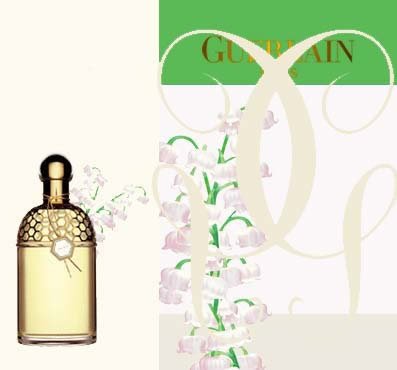
To start off our month of muguets, I’ve chosen discontinued Guerlain Aqua Allegoria Lila Bella. Created in 2001 by Jean Paul Guerlain himself, it was one of the early entries in the Aqua Allegoria line. Monsieur Guerlain, the blogging expert on all things Guerlain, writes that perfumer Mathilde Laurent collaborated on the first five Aqua Allegorias, but that would not include Lilia Bella. Like all the earlier Aqua Allegorias, Lilia Bella comes in a bee bottle housed in a pretty box with a botanical watercolor of the featured flower and the Guerlain monogram:

Bottle and package of Guerlain Aqua Allegoria Lilia Bella.

Aqua Allegoria Lilia Bella, by Guerlain.

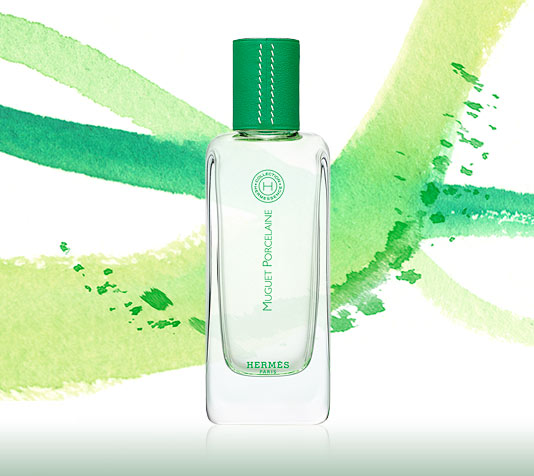
Lilia Bella launched early enough to be included in Turin and Sanchez’ guide to perfumes, where it got a dismissive “A pleasant, well-executed lily soliflore, if you like that sort of thing” and three stars. Well, I do like that sort of thing, and I like Lilia Bella. It opens with unspecified “green notes” that smell a bit like wet grass, not at all like the powerhouse green notes of, say, Chanel No. 19. This dewiness suits the original idea of the Aqua Allegoria line, which is meant to suggest a morning walk through a garden. There is almost a tone of green cucumber, but not actually cucumber; that impression is fleeting, but it is enough to remind me of Jean-Claude Ellena’s last Hermessence for the house of Hermes, the lovely Muguet Porcelaine.  Very quickly, the lily of the valley (or muguet) note appears, paired with lilac. The lilac sweetens the lily of the valley and tones down its green notes while complementing it overall.

One lovely touch in the packaging is that the little bells of the muguet flowers, normally pure white in nature, as above, are tinted to make them visible against the white background of the box. The tint is a very pale lilac-mauve-pink, evoking the muguet’s floral partner in this fragrance.

There are, actually, pale pink lilies of the valley; I have had one in my garden for several years, although it doesn’t flourish and spread like the white ones. On the other hand, in the warm climate where I garden, the white ones aren’t nearly as aggressive as they are up North, either. In any climate, the pink one, Convallaris majalis “Rosea” is not as fragrant as the white ones, but it is very pretty.

Blossoms of pink lily of the valley Rosea

Convallaris majalis “Rosea”; photo from http://www.jacksonandperkins.com

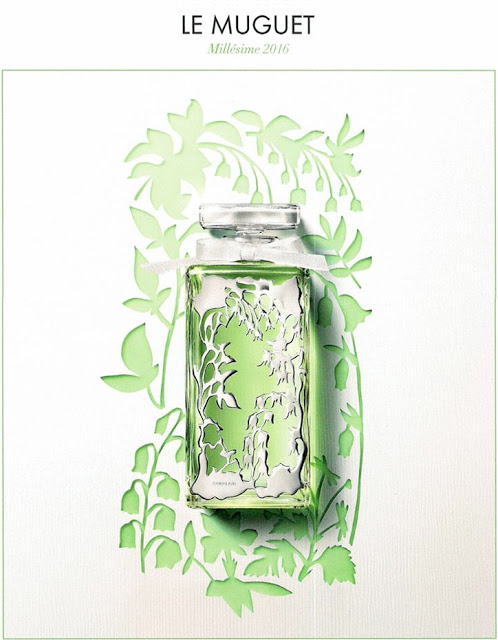
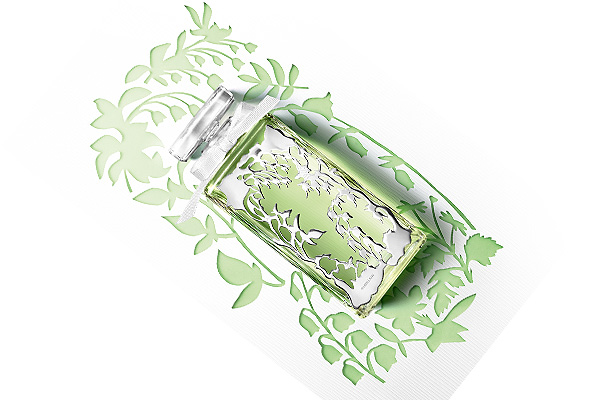
Monsieur Guerlain has written that Lilia Bella originated as a new Guerlain Muguet, sold under that name in 1998 and 1999. This was a successor to the much earlier Guerlain Muguet, created in 1908 by Jacques Guerlain, and discontinued in 1960. The new Muguet was off the market from 2000-2005, the period when the same fragrance seems to have been launched and sold as Aqua Allegoria Lilia Bella. In 2006,  Lilia Bella was discontinued under that name, and Guerlain began its new tradition of issuing the Muguet fragrance in a limited edition annual bottle every May 1, the May Day when the French traditionally give bouquets of muguet. The Muguet limited edition bottles are very beautiful, and very expensive. In 2016, Guerlain launched a new Muguet fragrance, created by Thierry Wasser, in the limited edition bottle that I think is the most beautiful.

Bottle of Guerlain Muguet 2016 fragrance

Guerlain Muguet 2016

Monsieur Guerlain also writes, in comparing Jean-Paul’s muguet to that of Jacques: “The lily of the valley note was still romantic, but effortlessly lifelike and fresh like an expensive bar of French soap. The addition of lilac gave it a very spring-like sensation of femininity, while rose and jasmine added natural depth and bloom. We recognize the cheerful, sunny style of an Aqua Allegoria.” I agree. As the rose and jasmine take their places behind the lily of the valley note, they add depth without diminishing the muguet. And yes, as Lilia Bella dries down, it does smell like a bar of expensive French or Italian soap, in a good way. On my skin, the sillage is moderate, and longevity is mid-range (5-6 hours). This is a very pretty scent, and it does evoke the scent of a dewy garden in the early morning of what will become a sunny day. Now, who doesn’t like that sort of thing?

Happy May Day, and happy muguet!

Happy May Day, and happy muguet!

via The Gift of Muguet

It has been two years since I did a “May Muguet Marathon“, so I think it’s time for another one. Happy May Day, and if you celebrate by giving or wearing real lilies of the valley, enjoy their heavenly fragrance. Je vous souhaite une bonne Fete du Muguet!

P.S. Please join me in the Comments — if you have a favorite muguet fragrance, or if you are wearing or have one that I review, or if you just want to share thoughts on lilies of the valley!

Fragrance Friday: Lilybelle

Fragrance Friday: Lilybelle

As you know if you read any of my posts during last year’s May Muguet Marathon, I love lily of the valley and all things muguet. I wore Diorissimo for a decade and have been happily exploring other LOTV fragrances — but something was missing. And, yes, something really WAS missing, due to IFRA restrictions and reformulations. One of those things was the former level of hydroxycitronnelal (“a lily of the valley aroma-chemical and the main constituent of Diorissimo’s muguet bouquet”, according to the blog Perfume Shrine). Several of the aromachemicals formerly used to create a LOTV scent, such as Lyral and Lillial, are now restricted, I have read.

Enter Lilybelle! “According to David Apel, Senior Perfumer at Symrise, ‘Lilybelle is a molecule with an extremely fresh, green and wet smell. A touch of aldehydes raises its luxuriant floral touch, thus capturing the sparkling freshness of spring.’

From Premium Beauty News: Symrise innovates with a lily of the valley note from sustainable sources:

After six years of development, the Symrise research team has designed Lilybelle, a new molecule with fresh and transparent notes that are very close to the scents of lily of the valley. This (…)

Source: Perfumes: Symrise innovates with a lily of the valley note from sustainable sources

Notably, Lilybelle is an aromachemical made with “green chemistry” practices and principles, from renewable resources, and it is biodegradable. Take that, IFRA!

I think this is a wonderful development and I share the hope expressed by Mr. Apel that perfumers will use this new aromachemical in creative, innovative ways, including its use in unisex and masculine fragrances. I already enjoy Laboratorio Olfattivo’s Decou-Vert, which is supposed to be unisex. However, I also hope that a talented perfumer who, like me, loves muguet, will create a lovely, feminine LOTV which, unlike Guerlain Muguet 2016, I can afford.

May Muguet Marathon: Diorissimo

May Muguet Marathon: Diorissimo

Today is the last day of May, so it’s time to address the most legendary muguet fragrance of all: Diorissimo. So many words have been published trying to describe Diorissimo in its many forms and reformulations! CaFleureBon has a wonderful short article by perfumer Michel Roudnitska, son of the legendary perfumer Edmond Roudnitska who created Diorissimo for Christian Dior. It includes his memory of the large patch of lilies of the valley his father planted in order to study and capture their fragrance.

There are many discussions of Diorissimo on various notable perfume blogs and websites, listed here: Now Smell ThisBois de JasminThe Black NarcissusThe Perfume ExpertPerfume-Smellin’ ThingsThe Candy Perfume BoyThe Perfumed DandyThe Non-Blonde , Undina’s Looking GlassAustralian Perfume Junkies, and even perfumer Ayala Moriel at Smelly Blog. These people are very knowledgeable, so please read their insights!

I own a few versions of it: a vintage eau de cologne in the tall, ribbed bottle; a mini flask of eau de toilette from a “Dior Voyage” set that includes Tendre Poison, so it must date after 1994 but before Tendre Poison was discontinued by 2010; a 2013 bottle of the eau de toilette; and a 7.5 ml flask of the parfum from December 2010. (For dating fragrances or cosmetics, try CheckCosmetic.net if you have the batch number; for dating Dior perfumes, read this helpful post by Raiders of the Lost Scent, and for dating Diorissimo by bottle, go to Perfume Shrine; these are all really helpful if you decide to try to buy a vintage bottle). Continue reading

May Muguet Marathon: Guerlain Muguet 2016

May Muguet Marathon: Guerlain Muguet 2016

Deep breath. I am not an experienced perfumista and I’m not sure I can do justice to this new Guerlain, but I will do my best. The new Guerlain Muguet 2016 is an entirely new eau de toilette by Guerlain’s in-house perfumer, Thierry Wasser. It builds on the tradition, begun in 2006, of Guerlain releasing its 1998 formulation of Guerlain Muguet every year in a different limited edition bottle on May 1, the day when traditionally the French present bunches of lilies of the valley to friends and loved ones as a “porte-bonheur”, a good luck token or “bringer of happiness.” So to start, I defer to “Monsieur Guerlain”, the longtime blogger and Guerlain aficonado, to describe Guerlain’s tradition: Muguet.

As you can see, the limited edition bottles are all beautiful, including this most recent one, which is a crystal bottle encased in silver-plated filigree, designed by the Parisian jewelers Ambre & Louise and influenced by the Art Nouveau master Alphonse Mucha. I saw the actual bottle at Neiman Marcus on May 1 this year, which I visited for the express purpose of trying this new Muguet. Continue reading

May Muguet Marathon: Demeter Lily of the Valley

May Muguet Marathon: Demeter Lily of the Valley

And now for something completely (okay, not COMPLETELY) different. From the heights of expensive perfumery and Muguet Porcelaineto the more prosaic and affordable Demeter Fragrance Library’s Lily of the Valley. I love the whole idea of Demeter Fragrance Library: that they try to capture individual fragrances of everyday objects, places or even weather, and you can combine those into whatever blend you like. From the company’s website: “Demeter was conceived in the East Village of New York City in 1996: a unique point of view about fragrance, a perspective that still remains unique, but that continues to expand. The original mission was to capture the beautiful smells of the garden and nature in wearable form. Consistent with that mission we took the Demeter name, inspired by the Greek Goddess of Agriculture.” Continue reading

May Muguet Marathon: Muguet Porcelaine

May Muguet Marathon: Muguet Porcelaine

Thank goodness. I have been eagerly anticipating the release of the new (and last) Hermessence by Jean-Claude Ellena, Muguet Porcelaine. I love his Jardin series very much; the transparency of his fragrances appeals to me although some other perfume lovers do not like it. And I truly love lily of the valley scents, so I was keeping my fingers crossed that Muguet Porcelaine would not disappoint. And it doesn’t.

Before I got my own sample, I read some comments that used words like “cucumber”, “melon”, “watermelon” and even “bubble gum”! No, no, no, I thought, surely Ellena would not play such a cruel joke on perfume lovers who look forward to his new works, or on the lovely lily of the valley flower that has so inspired great perfumers like Edmond Roudnitska, whom Ellena holds in high regard.

He did not. Continue reading

May Muguet Marathon: Muguet Fleuri

May Muguet Marathon: Muguet Fleuri

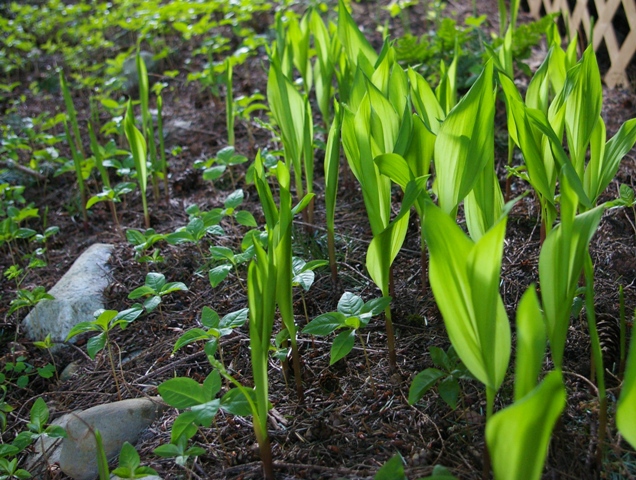
My oh my, muguet! Oriza  L. Legrand’s Muguet Fleuri opens with a decisive, spicy greenness that comes from top notes of green leaves, grass and lily-of-the-valley, per Fragrantica. The middle notes are galbanum, angelica, violet leaf and lily-of-the-valley; base notes are lily-of-the-valley, oakmoss and lily. Kafkaesque attributes the spiciness of the opening to the violet leaves, but I wonder if it doesn’t also come from the angelica. The firmness of the green top notes reminds me of the leaves of lily of the valley, which are very beautiful in their own right and offer just the right contrast to the delicate silver-white bells of the flowers on their long, slender stalks. The leaves are sculptural in their form, larger than the flowers and sometimes even hiding them. They are smooth and firm like the leaves of hostas, and reach to the sky in pairs like hands lifted in prayer.

Lily of the Valley leaves

Lily of the Valley leaves; photo from Verdure

I love the opening of this fragrance. It just happens that I am staying this week at my sister’s house, where she has an old, well-established patch of lilies of the valley, so I am able to compare the perfume and the flower directly while I type this. Continue reading