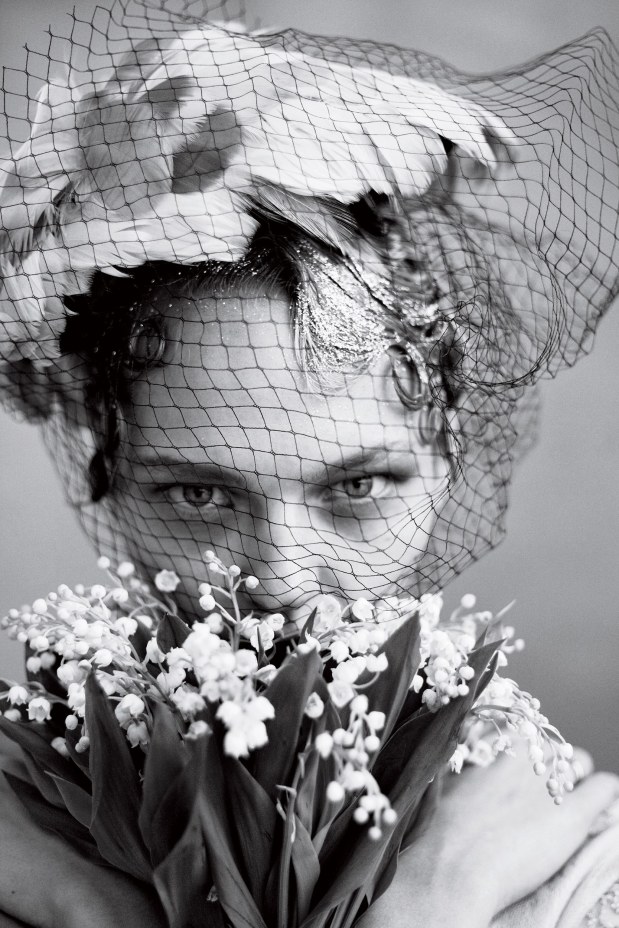
May Muguet Marathon: Sense of Smell

May Muguet Marathon: Sense of Smell

This week, the New York Times printed an article called: “You Will Never Smell My World the Way I Do”.  It opens with this statement:

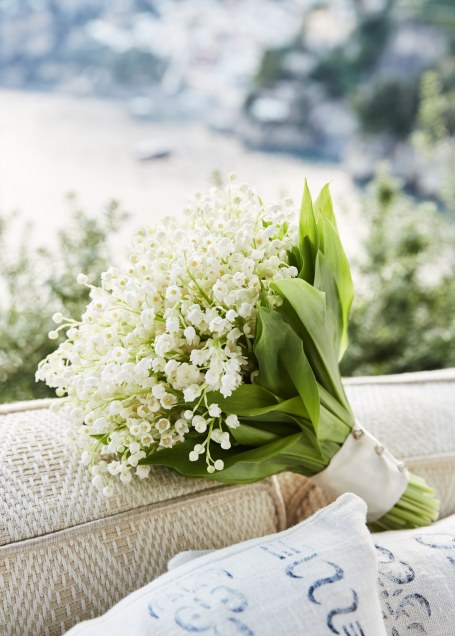
The scent of lily of the valley cannot be easily bottled. For decades companies that make soap, lotions and perfumes have relied on a chemical called bourgeonal to imbue their products with the sweet smell of the little white flowers. A tiny drop can be extraordinarily intense.

If you can smell it at all, that is. For a small percentage of people, it fails to register as anything.

The article is about a newly published research study that confirms what many of us know, i.e. that different people perceive different scents in different ways, and also identifies one reason why that is: our genetic make-up, specifically a single genetic mutation, in many instances. This is a scientific breakthrough, one that the researchers themselves did not expect, according to the New York Times:

The work provides new evidence of how extraordinarily different one person’s “smellscape” may be from another’s. It’s not that some people are generally better smellers, like someone else may have better eyesight, it’s that any one person might experience certain scents more intensely than their peers

“We’re all smelling things a little bit differently,” said Steven Munger, director of The Center for Smell and Taste at the University of Florida, who was not involved in the study.

The scientists who conducted the study looked for patterns in subjects’ genetic code that could explain these olfactory differences. They were surprised to find that a single genetic mutation was linked to differences in perception of the lily of the valley scent, beet’s earthiness, the intensity of whiskey’s smokiness along with dozens of other scents.

Fascinating! And now we know why one person’s Diorissimo is another person’s cat pee. This is also why there is no point in arguing with another perfumista about what they smell in your favorite fragrances; it may very well be entirely, and legitimately, different from what you smell.

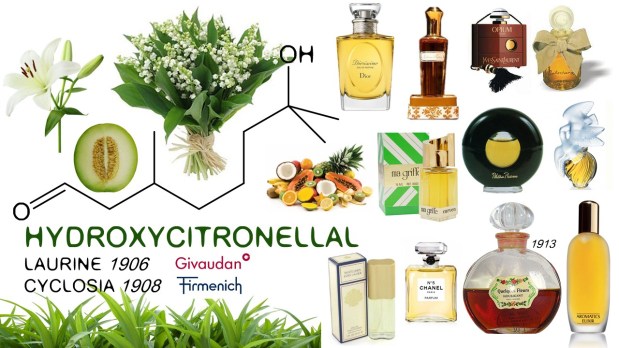
Bourgeonal is not the only option available to perfumers and noses, however. It is only one of many “muguet” fragrance molecules, which have to be created synthetically because it isn’t possible to extract fragrant essences from lilies of the valley the way one can with flowers like roses and lavender. Other synthetic molecules used to create a “muguet” scent include: hydroxyc­itronellal, Lilial, Lyral, Cyclosal, Heliopro­panal, and a relatively new introduction from Symrise, Lilybelle. For an in-depth professional article by a Firmenich chemist on the evolution of muguet fragrances, go here: Beyond Muguet. Chemist Mat Yudov also wrote a terrific article about the chemistry of muguet fragrances two years ago on Fragrantica: May Greetings: New Lily of the Valley Aromachemicals.

I’m glad to know that there is a new generation of aromachemicals available to support one of my favorite notes in fragrance, regardless of IFRA restrictions. Bravo, chemists! Do you have any fragrance notes that you know you simply don’t smell? Has your perception of any perfume been affected by that?

Featured image from Fragrantica.

May Muguet Marathon: Odalisque

May Muguet Marathon: Odalisque

Odalisque by Parfums de Nicolai is an eau de parfum with a strong floral heart of lily of the valley, jasmine, and iris, heralded by top notes of bergamot and mandarin, and resting on a base of oakmoss and musk. The brand calls it “a unique fragrance for strong personalities”, and on the website, its listing highlights, through graphics, the notes of mandarin, muguet, and oakmoss.

“Odalisque” is a word whose meaning has evolved over time. One author explains:

The English and French term odalisque (rarely odalique) derives from the Turkish ‘oda’, meaning “chamber”; thus an odalisque originally meant a chamber girl or attendant. In western usage, the term has come to refer specifically to the harem concubine. By the eighteenth century the term odalisque referred to the eroticized artistic genre in which a nominally eastern woman lies on her side on display for the spectator. (Joan DelPlato)

Patricia de Nicolai created the fragrance Odalisque in 1989. It is a very French perfume, as befits its creation by a member of the Guerlain family (her uncle is Jean-Paul Guerlain). It is not an Oriental fragrance by any means, or even a French version of an Oriental, as one might expect from a perfume that refers to a harem.  No, this Odalisque is a woody green chypre with a classic chypre structure, but using muguet as the featured floral note instead of the more commonly used rose and jasmine (Odalisque’s heart notes include jasmine blended with iris, together with the lily of the valley). So why the name?

Some of the most famous paintings of “odalisques” were by French painters, from Boucher to Matisse. In fact, right now the Norton Simon museum in Pasadena, California has an exhibit of paintings called “Matisse/Odalique”. Matisse himself candidly admitted that he used the theme of the “odalisque” as a reason to paint female nudes, and it is clear that many Western painters adopted the subject because it allowed them to paint titillating scenes of naked women, offering themselves to the male gaze (and, one is meant to assume, sexual availability), while also allowing the artists to distance themselves and deflect criticism by making the women and the scenes “exotic.”

Oil painting of odalisques playing checkers, by Henri Matisse

Odalisques Jouant Aux Dames; Henri Matisse

The heady flowers of rose and jasmine suit our traditional vision of the Ottoman Empire, but lily of the valley is quintessentially a Northern European flower, native to the cooler, temperate zones of the Northern Hemisphere, its preferred habitat being in shaded woodlands. Its prominence in Odalisque means that the fragrance is not exotic at all, although it is mysterious and beguiling. To my nose, the citrus opening leaves the stage very quickly, while I smell the oakmoss “base” right from the start. As the citrus notes fade, the greenness of the muguet takes over, the pure white lily of the valley flanked by rose and iris, as the odalisques in the paintings, frequently portrayed as white European women, are often shown attended by exotic Middle Eastern servants.

Painting of an odalisque in a harem with slave and eunuch, by Jean August Dominique Ingres; Fogg Art Museum.

Odalisque a l’Esclave; Jean Auguste Dominique Ingres; Fogg Art Museum.

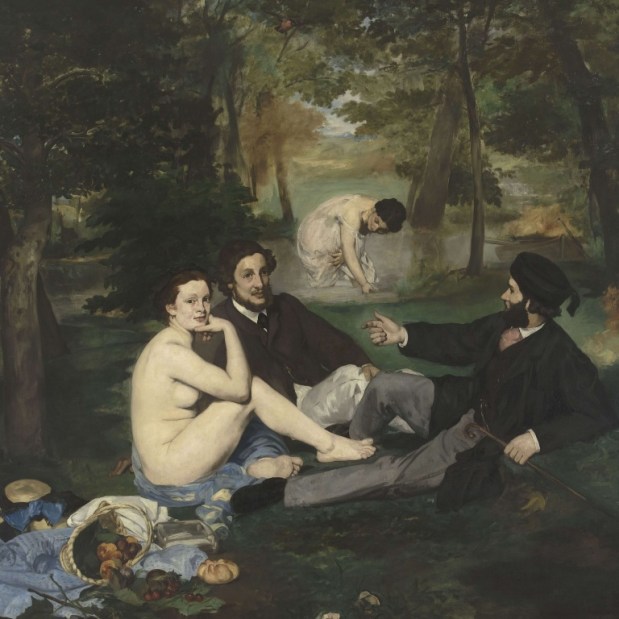
As it happens, one of the most famous French paintings using the trope of the “odalisque” also portrays a quintessentially European setting, green and woody like the chypre structure of Odalisque: Edouard Manet’s “Le Dejeuner sur l’Herbe.” That it refers to the figure of an “odalisque” is indisputable: the female model’s nudity, her pose with her body turned partly away from the viewer but displaying most of her naked body, her direct gaze, and the figure of another woman bathing at a distance, all evoke more traditional images of a concubine in a “Turkish bath” setting. One of the male figures wears an Ottoman-style flat cap with a tassel, reminiscent of a traditional Turkish fez.

Le Dejeuner sur l'Herbe, painting by Edouard Manet, from Musee de l

Le Dejeuner sur l’Herbe, by Edouard Manet; Musee d’Orsay.

I don’t think it is a coincidence that a perfumer as intelligent as Patricia de Nicolai created a fragrance like Odalisque that so readily lends itself to an evocation of one of France’s most famous, treasured masterpieces.

Luca Turin regarded the original Odalisque itself as something of a masterwork. He commented thus about its original formulation:

Odalisque’s superbly judged floral accord of jasmine and iris, both abstract and very stable, allied to a saline note of oakmoss, initially feels delicate, but in use is both sturdy and radiant. It is as if the perfumer had skillfully shaved off material from a classic chypre accord until a marmoreal light shone through it.

What, exactly, is a “marmoreal light”? According to Merriam-Webster, “marmoreal” means “suggestive of marble or a marble statue, especially in coldness or aloofness.” There you have it. I defy anyone to look at Manet’s painting and not see a marmoreal light on the key figure of the naked woman.

By making the muguet the most prominent floral note in Odalisque, Mme. de Nicolai has emphasized the cool, white, marmoreal aspect of the fragrance, but she sets it against a powerful base of oakmoss and musk, just as Manet’s odalisque is highlighted against the dark green, woody background of the setting he chose so deliberately (and radically). Odalisque was reformulated after IFRA imposed new restrictions on the use of oakmoss in fragrance, but I can attest to the continuing power of its oakmoss base.  As much as I love the muguet heart note of Odalisque, ultimately the story it tells is one of oakmoss. I can smell it from the very opening of Odalisque, and it persists for hours, taking its place on the olfactory center stage after about an hour of the fragrance’s progression. On my skin, the oakmoss and musk last for at least 10-12 hours; I’ve applied Odalisque at night and I can still clearly smell those base notes the next morning.

The combination of oakmoss and musk is very sensual without being “sexy”, as Caitlin points out in her blog “This Side of Perfume.” The accord is too classic and elegant to warrant such a trite phrase. Like Manet’s model, this sensual accord is direct without titillating. It simply presents itself, unconcerned. It also lends a retro, vintage feel to Odalisque without making it dowdy. In sum, if you are looking for a classic, French, high-quality perfume that features muguet, this one should be on your list. It differs significantly from the ultimate French muguet fragrance, Diorissimo, and others like Guerlain’s Muguet; it is darker, mossier, woodier. It is also glorious. Have you tried it?

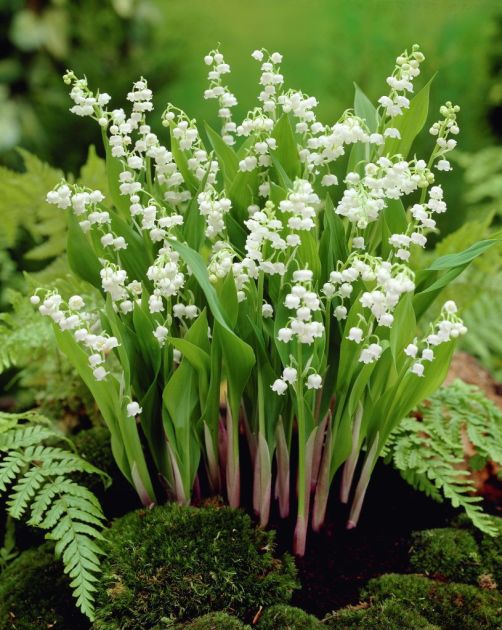
Lilies of the valley, green moss, and ferns in woodland garden

Lilies of the valley in woodland garden; image from Pinterest

May Muguet Marathon: Tocca Liliana Hair Mist

May Muguet Marathon: Tocca Liliana Hair Mist

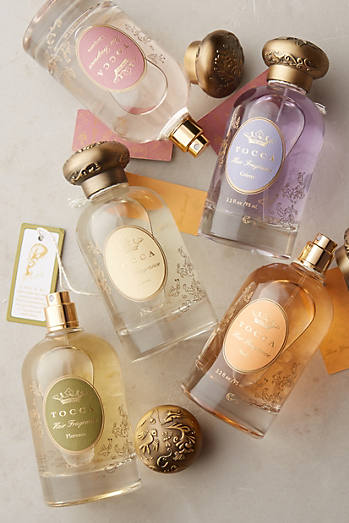
I am quite taken with hair mists these days, though I don’t use them often. The first two I bought came from Tocca: Colette and Liliana. I’ve enjoyed them both; lily of the valley is a prominent note in Liliana, while jasmine is the dominant floral in Colette. When Liliana was launched, it was described thus by the brand:

A lush, green, rolling lawn is the setting for a roaring 20s party in full swing. Liliana conjures a reveler in the bloom of youth dancing the Charleston amidst flowing bottles of champagne and a spirited jazz band. The lowering sun casts a golden sparkle as an intoxicating bouquet of muguet, gardenia and peony wafts from the gardens, filling the night with joie de vivre.

Sounds a lot like “The Great Gatsby”, doesn’t it? The notes for the eau de parfum are listed as: top notes are bergamot, neroli and peach; middle notes are lily-of-the-valley, gardenia and peony; base notes are sandalwood, musk, benzoin and patchouli. The hair mist is a bit different. I think it has less peach, and a more pronounced combination of lily of the valley and peony, with not as much gardenia. The base does have sandalwood and musk, but I don’t smell benzoin or patchouli. The opening starts with a burst of bergamot and neroli, very bright and refreshing, then the fragrance moves quickly into green floral territory. The muguet note is present but not dominant. John Reasinger decribed his impression on CaFleureBon when it first came out:

Liliana, however, is a young carefree girl and this perfume captures her essence. It has a delicate tenacity much like a young girl growing up in that era would. It radiates innocence, but also lively warmth…and just a hint of naughtiness. She is no flapper, yet that is; but she is most certainly eyeing them closely and seeing how much fun they are having.

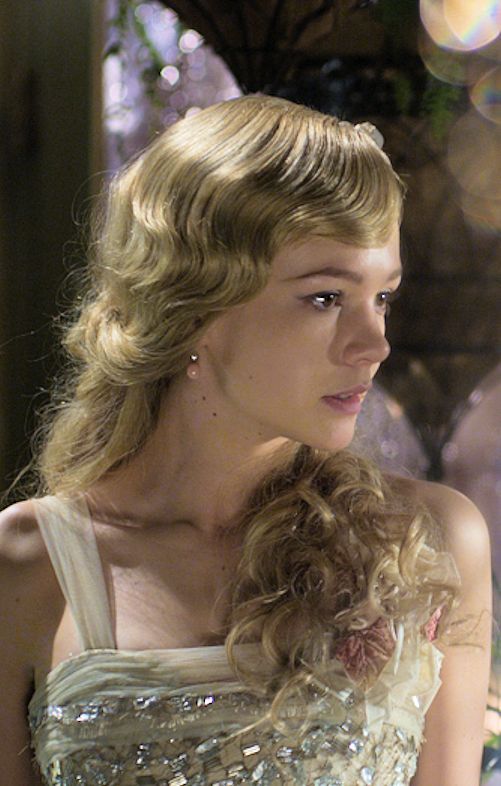
Given that the hair mist is softer and gentler, less sultry, than the description of the eau de parfum, it doesn’t evoke a jazz age flapper or a roaring 20s party complete with jazz and the Charleston. Perhaps,  like the description above, it is more like the younger Daisy, before she lost Jay Gatsby and Tom Buchanan swept into her life.

Actress Carey Mulligan as the young Daisy Buchanan in Baz Luhrman's The Great Gatsby, by F. Scott Fitzgerald.

Carey Mulligan as young Daisy; The Great Gatsby (2013).

May Muguet Marathon: Kissing

May Muguet Marathon: Kissing

For the first fragrance review this May, I’ve chosen an oddball: one of the line of less expensive scents from By Kilian, made for Sephora, the “My Kind of Love” collection. Its full name is Kissing Burns 6.4 Calories A Minute. Wanna Work Out?. I’ll refer to it just as Kissing. Here’s what the brand says about it:

“When else can you experience something so sweet and burn calories all at the same time? Kissing is a luscious remix of floral and gourmand notes, it speaks to the most perfect sport for couples with incredible chemistry. Just like a great kiss, as the perfume evolves the emotions get more intense.”—Kilian Hennessy

It is indeed a remix of floral and gourmand notes, starting with a top note of bergamot and moving quickly into a combination of lily of the valley, rose, green notes, hot milk, white sugar, and vanilla. It’s a very odd mix but it has really grown on me. I feel as if I smell the hot milk right away, then the green and floral notes slowly emerge. Honestly, if I hadn’t been told that the notes include lily of the valley, I’m not sure I would have identified that, although I do smell a slightly green floral. As the scent dries down, it becomes less floral and more gourmand, with vanilla and sugar intensifying the note of hot milk.

As anyone knows who has sipped hot milk or added steamed milk to their coffee, heated or steamed milk is noticeably sweeter than regular cold milk. Milk naturally contains sugars like lactose. When it is heated, the more complex sugar, which doesn’t taste as sweet, starts to break down into its simpler components: simpler sugars that taste sweeter to us. It is that sweetness that Kissing has captured, which is why it smells specifically like hot milk to me, not cold milk.

Over time, the vanilla gets stronger, but this fragrance never overpowers. It is soft and warm. Interestingly, Kissing has been identified by some Fragrantica readers as reminding them of a fragrance unicorn: the long-discontinued Le Feu d’Issey, from Issey Miyake. They do have several notes in common: bergamot, rose, milk, and vanilla. Le Feu combines its rose note with a lily note, while Kissing combines rose with lily of the valley. I haven’t tried them side by side, but I do have a few sample vials of Le Feu, so I’ll have to see if I think they are at all similar.

I like Kissing a lot — more than I expected to. I don’t usually gravitate to gourmands, although I do love my White Queen, with its wonderful whipped cream accord. I’m so intrigued by the idea of a “floral gourmand”! Kissing lasts several hours on my skin; by the end, it is mostly a milky vanilla with flowery undertones, almost as if one had floated some fragrant blossoms on top of a frothy cup of steamed milk or a bowl of sweet, steamed milk pudding. Have you tried any of the “My Kind of Love” collection? What did you think?

Green bowl of Chinese steamed milk pudding; yumofchina.

Chinese steamed milk pudding; image from www.yumofchina.com

Thunking Thursday: Miu Miu L’Eau Bleue

Thunking Thursday: Miu Miu L’Eau Bleue

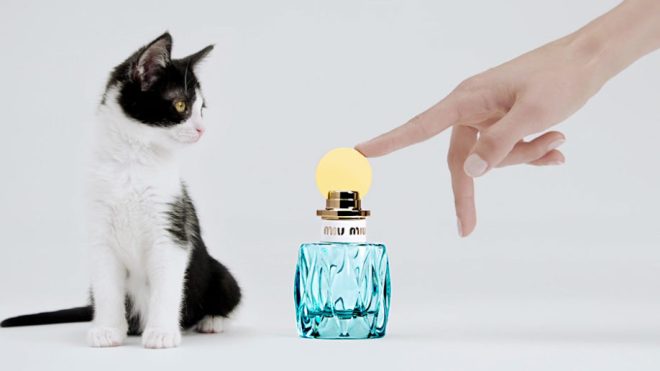
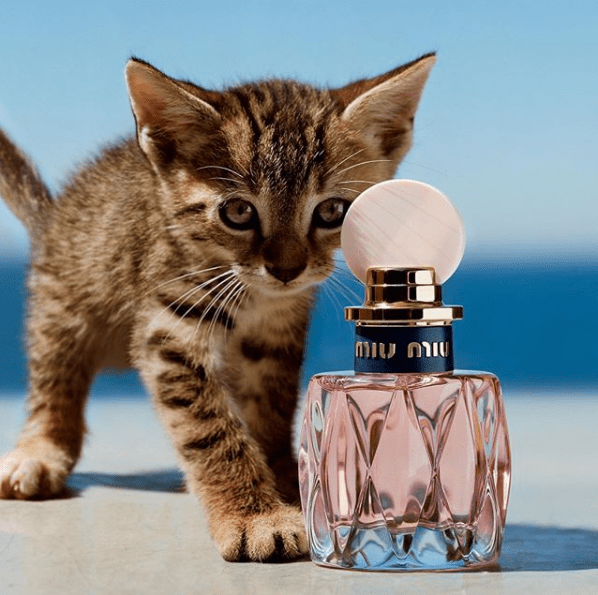
There’s a breath of spring in the air this morning (unlike yesterday, which was cold, rainy, and windy), so the sample I thunked today was Miu Miu’s L’Eau Bleue. This was the first flanker to the original Miu Miu, launched in 2015. L’Eau Bleue came along in early 2017. Meant to evoke light and happy spring awakenings, it is described on Fragrantica:

Spring flowers of lily of the valley in the top go into the heart of green notes and white flowers covered with morning dew. An akigalawood accord, a molecule developed by Givaudan which smells of patchouli, peppery notes and woody flavors of oud, forms the base of the perfume.

The nose is Daniela Andrier. Most wearers find the lily of the valley note to be quite dominant, and it is clearly present, though I don’t find it as dominant as others do. It’s not a heavy note, it is quite airy, but it stands out among the other light, dewy notes. I love lily of the valley and so I’ve enjoyed my sample of L’Eau Bleue. I don’t need a full bottle, although if a mini of the adorable bottle fell in my lap, I wouldn’t refuse it!

This would be an ideal scent for a girl or young woman who is just beginning her fragrance journey. Can you suggest any others?

Bottle of Miu Miu L'Eau Bleue fragrance with kitten

Miu Miu L’Eau Bleue

May Muguet Marathon: Miu Miu

May Muguet Marathon: Miu Miu

Fashion house Miu Miu launched its first fragrance in 2015, Miu Miu. According to Fragrantica, it was meant to emphasize lily of the valley:

The composition of the fragrance is signed by perfumer Daniela Roche Andrier, known for her creations for the house of Prada (as well as Bvlgari, Marni, Bottega Veneta). As Danielle explains it, the focus is on lily of the valley flowers supported with floral notes of jasmine, rose and green notes, as well as a special ingredient created by Givaudan, akigalawood, which develops the scent of patchouli, notes of pepper and woody aromas of oud. The composition of Miu Miu fragrance opens in a fresh and floral manner, and as it develops it begins warmer and woodsier, says Danielle.

I was disappointed when I tried it, though I liked it, because to me the lily of the valley note was not evident enough. Miu Miu felt to me like a pretty, greenish floral, but I really didn’t experience it as a muguet-centric fragrance, in spite of the stated focus and the promotional materials featuring a gorgeous lily of the valley textile design.

Bottle of Miu Miu fragrance and lily of the valley textile

Miu Miu fragrance; image from http://www.internetwhatever.com

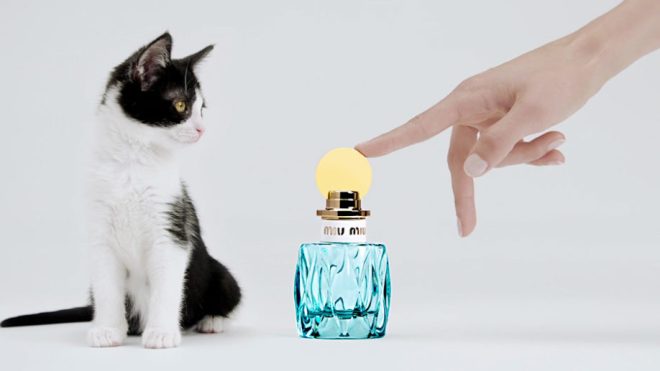
Next came Miu Miu L’Eau Bleue, in 2017. Ah, that’s more like it! The dewy greenness of this flanker correlates better, to my nose, to lily of the valley. The fragrance reads as crisper and greener than the original. Also, I greatly prefer L’Eau Bleue’s bottle over the first Miu Miu — the clear turquoise glass and light yellow top really appeal to me, and the brightness of the clear blue glass matches the brightness and transparency of this fragrance. It is a happy, cheerful, spring-into-summer fragrance. Later in the summer heat, I will probably want Un Jardin Sur le Nil, which is marvelous in really hot weather, but for spring and early summer, L’Eau Bleue is a lovely choice. Perfumer Daniela Andrier clearly has a way with floral notes; when I looked her up on Fragrantica, I was surprised to see how many of her creations I know and like, including many she did for Prada, like the marvelous Infusion d’Iris and dozens of others. (Ms. Andrier was also the perfumer behind Tiffany’s new fragrance, Tiffany & Co., an elegant floral scent launched in 2017 and a new favorite of mine).

Fragrance ad for Miu Miu L'Eau Bleue, with bottle and kitten

Miu Miu L’Eau Bleue; image from http://www.store.miumiu.com.

And now comes Miu Miu L’Eau Rosee. Yes, as the name suggests, it is pink. The muguet heart note is joined by peony and rose, as well as peach and pear, and this third flanker is more of a fruity floral than the first two scents. It isn’t sugary or sweet, though, and it has a pleasant gingery, spicy, light woodiness to its drydown, which lingers for several hours after first application. Like the other Miu Mius, it has a playfulness and sprightliness that is youthful and appealing.

Bottle of Miu Miu L'Eau Rosee fragrance with kitten

Miu Miu L’Eau Rosee

The lily of the valley note is present, albeit one created by hints of gardenia, tuberose, jasmine, and honeysuckle, according to the notes listed on the Miu Miu website, but the pink peony note is the most dominant. They blend well together, and this flanker retains the dewiness of its predecessor. It is also an appealing option for spring and summer, but if you really want muguet, you should look to L’Eau Bleue or some of the other fragrances in this May Muguet Marathon. Have you tried the original Miu Miu or either of its flankers? What did you think?


May Muguet Marathon: I Love NY for Earth Day

May Muguet Marathon: I Love NY for Earth Day

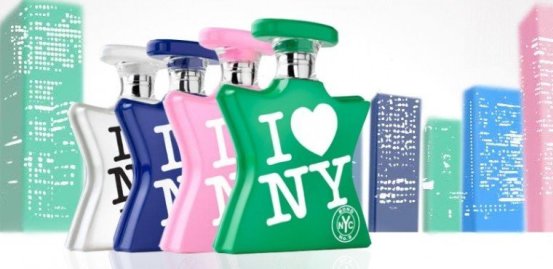
I haven’t tried many Bond No. 9 fragrances, partly because of their prices, partly because they sometimes seem a bit gimmicky, and partly because their bottles don’t appeal to me. I don’t often think of myself being that affected by a fragrance’s bottle, although I really love some of the beautiful bottles one sees and can sometimes be swayed to buy a fragrance because of one (have you seen the adorable new Nina Ricci Bella? I’m hoping they will do a coffret of minis with the other “apple” bottles!). But I’ve rarely felt put off a fragrance because of the bottle. Daisy is another bottle that doesn’t appeal to me AT ALL, though I love the Daisy Dream bottles. I’ve successfully resisted buying any of them, though.

Bottles of different Bond No. 9 I Love NY fragrances

Bond No. 9 I Love NY fragrances; image from http://www.parfumo.net

Today’s fragrance with lily of the valley in it is Bond No. 9’s I Love NY for Earth Day. I found it at a great discount at a local store, with I Love NY for the Holidays, and thought, why not? So they both came home with me. I lived in New York for several years, and grew up outside The City, as we called it, and I do appreciate how Bond No. 9 has worked to create scents that capture various aspects of New York life and different New York neighborhoods. I really enjoyed For the Holidays and have been looking forward to trying Earth Day.

Here’s the thing: Earth Day is a lovely fragrance, very floral, but I get almost no lily of the valley from it! From reading other reviews, I know that my experience differs from others’, as a number of commenters and reviewers have said they found the lily of the valley to be very prominent. My experience of the fragrance was much more like the review by John Reasinger at CaFleureBon: all about the tuberose. And in fact, this seems more like what its creators intended, based on this excerpt from their promotional materials when Earth Day was launched in 2011, which I found on The Candy Perfume Boy blog:

“Like New York, this lush green tuberose is also sophisticated and assured. Its wakeup opening notes, sprightly tangerine and orange flower water, blended with more tropical orchid, segue into the heart of the scent: a stunning floral composed of intoxicating tuberose, lily of the valley, and orris. Base notes of durable musk, amber, oakmoss, and sandalwood sustain this heady bouquet.”

So now that we’ve put the muguet to bed, so to speak, what is Earth Day like? To me, it is very tuberose-forward, teetering on the brink of too much without tipping over the edge. If I applied more than a couple of modest sprays, though, I think it would overwhelm. Tuberose is such a complicated fragrance note: in real life, the flowers’ scent is intoxicating, so much so that an oft-repeated legend is that in some countries, young women were forbidden to walk among gardens of tuberose lest they be overcome by lust! Perfumer Pierre Benard spoke at length about the note with Fragrantica, and the interview is well worth reading, as it leaps from science and chemistry to perfume to history: Tuberose: Flower, Scent, History, and Perfume.

tuberose flower

Tuberose flower; image from http://www.attarperfumes.net

Earth Day is supposed to be a unisex fragrance, but to me it is very feminine, because of its strong floral nature and the voluptuousness of the tuberose. I don’t think of men as “voluptuous”, although that may be my own limitation more than anything else! And this is a somewhat voluptuous scent, though not languorous. The city of New York has an energy and liveliness that is captured in this fragrance. What comes to mind? Princess Giselle in Central Park, in the movie Enchanted:

Princess Giselle in Central Park, NY, from Disney movie Enchanted

GIselle in Central Park; image from http://www.disney.com

Not a muguet, but definitely a happy, lively, green floral scent, with, as another reviewer said, a “sprightly tangerine” opening. It is very appealing on the right day and in the right weather, which to me would be spring and summer. Try it! But not if you dislike tuberose. Have you tried any other I Love NY fragrances? Which do you like, and why?


May Muguet Marathon: Live in Love

May Muguet Marathon: Live in Love

Another affordable muguet-focused fragrance comes from Oscar de la Renta: Live in Love. Launched in 2011, it was created by Jean-Marc Chaillan, Carlos Benaim, and Ann Gottlieb, according to Fragrantica. Top notes are hyacinth, galbanum, bergamot, lily-of-the-valley and orchid; middle notes are jasmine, african orange flower and rose; base notes are sandalwood, virginia cedar, woodsy notes, amber and musk.

Racked published an interview with M. de la Renta when this fragrance was launched:

… the notes in the fragrance were inspired by his own vast garden, which includes a sparkling ginger orchid that was flown in from France. De la Renta, if you didn’t know, feels very passionate about flowers, particularly their scents: “I think that a flower that doesn’t smell is like a woman with no fragrance. For example, one flower that they say is an unbelievable flower is the camellia; it’s a shame that it doesn’t smell. It’s such a beautiful flower but it has no scent. I wonder why Chanel decided to use camellia.”

The bottle itself is very pretty, eight-sided with a sectioned top. According to the Racked interview, the name came from a tattoo that M. de la Renta glimpsed on the arm of one of his colleagues during the creation of Live in Love; he was so intrigued by the phrase that he made it his new fragrance’s name.

The opening isn’t particularly reminiscent of lily of the valley, though it is very pleasant: bright bergamot that morphs into a light, fresh floral. As it evolves, the fragrance actually gets a bit greener than that very first stage when the galbanum emerges. Fragrantica readers find the lily of the valley and hyacinth notes most prominent, but I don’t. Most of what I smell is the African orange flower. Again, very pleasant, but not muguet! As it continues to dry down, it continues to be a fresh, pleasant, light floral, but not one where it is easy to pick out specific notes. Live in Love would be a good everyday office scent, especially in spring or summer, but if you’re looking for a true muguet-centric fragrance, it will disappoint you.

May Muguet Marathon: Gucci Envy

May Muguet Marathon: Gucci Envy

One of the great pleasures of reading Turin and Sanchez’ guide to perfumes is the occasional surprised snort of laughter when one of their reviews snarkily turns a phrase that perfectly captures their — and your — experience of a fragrance. One of my favorites: “cK IN2U Her: OMG PU. Insanely strong fruit meets insanely strong woody amber. KTHXBYE.”

The snarky humor applies evenly to perfumes they praise, such as Gucci Envy:

Envy (Gucci) ***** green floral $$

Maurice Roucel has a knack for putting together perfumes that feel haunted by the ghostly presence of a woman: Lyra was a compact, husky-voiced Parisienne, Tocade a tanned, free-as-air Amazon. These have another Roucel hallmark, the spontaneity of the unpolished gem. When subjected to the full grind of the marketing department, Roucel’s style can become cramped and tends toward brilliant pastiches of classical fragrances: 24, Faubourg; L’Instant; Insolence. Envy is to my knowledge the only time when the balance between Roucel’s magic and the real world gave rise to a work that, like a diamond, needed both heat and pressure to form. My recollection is that Envy was panel-tested again and again while Roucel adjusted it until it outperformed Pleasures, then at the top of its arc of fame. It is amusing to think that such a comparison between apples and pears could be considered meaningful. However, it did constrain the woman inside Envy to be at once seraphic and suburban, complete with the sort of suppressed anger that such a creature would feel at being reincarnated as a florist in eastern New Jersey.

Why a florist? People describing fragrances often describe very green, hyacinth-dominant scents as smelling like the inside of a florist’s refrigerator. And that is the major impression of Envy after the sharp, tangy-green opening. Envy’s heart notes are: hyacinth, lily of the valley, rose, jasmine, violet and iris, after an opening that is dominated by bergamot and freesia with support from minor top notes of peach, magnolia, and pineapple (for the record, I don’t smell pineapple, but that could be because my bottle of Envy is several years old; it was discontinued).

The muguet note is very prominent in Envy, but it isn’t soapy AT ALL, unlike some lily of the valley scents. It is green all the way, with hyacinth hot on its heels and gaining ground throughout Envy’s progression. Fragrantica has an interesting summary, describing it as a “metal accord surrounded by a floral bouquet”:

Envy could be compared to a breeze that brings spring into the city. Its architecture is modern; it denies gaudiness, accentuating minimalism. The composition starts with green notes with a cool metal note that freezes the senses. Gradually the scent warms up due to woody notes and musk.

Envy does start off as a very cool, contained, green scent, and I can understand the comparison to cold metal, given the “florist’s refrigerator” vibe it gives off, especially in the first hour or so. Maybe the seraph of Luca Turin’s imagination is trapped inside the florist’s refrigerator, not reincarnated as the suburban florist.

Gradually, Envy starts showing glimmers of — not warmth, exactly, but a mossy woodiness that grounds it. The base notes are oakmoss, sandalwood, cedar, musk, and jasmine. The green notes from the muguet, hyacinth, and freesia are still powerfully present, but the fragrance takes on an earthiness that brings them back to ground. The progression of Envy resembles the slow descent of a winged, green creature whose feet lightly touch the mossy floor of a forest.

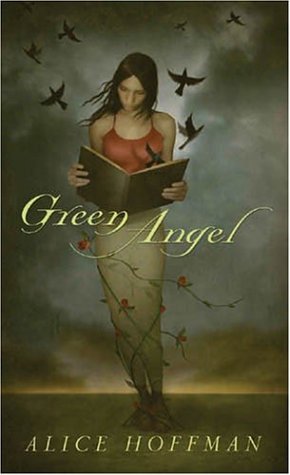
Novel Green Angel by Alice Hoffman

Green Angel, by Alice Hoffman

I haven’t yet read the book Green Angel, whose cover is featured above, but in my search for an image that captured the final stage of Gucci Envy, this popped up and it seemed just right. The College Gardener has a brief review of the book, and it may have to go on my reading waitlist. That’s for another day. In the meantime, I have to go liberate a green seraph who has been imprisoned within a tall bottle of eau de toilette.

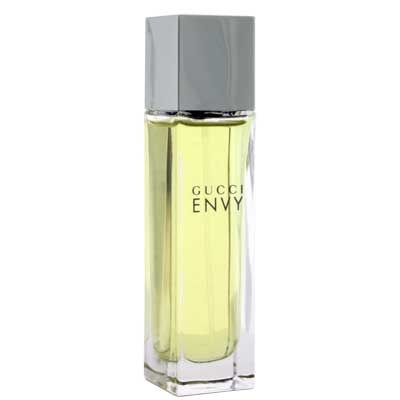
Bottle of Gucci Envy eau de toilette

Gucci Envy

Featured image above from Angels, by Olga Rezo.

May Muguet Marathon: Queen

May Muguet Marathon: Queen

For such a modest looking plant, lily of the valley keeps some surprises up its green sleeves. For one thing, the power of its fragrance is surprising; its flowers are so small, often partly hidden behind its upright green leaves, that one wouldn’t necessarily expect them to send out such a strong scent. But they do, and it can waft across an entire garden, surprising the casual visitor with its presence, and not necessarily revealing its source without a search. The “pips” of the plant are unprepossessing; they look like a small bundle of tangled roots topped by a growing tip. One plants them in the faith that a green plant will emerge — and when it does emerge in the spring, it can do so overnight.

Town & Country magazine published some surprising facts about lilies of the valley a couple of years ago: 13 Things You Didn’t Know About Lily of the Valley. With another royal wedding in the offing this month, it is fun to note how many royal brides have carried lilies of the valley in their wedding bouquets: Queen Victoria, Princess Astrid of Sweden, Grace Kelly, and Kate Middleton, among others.

But here is the most surprising thing I learned from the Town & Country article: Freddie Mercury and Queen wrote and recorded a song titled “Lily of the Valley”! Who knew?

And there is a powerful story behind the song. Guitarist Brian May, a founder of Queen, told a British music magazine in 1999 (several years after Freddie Mercury’s death from AIDS): “Freddie’s stuff was so heavily cloaked, lyrically… But you could find out, just from little insights, that a lot of his private thoughts were in there, although a lot of the more meaningful stuff was not very accessible. Lily of the Valley was utterly heartfelt. It’s about looking at his girlfriend and realising that his body needed to be somewhere else. It’s a great piece of art, but it’s the last song that would ever be a hit.”

According to Wikipedia, that girlfriend was Mary Austin, to whom May had introduced him and with whom Mercury had a long live-in relationship in the early 1970s, until he began an affair with a male executive in the music industry.

Mercury told Austin of his sexuality, which ended their romantic relationship.[59][78] Mercury moved out of the flat they shared, into 12 Stafford Terrace in Kensington and bought Austin a place of her own nearby.[59] They remained close friends through the years, with Mercury often referring to her as his only true friend. In a 1985 interview, Mercury said of Austin, “All my lovers asked me why they couldn’t replace Mary [Austin], but it’s simply impossible. The only friend I’ve got is Mary, and I don’t want anybody else. To me, she was my common-law wife. To me, it was a marriage. We believe in each other, that’s enough for me.”[79] He also wrote several songs about Austin, the most notable of which is “Love of My Life“. Mercury’s final home, Garden Lodge, 1 Logan Place, a twenty-eight room Georgian mansion in Kensington set in a quarter-acre manicured garden surrounded by a high brick wall, had been picked out by Austin.[80] In his will, Mercury left his London home to Austin, rather than his partner Jim Hutton, saying to her, “You would have been my wife, and it would have been yours anyway.”[81] Mercury was also the godfather of Austin’s oldest son, Richard.[60]

The song “Lily of the Valley” has been recorded by other artists. Why the title “Lily of the Valley”? No one knows for sure, but one wonders if Mercury had in mind one of several other names for the flower, Mary’s Tears. Regardless, this surprising flower with its secrets seems like an appropriate metaphor for the dilemma of a sensitive, loving man, realizing what his true orientation was and struggling with how to tell a woman he clearly loved deeply Although at one point he had proposed marriage to Mary, they never married because he was honest with her about his sexuality. The flowers of lily of the valley seem to have had ongoing meaning to him; when he and actress Jane Seymour had a pretend “wedding” at Royal Albert Hall at the fundraiser Fashion Aid, she wore lilies of the valley in her wreath of flowers, like so many other queens and queens-to-be.

Queen's Freddie Mercury and Jane Seymour at Fashion Aid, 1985.

Freddie Mercury and Jane Seymour at Fashion Aid, 1985.

Featured image: Freddie Mercury and actress Jane Seymour, pretend wedding at Fashion Aid in 1985; photo from http://www.imgur.com.